


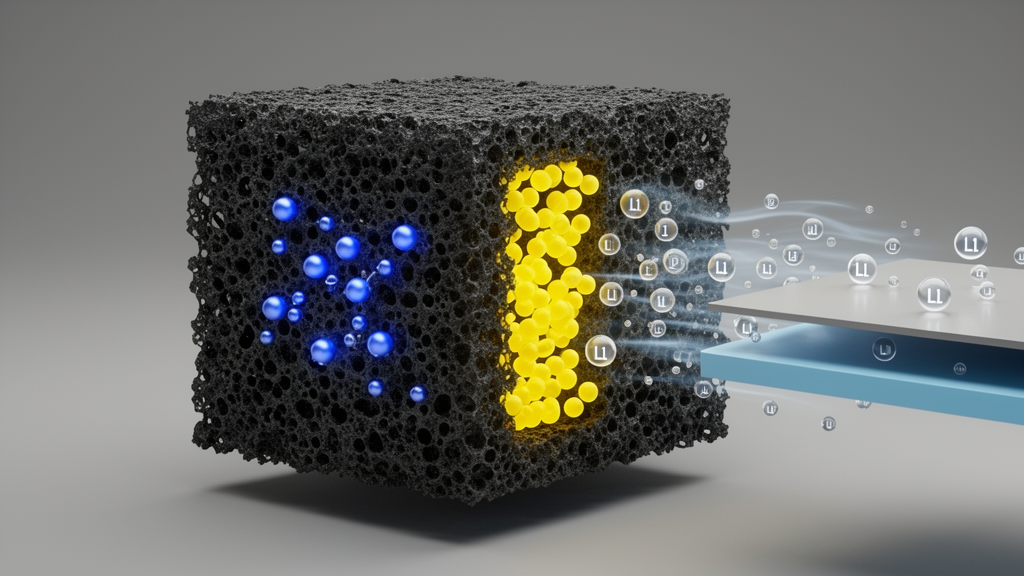
All-solid-state lithium-sulfur batteries promise a rare combination of high energy density and operational safety, but two stubborn problems have kept them from practical use: the sulfur redox reaction proceeds slowly, and the pathways for ion and electron migration at the electrode-electrolyte interface are discontinuous, which drags down electrochemical efficiency. A new study published in the Journal of Materials Science reports a cathode design aimed squarely at both bottlenecks, using cobalt single-atom catalysts anchored on a three-dimensional nitrogen-doped porous carbon framework as the sulfur host.
The material, designated Co-SAC/3DNPC, was synthesized through a sodium chloride template carbonization strategy. According to the researchers, this route yields a three-dimensional conductive framework with a broad internal surface area and hierarchical pores. That architecture matters for two reasons: it promotes the uniform distribution of atomically dispersed cobalt active sites, and it provides continuous channels for electron and ion transport while effectively confining sulfur species within the cathode structure.
The cobalt sites themselves are the catalytic heart of the design. The team reports that these atomically dispersed cobalt sites exhibit strong sulfur affinity and catalytic activity, which facilitates the sulfur redox conversion that is central to the battery’s operation. In the graphical abstract accompanying the paper, the authors describe the single-atom catalysts as showing strong chemical adsorption toward lithium polysulfides and effective catalysis of the solid-solid redox conversion from sulfur to lithium sulfide.
That adsorption-catalysis combination addresses a well-known failure mode. The researchers state that the anchored cobalt single atoms significantly suppress this shuttle effect in their system, while the porous carbon framework keeps the sulfur and its reaction products physically contained within the conductive host.
To understand what the cobalt sites are actually doing to the battery’s internal dynamics, the team turned to electrochemical diagnostics. The authors describe single active sites as kinetic boosters that can significantly enhance charge transfer at the electrode-electrolyte interface, which is precisely where the discontinuous transport pathways have limited all-solid-state devices.
The assembled Co-SAC/3DNPC cathode, the paper reports, manifests superior reversible benchmarks and sustainable electrochemical performance over prolonged cycling. The abstract does not report specific capacity values, rate capabilities or cycle numbers, so those quantitative benchmarks should be read from the full article rather than assumed from this summary. What the published abstract does establish is the qualitative claim of durable performance over extended cycling, attributed to the combination of fast sulfur redox kinetics and stable interfacial charge transfer.
The broader significance of the work lies in how it treats the cathode as an engineered system rather than a single material choice. The three-dimensional nitrogen-doped porous carbon is not merely a passive scaffold: according to the paper, the framework provides continuous electron and ion transport channels, effectively confines sulfur species, and its structure promotes the uniform distribution of atomically dispersed cobalt active sites. The cobalt single atoms, in turn, are not merely decoration: they provide the chemical affinity and catalytic activity that accelerate the sulfur conversion reactions. The design logic is that confinement, conduction and catalysis must be delivered simultaneously by one integrated host material.
The authors position the study as proposing a practical and efficient approach to constructing catalytic sulfur carriers, and as promoting the advancement of highly efficient cathode materials for all-solid-state lithium-sulfur batteries. In a field where the slow kinetics of solid-solid sulfur conversion and interfacial transport losses remain the defining obstacles, a host that combines atomic-scale catalysis with a continuous three-dimensional conductive network offers a coherent strategy.
As with any materials study reported at the laboratory stage, the findings describe a cathode architecture demonstrated in research cells, not a commercial product, and the reported performance characteristics apply to the specific Co-SAC/3DNPC system described. Readers interested in the quantitative electrochemical benchmarks, the synthesis details and the full impedance analysis will find them in the complete article, which is available from the publisher under subscription access. The study’s data and code availability statements are listed as not applicable in the published record.
Subject of Research: Cobalt single-atom catalysts on nitrogen-doped porous carbon as sulfur hosts for all-solid-state lithium-sulfur batteries
Article Title: Cobalt single-atom catalysts anchored on 3D nitrogen-doped porous carbon as efficient sulfur hosts for all-solid-state lithium-sulfur batteries
Article References: Zhu, F., Wang, N., Li, D., Li, Y., Zhang, R., Wang, X., Wang, L., Zhang, H., Wang, Z., & Ding, F. (2026). Cobalt single-atom catalysts anchored on 3D nitrogen-doped porous carbon as efficient sulfur hosts for all-solid-state lithium-sulfur batteries. Journal of Materials Science, 61(40), 31009-31028. https://doi.org/10.1007/s10853-026-13604-z
Image Credits: AI Generated
DOI: 10.1007/s10853-026-13604-z
Keywords: all-solid-state lithium-sulfur batteries, cobalt single-atom catalyst, nitrogen-doped porous carbon, sulfur host, lithium polysulfides, electrocatalysis, sodium chloride template, electrochemical impedance spectroscopy, distribution of relaxation times, energy materials, cathode materials, solid-state batteries
News Source: Bethany Barker. (October 29, 2026). Research report: Cobalt single-atom catalysts anchored on 3D nitrogen-doped porous carbon as efficient sulfur hosts for all-solid-state lithium-sulfur batteries. Scienmag.



