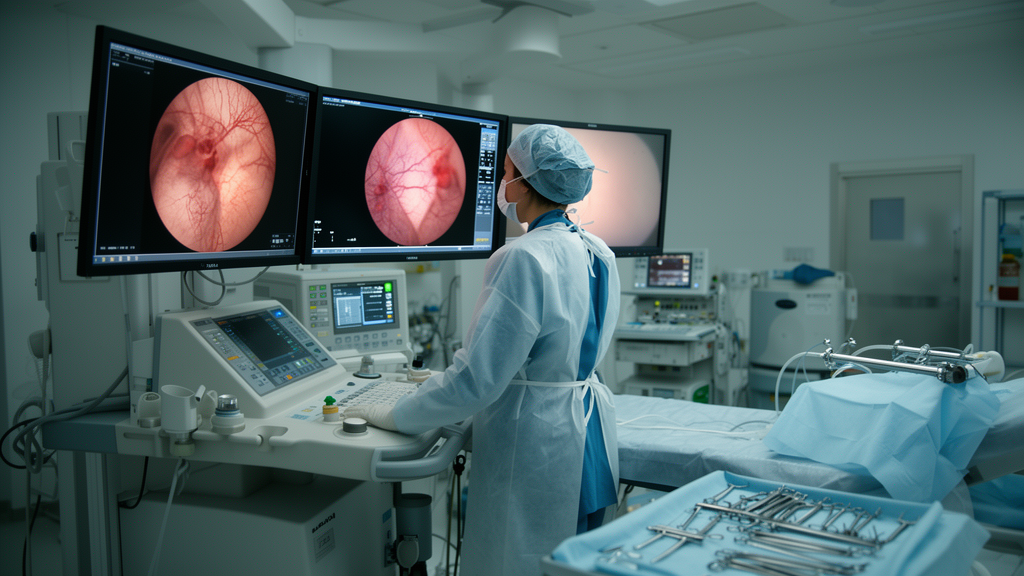
Deep learning models can now follow a cardiac catheterization from the first preparation step to the final cleaning of the table, recognizing what is happening in the room with more than 90 percent accuracy. The achievement comes from a Dutch team that trained artificial intelligence systems on a fully real-world dataset: video recordings, equipment logs and clinical notes from 222 diagnostic coronary angiograms performed at Reinier de Graaf Hospital, a large regional hospital in the Netherlands. The study, published in BMC Biomedical Engineering, is described by its authors as the first demonstration of automated phase recognition in actual catheterization laboratory procedures using an integrated dataset of this kind.
The motivation is practical rather than futuristic. Pressure on healthcare is rising as demand grows and staff shortages increase workload, and coronary artery disease is forecast to rise by 40 percent until 2040, placing additional strain on catheterization laboratories, the primary units for minimally invasive cardiac procedures. Non-clinical tasks such as administration can also distract staff from critical clinical actions. Previous efficiency initiatives, including Lean Six Sigma methods and early cath lab activation by alarmed emergency medical services, improved care for acute coronary syndromes but still depend partly on manual scheduling. A continuous, automated view of how elective procedures are progressing could help hospitals accommodate emergency cases more smoothly.
To build the dataset, the researchers ran an observational study in which elective diagnostic coronary angiograms were recorded with four standard video cameras and one fish-eye camera providing an overview of the workflow. All patients and staff gave written informed consent, and emergency procedures were excluded because patients might not have had enough time to consider participation. A Scaled-YOLOv4 object detection algorithm processed one camera angle that offered an unobstructed view of clinical activities, at a reduced rate of one frame per second, extracting information such as the number of people and objects in the room and the position coordinates of staff, patient and relevant equipment. System logging data from the Philips C-arm X-ray system and the operating table captured every input to the imaging equipment, while clinical data such as medication and contrast administration times were gathered retrospectively from electronic patient files.
The ground truth for training came from meticulous manual annotation. Each second of every procedure was labelled with its corresponding phase using dedicated behavioural observation software, with a cardiologist and a medical doctor identifying clinically relevant key points in time that marked transitions between phases. The annotators worked from the video recordings rather than being present in the lab, and ambiguous phase boundaries were resolved through consensus discussion. Two levels of granularity were defined: a high-granularity scheme with 14 distinct phases, and a low-granularity scheme with just four main phases covering preparation, catheterization of the first coronary artery, catheterization of the second coronary artery, and cleaning. Of the 297 procedures originally recorded, 69 had unavailable logging files and 6 had incomplete registrations, leaving 222 complete cases: 143 men, 64 percent, and 79 women, 36 percent, with a mean age of approximately 70 years and a standard deviation of 11 years.
The procedures were treated as time series, with one data point per second, right-padded with zeros to handle variable procedure length. A simple baseline model that predicted phases according to their average share of procedure duration reached a weighted accuracy of only 46 percent, and a random forest model improved this to 79 percent. The team then implemented two deep learning architectures: a Long Short-Term Memory network, or LSTM, which excels at modelling temporal dependencies, and an LSTM-Fully Convolutional Network, or LSTM-FCN, which adds convolutional layers capable of learning spatial features from the video-derived data. The final LSTM configuration used 160 units, a dropout rate of 0.1 and a batch size of 4, totalling 137,455 parameters, while the optimal LSTM-FCN used an LSTM layer of 20 units, a dropout rate of 0.3, three convolutional blocks with 128, 256 and 128 filters, and a batch size of 16, totalling 334,059 parameters.
Training used a custom weighted categorical cross-entropy loss to cope with severe class imbalance in the dataset, since phase C alone accounted for more than 20 percent of procedure time on average, roughly equal to the combined abundance of the last nine classes. The models were trained with the Adam optimizer for up to 200 epochs, with early stopping after 20 epochs without improvement, and performance was assessed with 3-fold cross-validation so that every model was trained and tested on the whole dataset. Accuracy was weighted by phase duration, emphasizing correct classification of the large portion of the procedure rather than short phases, and a prediction was counted as correct if it fell within an allowed time window margin, which ranged from 5 seconds up to 2 minutes.
The results were striking. With the highest granularity of 14 phases, the models performed above 70 percent with no tolerance for delay, rising above 90 percent when a 5-second time window was allowed. Reducing the problem to four classes pushed performance to 89 percent at a 0-second margin and nearly 95 percent with a 5-second window. The LSTM model achieved a duration-weighted accuracy of 91.3 percent, compared with 90.8 percent for the LSTM-FCN, and nearly all individual phases reached 90 percent accuracy. When misclassifications occurred, the confusion matrix showed the algorithm almost always predicted phases in close temporal proximity to the true one, suggesting the models grasp the sequential structure of the procedure even when they err. The median diagnostic procedure in the dataset lasted 42.49 minutes, with an interquartile range from 34.25 to 52.54 minutes, and phase C was the longest at 10 minutes.
Statistical comparison confirmed the two architectures were effectively equivalent: a 5×2 cross-validation paired t-test yielded a p-value of 0.290 and a t-statistic of 1.183, with an effect size of 1.67 percent, indicating the observed differences could be attributed to random variability. The decisive difference was efficiency. Training the LSTM for 3-fold cross-validation took 51 minutes, versus 114 minutes for the LSTM-FCN, making the recurrent model approximately 2.2 times faster with around 40 percent fewer parameters. The researchers attribute the similar accuracy to the fact that features extracted by the Scaled-YOLOv4 algorithm may already be highly informative, leaving little for the extra convolutional layers to add, while the sequential nature of the procedures favours the recurrent component. A robustness analysis running the LSTM 100 times with random train/test splits produced an average weighted accuracy of 0.89 with a standard deviation of 0.02, and more than 98 percent of runs exceeded 85 percent accuracy.
The integration of data sources proved essential. Trained on video data alone, the LSTM reached 90 percent accuracy and the LSTM-FCN 85 percent, while both models exceeded 70 percent using system logging data only, and performance increased significantly when the sources were combined. This suggests the approach could scale to hospitals that lack the full complement of recording equipment. The authors argue that 90 percent accuracy is suitable for supporting administrative functions such as real-time procedure tracking, resource allocation and schedule optimization, and that small workflow prediction errors are not expected to directly influence patient outcomes, in contrast to diagnostic or therapeutic decision-making where higher accuracy and explainability would be required.
Important limitations remain. The study was conducted at a single location, so performance in other hospital environments, where floor plans and equipment differ, has not been tested. Only diagnostic catheterizations were included; therapeutic procedures such as percutaneous coronary interventions involve more variability, and phases like stenting and ballooning would be challenging to classify, likely requiring retraining and additional data sources such as radiological imaging. The dataset contained minimal adverse events, so robustness to exceptions and rare events is uncertain, and deep learning models of this kind lack the explainability often preferred in medicine, although the authors note this matters less for workflow monitoring than for clinical decision support. Future work will focus on predicting procedure duration, evaluating attention-based, temporal convolutional and transformer architectures, and ultimately building scheduling tools that process live clinical data to help departments with multiple cath labs accommodate emergency cases more efficiently.
Subject of Research: Automated recognition of workflow phases in cardiac catheterization procedures using deep learning on integrated real-world hospital data
Article Title: Automated phase recognition in the cardiac catheterization laboratory with deep learning
Article References: Vijfvinkel, T. S., Frassini, E., Weijenberg, Y., Nikookar, B., Butler, R. M., Constandse, J., van der Elst, M., Hendriks, B. H. W., & van den Dobbelsteen, J. J. (2026). Automated phase recognition in the cardiac catheterization laboratory with deep learning. BMC Biomedical Engineering, 8(1), Article 18. https://doi.org/10.1186/s42490-026-00122-x
Image Credits: AI Generated
DOI: 10.1186/s42490-026-00122-x
Keywords: deep learning, cardiac catheterization, coronary angiography, LSTM, workflow phase recognition, catheterization laboratory, object detection, healthcare efficiency, surgical process modelling, time series classification, real-world clinical data, hospital scheduling
News Source: Blake Davidson. (October 28, 2026). Research report: Automated phase recognition in the cardiac catheterization laboratory with deep learning. Scienmag.