

• HOME
  • NEWS
  • EXPLORE
    • CAREER
      • Companies
      • Jobs
    • EVENTS
    • iGEM
      • News
      • Team
    • PHOTOS
    • VIDEO
    • WIKI
  • BLOG
  • COMMUNITY
    • FACEBOOK
    • INSTAGRAM
    • TWITTER
Sunday, April 26, 2026
BIOENGINEER.ORG
No Result
View All Result
  • Login
  • HOME
  • NEWS
  • EXPLORE
    • CAREER
      • Companies
      • Jobs
        • Lecturer
        • PhD Studentship
        • Postdoc
        • Research Assistant
    • EVENTS
    • iGEM
      • News
      • Team
    • PHOTOS
    • VIDEO
    • WIKI
  • BLOG
  • COMMUNITY
    • FACEBOOK
    • INSTAGRAM
    • TWITTER
  • HOME
  • NEWS
  • EXPLORE
    • CAREER
      • Companies
      • Jobs
        • Lecturer
        • PhD Studentship
        • Postdoc
        • Research Assistant
    • EVENTS
    • iGEM
      • News
      • Team
    • PHOTOS
    • VIDEO
    • WIKI
  • BLOG
  • COMMUNITY
    • FACEBOOK
    • INSTAGRAM
    • TWITTER
No Result
View All Result
Bioengineer.org
No Result
View All Result
Home NEWS Science News

Research offers hope for simpler cancer diagnosis and treatment

Bioengineer by Bioengineer
November 19, 2018
in Science News
Reading Time: 2 mins read
0
Share on FacebookShare on TwitterShare on LinkedinShare on RedditShare on Telegram
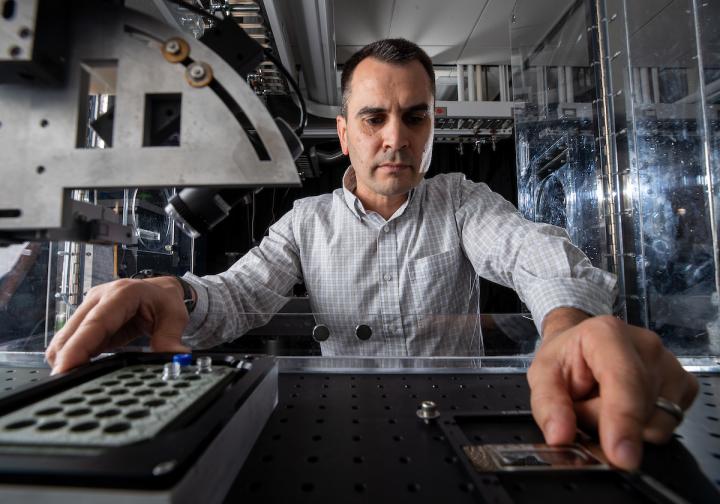
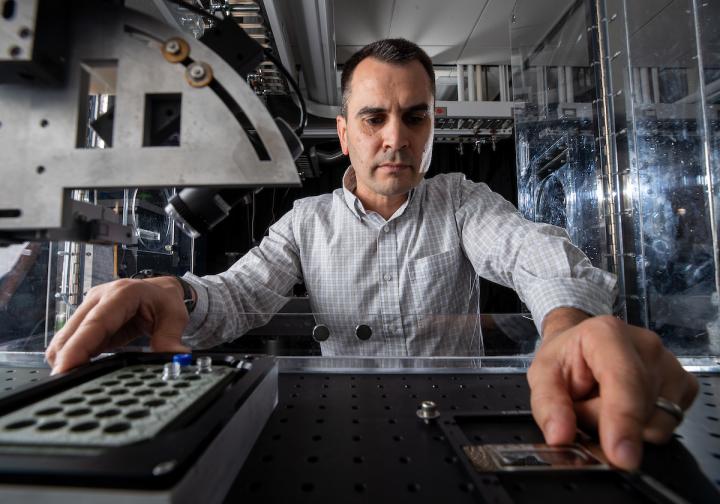
IMAGE

Credit: Jaren Wilkey/BYU Photo

Monitoring cancer can often be an intrusive and exhausting process for patients. But with Brigham Young University chemistry professor Ryan Kelly's new research, there is hope for a simpler way: No more biopsies. No more spinal taps. Instead, patients may be able to take a simple blood test to diagnose, monitor and tailor appropriate therapies for various cancers.

Creating therapies for cancer patients is greatly enhanced when doctors know about the biochemical makeup of tumors, including what proteins are present and at what levels. For this project, recently published in top-ranked journal Analytical Chemistry, Kelly collaborated with researchers from the Pacific Northwest National Laboratory and Oregon Health & Science University to isolate circulating tumor cells (CTCs) from blood and determine which proteins were present.

Their technique uses a new technology, called nanopots, to capture more protein information from a single cell than ever before.

CTCs are extremely rare cells that have shed from a tumor and are carried around the body, acting as seeds for the growth of additional tumors in distant organs. Traditionally, learning about the protein makeup of a blood or tissue sample has required thousands or millions of cells. Because CTCs are so rare, their proteins could not be studied.

"It used to be that the only thing you could do with CTCs is count them, which would usually correlate with cancer," said Kelly. "But it's not always effective. We want to get beyond that."

By measuring the proteins in CTCs, physicians will be better equipped to know what is working with a therapy regimen and continue or modify treatment accordingly.

"Targeted approaches for studying proteins from single cells have been around for a while, but the problem is you have to know exactly what you're looking for," Kelly said. "What we are doing is cataloging as many proteins as possible from single cells, without having to pick what we're looking for beforehand. Nobody's done that before with small numbers of CTCs."

The research team hopes CTCs can eventually serve as a "liquid biopsy" by providing information about the tumors from a simple blood test.

"We would like to know how a therapy is impacting a cancer without having to do an invasive biopsy every time," Kelly said. "We're excited about the implications this could have in the long run for cancer diagnosis, treatment and the development of new therapeutic approaches."

###

Media Contact

Andrea Christensen
[email protected]
801-368-4194
@byu

http://www.byu.edu

Original Source

https://news.byu.edu/news/research-offers-hope-simpler-cancer-diagnosis-and-treatment http://dx.doi.org/10.1021/acs.analchem.8b03268

Share12Tweet8Share2ShareShareShare2

Related Posts

Stable Ferrimagnetism in Cr(pyrazine)3 Framework — Chemistry

Stable Ferrimagnetism in Cr(pyrazine)3 Framework

April 26, 2026

Multidimensional Stress Impacting Rural China’s Elderly Mental Health

April 26, 2026

Oral Frailty in Older Chinese with Chronic Diseases

April 26, 2026

Diazoboranes React with Oxygen to Form Dioxaboriranes

April 25, 2026
Please login to join discussion

POPULAR NEWS

  • Research Indicates Potential Connection Between Prenatal Medication Exposure and Elevated Autism Risk

    821 shares
    Share 328 Tweet 205
  • New Study Reveals Plants Can Detect the Sound of Rain

    682 shares
    Share 272 Tweet 170
  • Scientists Investigate Possible Connection Between COVID-19 and Increased Lung Cancer Risk

    66 shares
    Share 26 Tweet 17
  • Salmonella Haem Blocks Macrophages, Boosts Infection

    60 shares
    Share 24 Tweet 15

About

We bring you the latest biotechnology news from best research centers and universities around the world. Check our website.

Follow us

Recent News

Stable Ferrimagnetism in Cr(pyrazine)3 Framework

Multidimensional Stress Impacting Rural China’s Elderly Mental Health

Oral Frailty in Older Chinese with Chronic Diseases

Subscribe to Blog via Email

Enter your email address to subscribe to this blog and receive notifications of new posts by email.

Join 81 other subscribers
  • Contact Us

Bioengineer.org © Copyright 2023 All Rights Reserved.

Welcome Back!

Login to your account below

Forgotten Password?

Retrieve your password

Please enter your username or email address to reset your password.

Log In
No Result
View All Result
  • Homepages
    • Home Page 1
    • Home Page 2
  • News
  • National
  • Business
  • Health
  • Lifestyle
  • Science

Bioengineer.org © Copyright 2023 All Rights Reserved.