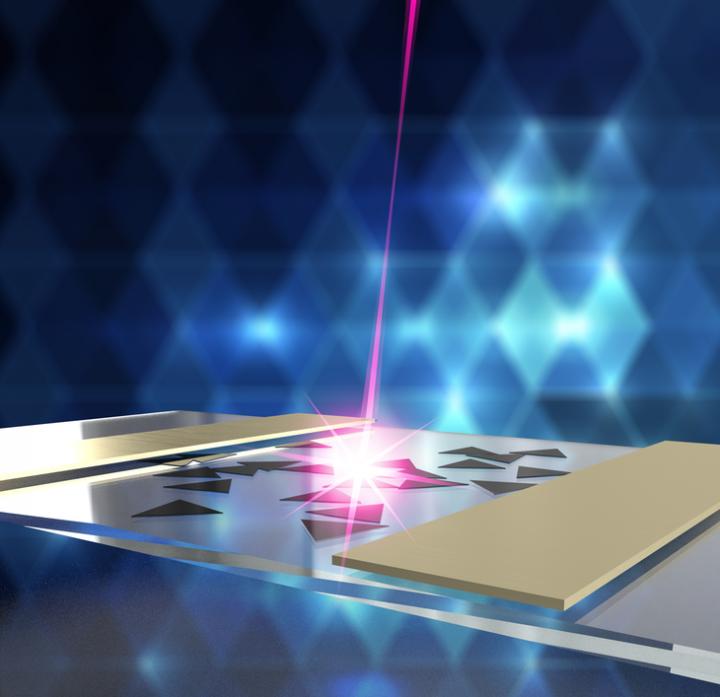
Credit: Jennifer M. McMann – Penn State Materials Research Institute
Though we may not always realize it, photodetectors contribute greatly to the convenience of modern life. Also known as photosensors, photodetectors convert light energy into electrical signals to complete tasks such as opening automatic sliding doors and automatically adjusting a cell phone’s screen brightness in different lighting conditions.
A new paper, published by a team of Penn State researchers in ACS Nano, seeks to further advance photodetectors’ use by integrating the technology with durable Gorilla glass, the material used for smart phone screens that is manufactured by Corning Incorporated.
The integration of photodetectors with Gorilla glass could lead to the commercial development of “smart glass,” or glass equipped with automatic sensing properties. Smart glass has a number of applications ranging from imaging to advanced robotics, according to the researchers.
“There are two problems to address when attempting to manufacture and scale photodetectors on glass,” said principal investigator Saptarshi Das, assistant professor of engineering science and mechanics (ESM).?”It must be done using relatively low temperatures, as the glass degrades at high temperatures, and must ensure the photodetector can operate on glass using minimal energy.”
To overcome the first challenge, Das, along with ESM doctoral student Joseph R. Nasr, determined that the chemical compound molybdenum disulfide was the best material to use as a coating on the glass.
Then, Joshua Robinson, professor of materials science and engineering (MatSE) and MatSE doctoral student Nicholas Simonson used a chemical reactor at 600 degrees Celsius — a low enough temperature so as not to degrade the Gorilla glass – to fuse together the compound and glass. The next step was to turn the glass and coating into a photodetector by patterning it using a conventional electron beam lithography tool.
“We then tested the glass using green LED lighting, which mimics a more natural lighting source unlike laser lighting, which is commonly used in similar optoelectronics research,” Nasr said.
The ultra-thin body of the molybdenum disulfide photodetectors allows for better electrostatic control, and ensures it can operate with low power — a critical need for the smart glass technology of the future.
“The photodetectors need to work in resource-constrained or inaccessible locations that by nature do not have access to sources of unrestricted electricity,” Das said. “Therefore, they need to rely on pre-storing their own energy in the form of wind or solar energy.”
If developed commercially, smart glass could lead to technology advances in wide-ranging sectors of industry including in manufacturing, civil infrastructure, energy, health care, transportation and aerospace engineering, according to the researchers. The technology could be applied in biomedical imaging, security surveillance, environmental sensing, optical communication, night vision, motion detection and collision avoidance systems for autonomous vehicles and robots.
“Smart glass on car windshields could adapt to oncoming high-beam headlights when driving at night by automatically shifting its opacity using the technology,” Robinson said. “And new Boeing 757 planes could utilize the glass on their windows for pilots and passengers to automatically dim sunlight.”
###
Mark W. Horn, professor of ESM, and Aaryan Oberoi, ESM doctoral student, also participated in this project.
Corning Incorporated and the Center for Atomically Thin Multifunctional Coatings,?housed in Penn State’s Materials Research Institute, funded this research.
Media Contact
A’ndrea Elyse Messer
[email protected]
Related Journal Article
http://dx.