A comparative review argues that reproduction should be used as a criterion for distinguishing genuinely multicellular organisms from colonies, and proposes that internal fertilization and initial viviparity were the original reproductive condition in multicellular animals. The review examines reproductive patterns across prokaryotes, algae, fungi, plants and animals, focusing on whether a multicellular body develops obligatorily, how a new organism begins, and how gametes are brought together. Its conclusions are conceptual interpretations of a broad taxonomic literature rather than results from a new experiment or a single controlled study.
The first proposed criterion is that a unitary multicellular organism, unlike a colonial aggregation of unicellular organisms, must develop as a multicellular body and reproduce only after reaching a multicellular vegetative stage. On this definition, colonies formed by independently living cells, such as those in slime molds, myxobacteria and some algae, remain distinct from organisms whose life cycle obligatorily includes a multicellular phase. The author also treats multinucleate bodies that lack genuine cellular partitions, including those of some ciliates and protists, as nonmulticellular under the criterion.
The second criterion concerns how a multicellular body produces a daughter organism. Reproduction may be monocytic, when a new organism originates from one cell, such as a spore, zygote, gamete, parthenogenetic egg or totipotent somatic cell, or polycytic, when it originates from many cells through fragmentation, fission or budding. The review also emphasizes that sexual and asexual reproduction need not increase the number of individuals, and it treats parthenogenesis as a variant of sexual reproduction because the offspring develops from a specialized gamete. In plants, parthenogenesis is distinguished from other forms of apomixis in which embryos arise from cells other than the egg.
Based on the monocytic criterion, the review divides obligate multicellularity into protonemal, siphonoseptal and embryogenic forms. Protonemal multicellularity begins when a spore or zygote divides to form a filamentous protonema, with daughter cells growing after division; examples occur among bacteria and numerous algal and plant lineages. Siphonoseptal multicellularity begins with repeated nuclear divisions without cytoplasmic division, producing a multinucleate siphon that may later become partitioned by septa; the review identifies this pattern in green algae, yellow-green algae, fungi and fungus-like organisms. Some bodies that separate into cenocytes and later fuse are interpreted as colonies rather than multicellular organisms under this framework.
Embryogenic multicellularity is described as the most complex of the three forms. It develops through obligate accumulative oogamy or accumulative aplanosporia, in which the gamete or spore is larger than the ordinary cells of the maternal body, sometimes by hundreds or thousands of times in size. Palintomic divisions, in which nuclear and cytoplasmic division recur without intervening growth, or syntomic divisions, in which the cytoplasm is divided into numerous compartments, then produce an embryo or an asexual analogue termed an embryoid. The embryo depends on maternal nourishment or stored reserves until it begins an independent life. The review associates this form with all animals, higher-plant sporophytes and selected algal and plant life cycles.
Complex multicellular organisms with differentiated tissues and organs are described as developing through the embryogenic route. The author proposes that a large, structured egg and rapid cleavage help establish developmental organization, including predetermined cleavage and the formation of tissues and organs. No embryogenic multicellularity is identified among prokaryotes, although the review presents this as a probable evolutionary explanation rather than a directly tested mechanism. It attributes the absence partly to limited internal transport in prokaryotic cells, noting that their lack of an endoplasmic reticulum restricts diffusion-based transport and cell size. The large bacterium Thiomargarita namibiensis, reaching 0.75 millimetres in diameter, is exceptional because much of its interior is vacuolar and only a thin peripheral layer contains cytoplasm.
The review then considers a problem created by multicellular growth: male and female gametes must become available at the same place and time, but the larger parental bodies mature at different rates and immobile female gametes cannot travel far. It identifies three broad solutions: retaining eggs on or within the maternal organism until sperm arrive, synchronously releasing gametes into the external environment, or releasing them passively in response to shared environmental cues. The author argues that the first arrangement is the simplest and occurs in many archaic plants, fungi, algae and animals, including sponges, Trichoplax, dicyemids, orthonectids, Volvox and higher plants.
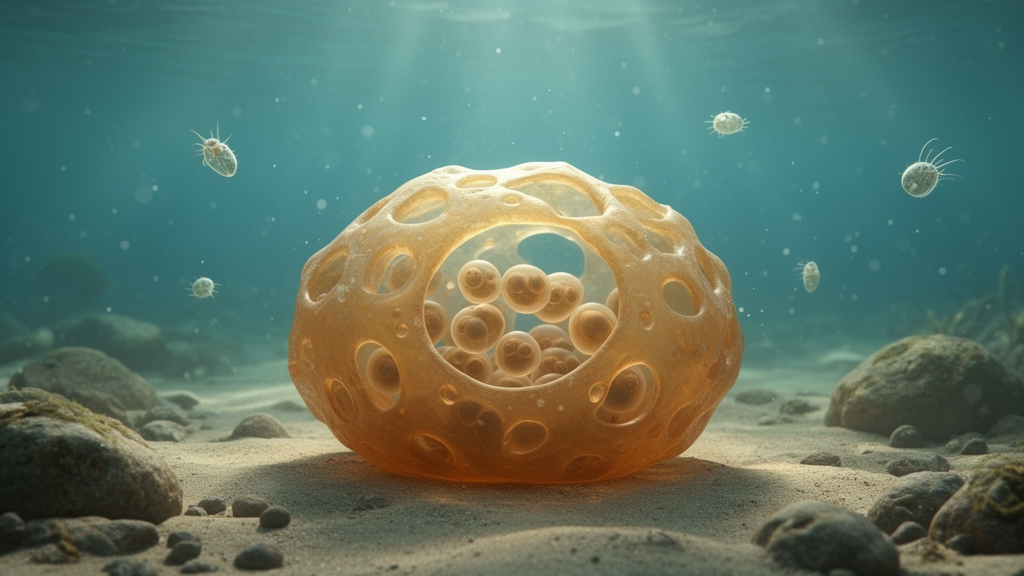
From this distribution, the review infers that internal fertilization, defined broadly to include fertilization on the maternal body, was ancestral to multicellular animals. It contrasts this inference with traditional diagrams of animals arising from choanoflagellate colonies, in which eggs are commonly shown entering open water. Archaic organisms lacked the coordinated nervous, muscular and reproductive structures used by later animals to eject gametes together, while rupture of an individual gametangium would not ensure simultaneous release among separate individuals. The proposed sequence instead places zygote division and early development within the colonial body, followed by formation of a mobile dispersal stage comparable to the synzoospore concept associated with Zakhvatkin and represented in modern sponges by a comparable larval role.
External fertilization is therefore treated as a later animal innovation enabled in cnidarians and ctenophores by nervous systems, gonads, musculature and, in some groups, reproductive ducts. The review also examines less coordinated alternatives, including water-flow-mediated gamete release in some demosponges and tidal synchronization in algae such as Fucus, where gametangia may dry at low tide and rupture after rewetting. It attributes the predominance of spore-based reproduction in plants to the difficulty of synchronizing gamete release, while noting that many flowering plants depend on animal pollinators and that some red algae use crustaceans for gamete transfer. The synthesis remains a broad review with variable evidence across taxonomically difficult groups, particularly fungi, algae and colonial organisms, and its evolutionary conclusions are explicitly dependent on the proposed reproductive definitions and classifications.
Subject of Research: Evolutionary origins of multicellularity and reproductive modes
Article Title: Ancient reproductive modes and criteria of multicellularity
Article References: Gavrilov-Zimin, I. A. (2023). Ancient reproductive modes and criteria of multicellularity. Comparative Cytogenetics, 17, 195-238. https://doi.org/10.3897/compcytogen.17.109671
Image Credits: AI Generated
DOI: 10.3897/compcytogen.17.109671
Keywords: multicellularity, evolutionary biology, reproductive modes, internal fertilization, viviparity, embryogenesis, protonemal multicellularity, siphonoseptal multicellularity, algae, animals, Ancient, reproductive
News Source: Gavin Prescott. (October 20, 2026). Reproductive criteria distinguish multicellularity and suggest viviparity in early animals. Scienmag.