Scientists from the Universities of Leicester and Nottingham have received nearly £600,000 to research how sexual development and gene shuffling within the malaria parasite could help to control malaria transmission.
Credit: University of Leicester
Scientists from the Universities of Leicester and Nottingham have received nearly £600,000 to research how sexual development and gene shuffling within the malaria parasite could help to control malaria transmission.
Led by Dr David Guttery from the University of Leicester and Professor Rita Tewari from the University of Nottingham, the research, which has been published this week, will focus on the molecular players involved in the development and transmission of the malaria parasite – one of the biggest killers in the world.
This is a unique type of cell division in sexual cells in malaria parasites, which happens during a process called meiosis. Meiosis is a fundamental process for all sexual organisms that enables them to generate sex cells (i.e. sperm and egg cells) that then go on to fertilise and reshuffle their genes, ultimately generating off-spring.
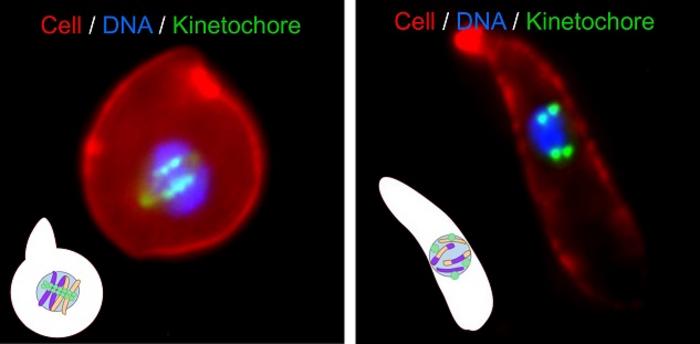
The molecules controlling the process are well studied in many model organisms, including yeast, Drosophila and humans. However, meiosis is very different in the malaria parasite as it begins after fertilisation in a banana-shaped stage of the malaria life-cycle called the ookinete, which is a crucial stage required for transmission from the mosquito.
Dr David Guttery said: “We know that the malaria parasite shuffles genes during sexual reproduction (termed gene recombination), but what we don’t know is how it works. The funding we have received will open the door for us to discover this, and to potentially uncover new targets for therapies to control the spread of this devastating disease.”
Professor Rita Tewari said: “To understand the basic machinery of cell division in malaria parasites, especially during the sexual stages of transmission, is crucial to stop the parasite in its tracks. Controlling the transmission of this devastating disease is as important as the disease itself. We have seen this in the case of COVID.”
The research has been funded from the Biotechnology and Biological Sciences Research Council (BBSRC) and will include collaborators at the University of Leicester (Dr James Higgins), University of Nottingham (Dr Stephen Gray and Professor Levi Yant), the Francis Crick Institute (Dr Tony Holder), University of Oxford (Professors David Ferguson and Sue Vaughan) and University of Warwick (Dr Andrew Bottrill).
This study will complement Professor Tewari’s research on cell division in male sex cells as part of a £2.5 million European Research Council grant. To address some of the questions on meiosis, collaborators at the University of Nottingham, University of Leicester, Francis Crick Institute and University of Groningen offer their insights into Plasmodium meiosis, published in Trends in Parasitology.
The researchers highlight the process of meiosis and how it is so different in malaria parasites and discuss state-of-the-art technologies that could be used to solve the mystery of how meiosis and gene shuffling in the malaria parasite works, which could significantly and positively impact both human and animal health in the future.
Journal
Trends in Parasitology
DOI
10.1016/j.pt.2023.07.002
Method of Research
Experimental study
Subject of Research
Animal tissue samples
Article Title
Meiosis in Plasmodium: how does it work?
Article Publication Date
2-Aug-2023