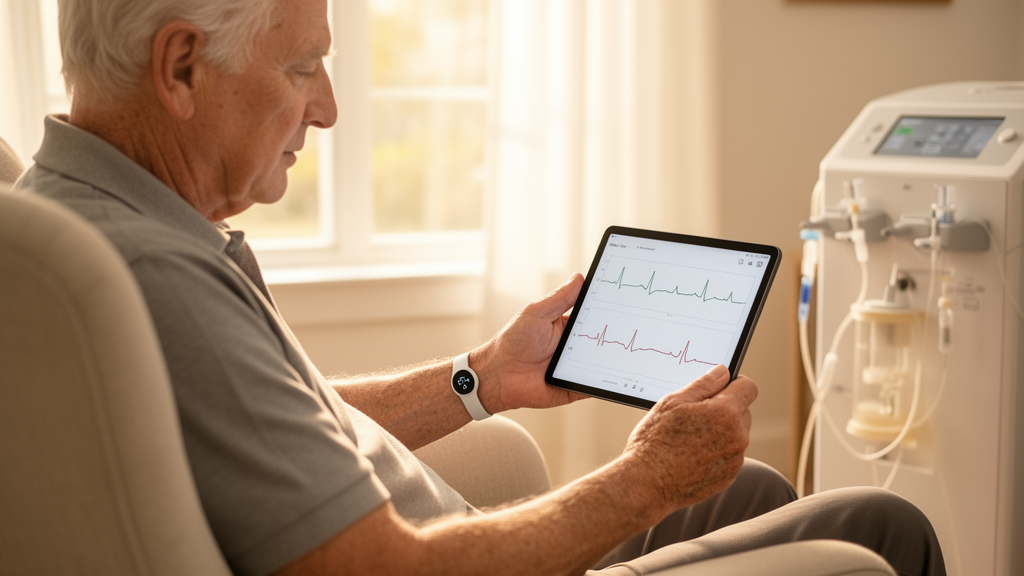
While remote patient monitoring is increasingly used in automated peritoneal dialysis, evidence for its use in CAPD, where patients manually perform exchanges rather than relying on a cycler, has remained limited.
The study followed 15 adults receiving stable CAPD between July and November 2025, with January to June 2025 serving as a historical reference period. Daily clinical and treatment data were transmitted through the MyPD application and the Sharesource CAPD portal. The primary outcomes were feasibility, the daily-report transmission rate, and safety, while secondary exploratory outcomes included blood pressure, deviation from target weight, time to outpatient assessment, healthcare utilization, complication management, and patient satisfaction.
All 15 participants completed follow-up. The daily-report transmission rate reached 97% according to platform reports, with non-receipt reflecting technical problems or omitted patient submissions. No clinical harm attributed to remote monitoring was reported, and no technique failures or transfers to haemodialysis occurred during the observation period.
Satisfaction ratings were favourable. All participants completed the satisfaction assessment, and the reported mean score was 4.6 out of a possible 5, with a standard deviation of 0.4. The researchers noted that the cohort was small and digitally selected, which may limit how broadly these satisfaction findings apply.
Clinical comparisons were descriptive and relied on aggregate data. Historical cohort-level home blood pressure was 138 plus or minus 10 over 82 plus or minus 7 mmHg, compared with 131 plus or minus 7 over 77 plus or minus 5 mmHg during the final observation month. Because only aggregate data were used, paired analysis was not possible, and the authors stressed that these comparisons remain exploratory.
Fluid-related events, early peritonitis, and constipation-related drainage problems were reported in seven, two, and four participants respectively, comprising 13 distinct patients in total. The study did not attribute these complications to the remote monitoring workflow itself.
Healthcare utilization showed no statistically significant differences. Unscheduled visits numbered 25 per 90 patient-months historically and 15 per 75 patient-months during remote monitoring, an incidence-rate ratio of 0.72 with a 95% confidence interval of 0.35 to 1.42 and a p-value of 0.344. Hospitalizations numbered four per 90 and one per 75 patient-months, an incidence-rate ratio of 0.30 with a 95% confidence interval of 0.01 to 3.03 and a p-value of 0.385. The authors emphasized that sparse healthcare events produced imprecise estimates.
The study’s conclusions were carefully qualified. The workflow was feasible, with a high reported daily-report transmission rate and favourable satisfaction ratings in this small, digitally selected cohort. However, the absence of reported remote-monitoring-related clinical harm does not establish safety, and the uncontrolled design precludes causal inference. Clinical imaging was exploratory, and healthcare-event rates were compared using exact Poisson methods.
The authors called for larger controlled multicentre studies to confirm their findings. For now, the pilot study offers an early signal that a CAPD-adapted remote monitoring workflow can be implemented with high transmission rates and positive patient ratings, while leaving open the question of whether such monitoring improves clinical outcomes or reduces healthcare utilization.
Subject of Research: Feasibility and clinical associations of remote patient monitoring in continuous ambulatory peritoneal dialysis
Article Title: Feasibility and clinical associations of remote monitoring in continuous ambulatory peritoneal dialysis: a prospective single-centre observational pilot study
Article References: Argentino, G., Sirico, M. L., Cascella, J., Viscido, F., Carpini, V. D., Vigorito, L., Amich, P., & Camocardi, A. (2026). Feasibility and clinical associations of remote monitoring in continuous ambulatory peritoneal dialysis: a prospective single-centre observational pilot study. BMC Nephrology. https://doi.org/10.1186/s12882-026-05475-y
Image Credits: AI Generated
DOI: 10.1186/s12882-026-05475-y
Keywords: peritoneal dialysis, remote patient monitoring, CAPD, nephrology, dialysis technology, telemedicine, patient satisfaction, blood pressure, healthcare utilization, pilot study, kidney disease, MyPD
News Source: Jerry Hayes. (October 28, 2026). Remote Monitoring Shows Feasibility in Peritoneal Dialysis Pilot Study. Scienmag.