• HOME
  • NEWS
  • EXPLORE
    • CAREER
      • Companies
      • Jobs
    • EVENTS
    • iGEM
      • News
      • Team
    • PHOTOS
    • VIDEO
    • WIKI
  • BLOG
  • COMMUNITY
    • FACEBOOK
    • INSTAGRAM
    • TWITTER
Saturday, April 4, 2026
BIOENGINEER.ORG
No Result
View All Result
  • Login
  • HOME
  • NEWS
  • EXPLORE
    • CAREER
      • Companies
      • Jobs
        • Lecturer
        • PhD Studentship
        • Postdoc
        • Research Assistant
    • EVENTS
    • iGEM
      • News
      • Team
    • PHOTOS
    • VIDEO
    • WIKI
  • BLOG
  • COMMUNITY
    • FACEBOOK
    • INSTAGRAM
    • TWITTER
  • HOME
  • NEWS
  • EXPLORE
    • CAREER
      • Companies
      • Jobs
        • Lecturer
        • PhD Studentship
        • Postdoc
        • Research Assistant
    • EVENTS
    • iGEM
      • News
      • Team
    • PHOTOS
    • VIDEO
    • WIKI
  • BLOG
  • COMMUNITY
    • FACEBOOK
    • INSTAGRAM
    • TWITTER
No Result
View All Result
Bioengineer.org
No Result
View All Result
Home NEWS Science News Biology

Releasing brakes on biocatalysis

Bioengineer by Bioengineer
November 29, 2023
in Biology
Reading Time: 2 mins read
0
Group of authors
Share on FacebookShare on TwitterShare on LinkedinShare on RedditShare on Telegram

How a preservative affects H2-forming biocatalysts
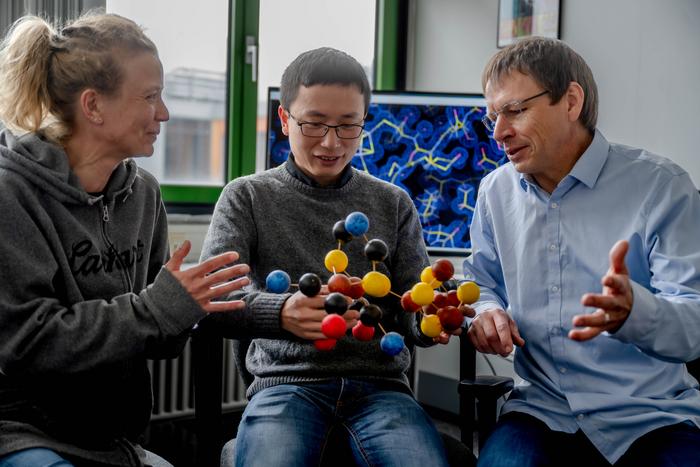
Group of authors

Credit: RUB, Marquard

How a preservative affects H2-forming biocatalysts

Formaldehyde is known as a preservative, among other things, but it also occurs as a natural metabolite in living cells. Twelve years ago, scientists from the University of Oxford, UK, and Ruhr University Bochum, Germany, showed that this omnipresent molecule inhibits a certain class of biocatalysts, namely the particularly efficient hydrogen-generating hydrogenases of the two-iron type – so-called [FeFe]-hydrogenases. “This was an interesting discovery, because formaldehyde could inhibit both the natural H2 metabolism of microorganisms and isolated hydrogenases in biotechnological applications,” explains Dr Jifu Duan, first author of the study.

Molecular mechanism of formaldehyde poisoning elucidated

After various theoretical studies had hypothesized how the formaldehyde molecule might influence [FeFe]-hydrogenases, a team of researchers led by Jifu Duan and Professor Eckhard Hofmann at Ruhr University has now succeeded in elucidating the molecular mechanism experimentally. Using structures of formaldehyde-treated [FeFe]-hydrogenases obtained by protein crystallography, they were able to show that formaldehyde reacts with the so-called active center of the biocatalysts – an inorganic protein part where protons and electrons are converted to H2. In addition, however, formaldehyde combines with another very important protein part, which is necessary for the transport of protons to the active center by means of a sulfur-containing chemical group. When the scientists replaced this part with another, formaldehyde was hardly able to exert its inhibitory effect.

The new findings could play a role in H2 technologies

“Future biotechnological applications of [FeFe]-hydrogenases may well involve the presence of formaldehyde, so that our modified formaldehyde-resistant biocatalysts could be used here,” explains Jifu Duan. “We also believe that our findings can be transferred to other biocatalysts.” This could play a role for bio-based industrial processes, but also for understanding metabolic pathways in living organisms.


Journal

Journal of the American Chemical Society

DOI

10.1021/jacs.3c07800

Method of Research

Experimental study

Subject of Research

Cells

Article Title

Insights Into the Molecular Mechanism of Formaldehyde Inhibition of [FeFe]-hydrogenases

Article Publication Date

20-Nov-2023

Share12Tweet8Share2ShareShareShare2

Related Posts

Damselfly Mating Strategies Shed Light on Reproductive Barriers

Damselfly Mating Strategies Shed Light on Reproductive Barriers

April 4, 2026
blank

Custom Biochar Approaches Enhance Alfalfa Growth and Stress Tolerance in Saline Soils

April 3, 2026

Mutant Clownfish Sheds Light on How Nature Defines Boundaries

April 3, 2026

Scientists Discover How Bacterial Enzyme Breaks Down Sturdy Collagen

April 3, 2026

POPULAR NEWS

  • blank

    Revolutionary AI Model Enhances Precision in Detecting Food Contamination

    97 shares
    Share 39 Tweet 24
  • Imagine a Social Media Feed That Challenges Your Views Instead of Reinforcing Them

    1008 shares
    Share 398 Tweet 249
  • Promising Outcomes from First Clinical Trials of Gene Regulation in Epilepsy

    51 shares
    Share 20 Tweet 13
  • Popular Anti-Aging Compound Linked to Damage in Corpus Callosum, Study Finds

    44 shares
    Share 18 Tweet 11

About

We bring you the latest biotechnology news from best research centers and universities around the world. Check our website.

Follow us

Recent News

Do Long-Term Care Facilities Feel Like Home?

Metabolomic Shifts Drive Long-Distance Bird Migration

Solving China’s Soybean Crisis: Optimized Crops, Diets

Subscribe to Blog via Email

Success! An email was just sent to confirm your subscription. Please find the email now and click 'Confirm' to start subscribing.

Join 78 other subscribers
  • Contact Us

Bioengineer.org © Copyright 2023 All Rights Reserved.

Welcome Back!

Login to your account below

Forgotten Password?

Retrieve your password

Please enter your username or email address to reset your password.

Log In
No Result
View All Result
  • Homepages
    • Home Page 1
    • Home Page 2
  • News
  • National
  • Business
  • Health
  • Lifestyle
  • Science

Bioengineer.org © Copyright 2023 All Rights Reserved.