


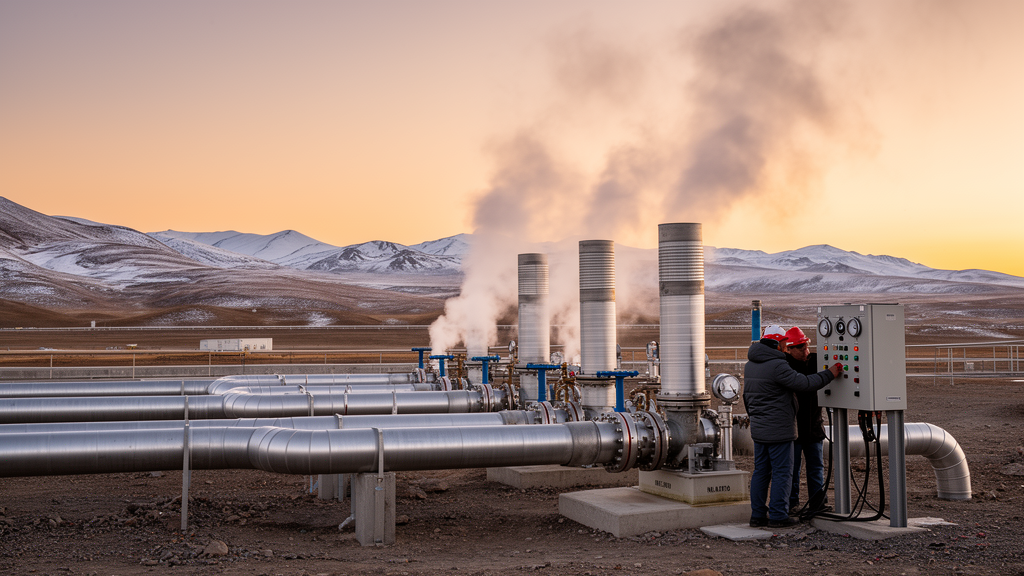
Reinjection of spent geothermal fluids is essential for sustaining production at high-temperature geothermal fields, but it can trigger water–rock interactions that damage the reservoir and reduce productivity. A new study of the Yangbajing geothermal field in Tibet combines laboratory experiments with numerical simulations to trace how these interactions cause formation clogging, and it identifies reinjection conditions that could limit the damage. The work, published in the journal Geothermal Energy, was carried out by Yanyan Huang, Hongwu Lei, Jin Na, Yilong Yuan, Yi Yu and colleagues.
The researchers built a site-specific numerical model of the Yangbajing reservoir using the TOUGHREACT simulator, and they calibrated the model’s thermodynamic parameters against high-temperature, high-pressure water–rock reaction experiments conducted in the laboratory. This calibration was intended to improve the accuracy and reliability of the simulations of how the reservoir evolves chemically under reinjection conditions.
The simulations showed distinct patterns of mineral reaction near different types of wells. In the production wells, quartz and feldspar were the dominant minerals undergoing dissolution, while illite and mica were the primary precipitated phases. In the injection wells the pattern was partly reversed: mica was the main mineral dissolving, and quartz, feldspar and illite constituted the major precipitated phases. These dissolution–precipitation dynamics near the geothermal wells were associated with a 10% decrease in reservoir porosity and permeability, the mechanism behind reinjection-induced clogging.
Sensitivity analyses, in which key simulation parameters were adjusted, indicated that reinjection at low temperature and low flow rate mitigated the extent of mineral dissolution and precipitation during reinjection, thereby easing the adverse impacts on reservoir permeability and porosity. According to the model results, the flow rate should be maintained below 14 litres per second and reinjection should be performed at a temperature of 50 degrees Celsius to minimise adverse impacts on the geothermal reservoir.
The authors describe the study as a systematic analysis of reinjection-induced site clogging arising from water–rock interactions, and they suggest the findings offer insights for optimising the sustainable exploitation of high-temperature geothermal reservoirs. Because the reported reinjection thresholds emerge from calibrated simulations supported by laboratory experiments rather than from field-scale trials, their applicability to operating decisions at Yangbajing or other fields would need to be assessed against site-specific conditions. The article is open access and was published on 10 August 2026.
Subject of Research: Water–rock interactions causing reinjection blockage in the Yangbajing geothermal field and strategies to mitigate reservoir clogging
Article Title: Mechanisms and mitigation strategies of reinjection blockage in the Yangbajing geothermal field, Tibet
Article References: Huang, Y., Lei, H., Na, J., Yuan, Y., & Yu, Y. (2026). Mechanisms and mitigation strategies of reinjection blockage in the Yangbajing geothermal field, Tibet. Geothermal Energy. https://doi.org/10.1186/s40517-026-00399-0
Image Credits: AI Generated
DOI: 10.1186/s40517-026-00399-0
Keywords: geothermal energy, reinjection, reservoir clogging, water–rock interaction, Yangbajing, Tibet, TOUGHREACT, numerical simulation, porosity, permeability, mineral dissolution, formation damage
News Source: Violet Maxwell. (October 29, 2026). Reinjection at 50°C and below 14 L/s could limit clogging in Tibet geothermal field. Scienmag.



