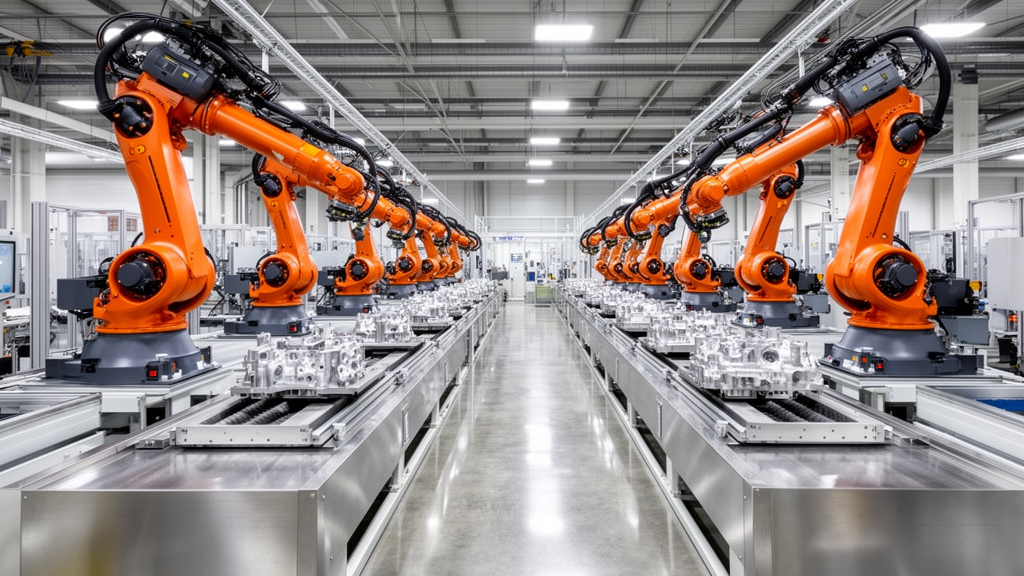
A simulation-based investigation has demonstrated that combining manufacturing scheduling with internal robotic logistics into a unified reinforcement learning model enables autonomous mobile robots to dynamically coordinate factory transportation and reduce total production makespan under operational uncertainty. Modern manufacturing plants aligned with the Industry 4.0 paradigm increasingly deploy autonomous mobile robots, cyber-physical systems, and digital monitoring infrastructures, yet internal material transportation frequently forms a critical bottleneck across flexible production lines. Historically, operational planners separated the sequencing of machine tasks from internal transport, treating the former as a classical job shop scheduling problem and the latter as a capacity-constrained knapsack problem solved via offline metaheuristics. Under dynamic factory conditions involving stochastic processing times, machine inspections, and shifting material flows, such decoupled approaches struggle to adapt. The newly reported framework unifies these problems within a multi-head deep reinforcement learning architecture that simultaneously determines where an autonomous robot travels and exactly how much material it transfers at each station.
The mathematical formulation couples the job shop scheduling problem and the knapsack problem to address two primary operational causes of manufacturing delay: the unavailability of raw parts at machine entry buffers and the suboptimal prioritization of production orders. By structuring material storage at machines, warehouses, and the mobile robot as capacity-constrained knapsacks, the system models physical limitations including finite vehicle carrying capacity, intermediate machine entry and exit buffers, and overall storage thresholds. Simultaneously, temporal constraints govern operation sequences, asymmetric part precedences, non-overlapping machine processing, and lower bounds on completion times. To prevent the exploration of physically impossible or rule-breaking states during training, the authors implemented dynamic action masking. A discrete mask eliminates infeasible robot destinations based on part availability and buffer saturation, while a subsequent conditional mask constrains the admissible transfer quantity according to available payload space and destination capacity, guaranteeing operational feasibility without relying on artificial penalty functions.
To represent the coupled decision-making structure efficiently, the researchers designed a multi-head neural network architecture that operates over a factored action space. The network consists of shared hidden layers that process a twenty-four-dimensional observation vector capturing storage levels across machine entry and exit buffers, current robot payloads, and discrete operational machine states indicating active processing, inspection shutdowns, buffer starvation, or upstream bottlenecks. Branching from this shared representation, a first output head selects the discrete transfer action, determining whether the robot should load, unload, or wait, as well as specifying the target machine or warehouse. A second output head calculates the discrete quantity of parts to be transferred, conditioned directly on the chosen transfer action and part type constraints. This factored structure mirrors the natural physical sequence of industrial logistics, where a robot must first designate a destination before committing to a specific transfer volume.
The framework was implemented and validated within an OpenAI Gym-compatible discrete-step simulation environment specifically constructed by the authors to model a flexible manufacturing plant. The modeled facility comprises six processing machines distributed across two parallel lines containing homologous turning, milling, and molding stages, supported by raw material and finished goods warehouses and a single autonomous mobile robot with a carrying capacity of fifteen units. Within this setup, each machine incorporates dedicated entry and exit buffers holding up to ten parts. The agent receives rewards structured as a weighted combination of makespan minimization and streamlined robot motion, providing positive signals for productive forward transfers that feed downstream machines and penalties for backward flows, alongside small rewards for deliberate idle waiting to prevent unproductive vehicle movement.
The experimental evaluation systematically compared four distinct deep reinforcement learning algorithms across three scenarios of increasing operational complexity: Deep-SARSA, Deep Q-Learning, Advantage Actor-Critic, and Proximal Policy Optimization. In addition, the authors tested three benchmark policies to contextualize performance: the Late-Flow Priority Heuristic, the Maximum-Capacity Heuristic with Late-Flow Priority, and an evolutionary metaheuristic based on a genetic algorithm optimizing the same neural network weights. All models underwent rigorous hyperparameter grid searches in Scenario I, a fully deterministic baseline environment where processing times were fixed and inspection disruptions were absent. In this controlled benchmark, all four reinforcement learning methods learned effective policies that achieved one hundred percent part completion, outperforming the heuristic baselines by reaching evaluation rewards within roughly zero point seventy-five percent of the theoretical reference maximum of 430.802.
To evaluate algorithmic robustness under operational variability, Scenario II introduced stochastic processing times where machine progress was sampled from truncated normal distributions. In this intermediate setting, Proximal Policy Optimization, Advantage Actor-Critic, and Deep Q-Learning rapidly converged to high reward levels, surpassing the dedicated maximum-capacity heuristic within 104, 194, and 210 training episodes, respectively. In contrast, Deep-SARSA exhibited substantially slower convergence, requiring 1321 episodes in its best configuration and showing persistent reward dispersion. Over five thousand training episodes, Proximal Policy Optimization proved the most sample-efficient method, consuming between 481,000 and 485,000 environment interactions, whereas the genetic algorithm and rule-based heuristics consumed near the maximum step limits. A two-sided Mann–Whitney U test confirmed that Proximal Policy Optimization and Advantage Actor-Critic achieved statistically equivalent evaluation rewards that significantly exceeded Deep-SARSA, the genetic algorithm, and both rule-based heuristics.
Analysis of production flow progression in Scenario II revealed pronounced differences in how effectively the methods advanced material toward completion. By reference step ninety-four of the simulation episode, Proximal Policy Optimization attained full completion, while Advantage Actor-Critic trailed by zero point two percent, Deep Q-Learning trailed by one percent, and Deep-SARSA trailed by two point nine percent. Conversely, the specialized heuristic trailed by fifteen point four percent, the genetic algorithm trailed by forty-nine point seven percent, and the basic priority heuristic processed less than half the required material, trailing by seventy-three point three percent. Furthermore, the actor-critic and policy-gradient agents maintained balanced workload distributions across the parallel manufacturing lines, rapidly minimizing operational imbalances between homologous machine pairs, whereas the genetic algorithm failed to distribute workloads evenly because its fitness function rewarded only aggregate throughput.
Scenario III established the most demanding testing environment by compounding stochastic processing times with random machine inspection events that temporarily halted individual machines for two to seven discrete steps. Because nominal inspection probabilities provided insufficient exposure for effective policy updates, the researchers deployed an inspection curriculum during training, initiating inspection probabilities at nine percent across all machines before gradually reducing them to nominal levels via a sigmoidal annealing schedule. Under this curriculum, Proximal Policy Optimization and Advantage Actor-Critic successfully learned to avoid dispatching parts to blocked machines, reducing the proportion of load actions directed toward inspected units from approximately twenty-five percent down to two percent at the conclusion of training.
Ablation experiments conducted within Scenario III demonstrated that both action masking and reward shaping are indispensable for training stability and operational efficiency. When researchers removed the conditional material quantity mask during training with seed zero, the episode completion rate for Proximal Policy Optimization plummeted from one hundred percent to thirty-four point six percent, while removing both masks caused the completion rate to collapse to three point eight percent. Eliminating reward shaping preserved completion capability at ninety-six point two percent but severely degraded reward magnitude, confirming that action masking keeps the learning agent within feasible operational regions while reward shaping directs the speed and quality of convergence. Subsequent sensitivity testing demonstrated that scaling inspection probabilities up to eight times nominal values increased total makespan by only sixteen percent, illustrating high policy resilience.
Cross-scenario transfer evaluations revealed that agents trained under the adverse conditions of Scenario III developed an anticipatory load-balancing behavior that persisted when deployed back into the deterministic conditions of Scenario I. When evaluated in the undisrupted plant, the transferred Advantage Actor-Critic agent achieved a thirty-eight percent relative reduction in intra-pair machine imbalance compared to an agent trained purely on deterministic data. For the transferred Proximal Policy Optimization agent, the relative reduction in machine imbalance reached fifty-six percent. In both cases, the transferred agents spread nominal processing evenly across homologous machine pairs during steady-state production without sacrificing throughput, demonstrating that exposure to stochastic bottlenecks cultivates proactive resource-sharing strategies.
Interpretability assessments using gradient-based feature saliency analysis illuminated how the trained neural network decomposed its factored decisions. For the transfer decision head, machine material variables accounted for forty-six point four percent of total attribution and machine operational states accounted for twenty-eight point six percent, confirming that routing decisions are predominantly guided by buffer occupancy and station availability. For the quantity decision head, robot payload variables and machine material levels collectively accounted for seventy-four point six percent of attribution, aligning with the capacity constraints of the knapsack problem. Systematic state perturbation tests confirmed that the policy remains robust to small buffer shifts but exhibits sharp decision boundaries when perturbations reach fifty to seventy percent of buffer capacities, reflecting structural boundaries imposed by plant geometry.
Finally, counterfactual analysis confirmed that the learned reinforcement learning policy captured the causal relationship between machine availability and bottleneck emergence. In thirty-three out of thirty-four counterfactual scenarios where an active target machine was simulated as entering inspection, the agent dynamically altered its routing decision, redirecting material toward the functional homologous machine in thirty-two instances and back to the raw warehouse in one instance. The authors noted that while the current framework models a single autonomous mobile robot within a fixed facility layout, it provides a viable, non-intrusive foundation for Industry 4.0 plant logistics that requires no retrofitting of legacy monitoring equipment, leaving multi-robot fleet coordination, battery charging constraints, and dynamic layout adaptation for future research.
Subject of Research: Simulation-based reinforcement learning for coordinated production scheduling and autonomous mobile robot transportation
Article Title: On a novel conception of the dynamic management of the industrial transportation with AMRs through reinforcement learning
Article References: Verde, P., Díez-González, J., Álvarez, R., Ferrero-Guillén, R., Martínez-Gutiérrez, A., & Perez, H. (2026). On a novel conception of the dynamic management of the industrial transportation with AMRs through reinforcement learning. Results in Engineering, 32, Article 114223. https://doi.org/10.1016/j.rineng.2026.114223
Image Credits: AI Generated
DOI: 10.1016/j.rineng.2026.114223
Keywords: Reinforcement Learning, Autonomous Mobile Robots, Job Shop Scheduling, Knapsack Problem, Industrial Logistics, Action Masking, Proximal Policy Optimization, Advantage Actor-Critic, Deep Q-Learning, Deep-SARSA, Industry 4.0, Flexible Manufacturing Systems, Cyber-Physical Systems, Simulation Modeling, Makespan Optimization, Stochastic Processing Times, Machine Inspection Disruptions, Feature Saliency Analysis, Heuristic Baselines
News Source: Denise Maddox. (November 24, 2026). Reinforcement Learning Coordinates Autonomous Factory Robots to Optimize Industrial Manufacturing Makespan. Scienmag.