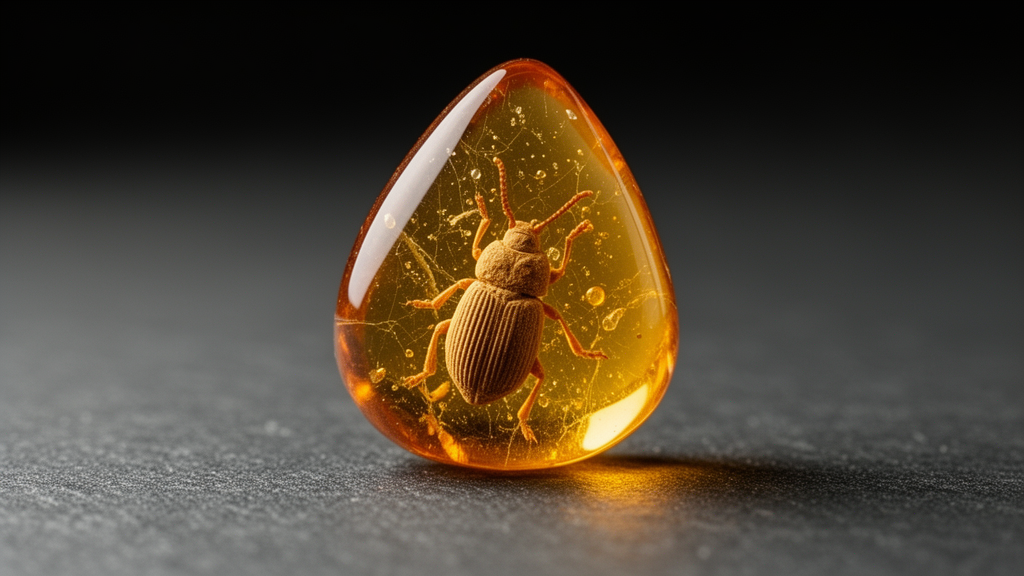
Paleontologists studying amber inclusions from northern France have formally described †Palaeocnopus testardi, a newly identified fossil beetle species preserved in lowermost Eocene resin dated to approximately 53 million years ago. Discovered within the Oise amber deposits at Le Quesnoy in the Paris Basin, the minute specimen represents the first recorded occurrence of the extinct genus †Palaeocnopus within this ancient ecosystem. Furthermore, the find marks the first documented case of an extinct coleopteran genus shared between the early Eocene Oise amber and the uppermost Eocene Baltic-related amber deposits of northern and central Europe. Belonging to the ant-like leaf beetle family Aderidae, †Palaeocnopus was previously known exclusively from four species described from Baltic and Bitterfeld ambers, which formed around 36 million years ago. By revealing the occurrence of this extinct lineage across an expansive temporal span of roughly 15 million years, the discovery provides crucial direct evidence regarding beetle lineage persistence across major Eocene environmental changes.
The family Aderidae represents one of the comparatively poorly studied lineages within Coleoptera, with its moderate diversity of approximately one thousand described living species largely reflecting limited taxonomic attention rather than actual species richness. Ecological knowledge concerning aderids remains fragmentary, though available observations indicate a predominantly arboreal or shrubby lifestyle in the adult stage. Adult aderids are generally encountered on foliage, whereas immature stages inhabit concealed microhabitats, with larvae reported primarily from decaying wood, leaf litter, and occasionally social insect nests. Prior to this study, only twelve formally described fossil aderid species were known worldwide. The oldest is †Grzymalia wukong from mid-Cretaceous Kachin amber in Myanmar, dated to approximately 99 million years ago, alongside additional records from Lebanese and Spanish Early Cretaceous ambers. Described fossil species are otherwise known mainly from Eocene Baltic-related ambers, Miocene Zhangpu amber in China, and a recently described species from the Oise amber, †Cnopus twentyonepilotorum, which attested to the antiquity of the living genus Cnopus.
The fossil specimen was recovered from the Oise amber deposit situated at Le Quesnoy near Creil in the Paris Basin, located in northern France. This locality dates to the lowermost Eocene, corresponding stratigraphically to the Sparnacian and the European Mammal Palaeogene reference level MP7, with an estimated geological age of approximately 53 million years. Unlike northern European fossil resins that derived from gymnosperms, the resin forming the Oise amber originated from †Aulacoxylon sparnacense, an extinct plant species whose systematic affinities have been placed within either Combretaceae or Caesalpinioideae, both of which are flowering angiosperm families. The single amber sample examined during the study bears the collection number C05039 and is deposited in the paleontological collections of the Centre de Recherche en Paléontologie within the Muséum national d’Histoire naturelle in Paris. Morphological examination revealed that the holotype is most likely a female specimen, as evidenced by the clearly visible apex of the ovipositor projecting from its abdomen.
To analyze the morphological structures of the holotype without causing physical damage, the researchers combined stereomicroscopy with high-resolution synchrotron imaging. Optical observations were conducted using a Leica M125 C stereomicroscope with a Leica K5C camera, and multiple focus planes were combined via Helicon Focus 8 to create extended depth-of-field images. Non-destructive phase-contrast X-ray microtomography was subsequently carried out at the BL31-FaXToR beamline of the ALBA Synchrotron in Barcelona, Spain. The tomographic setup utilized an effective photon energy of 25 kiloelectronvolts, recording 3,000 projections across 180 degrees using a pco.edge 4.2 detector and a 5× optical objective, delivering a spatial resolution of 1.3 micrometers per pixel. Datasets were reconstructed via filtered back-projection and phase retrieval methods in TomocuPy, processed in FIJI and 3D Slicer, and rendered in Avizo 3D software. This imaging approach allowed virtual three-dimensional sectioning of internal and external structures while preserving the fragile inclusion completely intact.
The anatomical data confirmed the placement of the new fossil within Aderidae based on characteristic family traits, including externally open procoxal cavities, partly connate basal abdominal ventrites, and a tarsal formula of 5-5-4 that appears as 4-4-3 due to a reduced penultimate tarsomere. The beetle is minute, exhibiting a standardized body length of approximately 1.28 millimeters and a body length about 2.7 times its width. Its elytra measure approximately 0.87 millimeters long and 0.47 millimeters wide, while the pronotum is 0.21 millimeters long and 0.30 millimeters wide, making it roughly 1.4 times wider than long. The head carries protuberant, coarsely faceted eyes without an anterior emargination. Antennomeres three through eleven possess elongate pubescence, with length ratios calculated as 0.6–0.55–0.55–0.4–0.4–0.35–0.5–0.35–0.5–0.5–1 relative to the terminal segment. The pronotum displays rounded sides, two deep triangular open impressions at its anterior angles, and a deep, transverse, sinuate sub-basal impression open laterally.
The differential diagnosis demonstrates that †Palaeocnopus testardi is distinct from all four previously described Baltic and Bitterfeld amber species: †Palaeocnopus densipunctatus, †Palaeocnopus saeticornis, †Palaeocnopus glabricornis, and †Palaeocnopus mara. The new fossil differs from †P. densipunctatus, †P. glabricornis, and †P. mara by possessing a single continuous sinuate sub-basal impression and distinct pubescence on both the pronotum and elytra. It shows its closest affinities with †P. saeticornis, sharing elongate antennal pubescence and a laterally open sinuate pronotal impression. However, †P. testardi differs in having a pubescent pronotum that is more densely punctate, with puncture spacing measuring 0.5 to 1 times puncture diameter compared to 1.5 to 2 times in †P. saeticornis. Furthermore, its pronotum is proportionally broader, being 1.4 times wider than long with rounded lateral sides rather than 1.2 times wider with subparallel sides, and features a more pronounced sinuosity in its sub-basal impression, characters unaffected by sexual dimorphism.
The temporal separation of approximately 15 million years between the lowermost Eocene Oise amber and the uppermost Eocene Baltic-related deposits provides further compelling evidence against conspecificity. The average evolutionary lifespan of an insect species is estimated at about 3 to 10 million years, making instances of species persistence exceeding 15 million years exceptionally rare among beetles. Well-documented exceptions include the primitive wood-borer Micromalthus debilis from early Miocene Dominican and Mexican ambers and the water scavenger beetle Helophorus sibiricus from the early Miocene of Siberia. Because secondary sexual dimorphism in Aderidae primarily influences eye dimensions, antennal ratios, and tarsal or femoral setal structures, differences in antennal ratios between the female Oise holotype and male type specimens of †P. saeticornis were interpreted with caution. However, non-dimorphic structural traits—notably pronotal pubescence, overall proportions, punctation density, and groove sinuosity—firmly justify classifying †Palaeocnopus testardi as an independent species.
To evaluate broader patterns of lineage continuity across the Eocene, the authors compiled a taxonomic checklist of coleopteran genera present in both the Oise and Baltic-related amber assemblages. In total, twelve beetle genera are now documented from both deposits, including Cnopus and †Palaeocnopus within Aderidae, Rhyzobius in Coccinellidae, Cupes in Cupedidae, Attagenus and Trinodes in Dermestidae, Corticaria in Latridiidae, Colotes in Melyridae, Micromalthus in Micromalthidae, Contacyphon in Scirtidae, Smicrips in Smicripidae, and Trixagus in Throscidae. The ecological affinities of living representatives of these shared genera provide valuable insights into early Paleogene forest environments. Many of these beetles inhabit moist forest microhabitats associated with decaying woody matter and decomposing plant debris. For instance, modern Corticaria larvae occur in mould, bark, and leaf litter, while Micromalthus larvae develop inside moist decaying timber. Furthermore, larvae of Contacyphon are strictly aquatic, pointing directly to the presence of persistent freshwater bodies in both forest ecosystems.
The shared occurrence of these coleopteran genera is notable because the Oise and Baltic-related amber ecosystems developed under substantially different environmental and climatic regimes. Geological reconstructions interpret the Oise deposit as a forested fluvio-lacustrine wetland under a warm, humid seasonal climate, formed between the Paleocene–Eocene Thermal Maximum and the Early Eocene Climatic Optimum when paratropical conditions reached northern Europe. In contrast, the younger Baltic amber forests developed under cooler mesothermal conditions during late Eocene cooling, representing a habitat mosaic of riparian forests, coastal swamps, bogs, and mixed conifer-angiosperm woodland. Furthermore, while the Oise amber originated from angiosperm trees, Baltic-related ambers derived primarily from gymnosperms. Although beetles may have become entrapped in resin incidentally without specific host relationships, the presence of identical genera in both assemblages suggests that these lineages were either ecologically flexible enough to associate with both gymnosperms and angiosperms or that they shifted host-plant associations as European forest compositions changed across the Eocene.
The researchers note that this documented generic overlap must be interpreted with caution, as amber assemblages are inherently affected by taphonomic and sampling biases. Substantial disparities in collection history and taxonomic effort currently exist between the two European deposits. The coleopteran fauna of the Baltic-related ambers has undergone extensive international study for more than a century, with syntheses documenting over 420 genera and the Paleobiology Database currently listing approximately 648 described beetle species. In sharp contrast, the Oise amber fauna has received far less sustained research, with only approximately 45 coleopteran species described to date, despite many additional specimens awaiting formal description in institutional collections. Consequently, the twelve shared genera recognized today represent only a minimum estimate of the actual biological continuity between the early and late Eocene forest ecosystems. Continued taxonomic work on the Oise amber promises to clarify whether this continuity reflects a broader regional persistence of beetle lineages across major Cenozoic environmental transitions.
Subject of Research: Discovery of an extinct aderid beetle in early Eocene Oise amber showing generic continuity with late Eocene Baltic ambers
Article Title: First occurrence of † Palaeocnopus ( Coleoptera , Tenebrionoidea , Aderidae ) in the lowermost Eocene Oise amber (France), with notes on beetle genera shared with the uppermost Eocene Baltic-related ambers
Article References: Ferreira, J., Patera, A., Spiessberger, E. L., & Nel, A. (2026). First occurrence of † Palaeocnopus (Coleoptera, Tenebrionoidea, Aderidae) in the lowermost Eocene Oise amber (France), with notes on beetle genera shared with the uppermost Eocene Baltic-related ambers. Fossil Record, 29(2), 919-930. https://doi.org/10.3897/fr.29.217019
Image Credits: AI Generated
DOI: 10.3897/fr.29.217019
Keywords: Palaeocnopus testardi, Aderidae, Oise amber, Baltic amber, Bitterfeld amber, lowermost Eocene, Le Quesnoy, synchrotron microtomography, ALBA Synchrotron, fossil Coleoptera, lineage continuity, Aulacoxylon sparnacense, saproxylic beetles, Sparnacian, Tenebrionoidea, paleoenvironmental reconstruction, angiosperm resin, fluvio-lacustrine wetland
News Source: Drew Townsend. (November 24, 2026). Extinct Beetle Discovered in French Amber Extends Eocene Lineage Continuity. Scienmag.