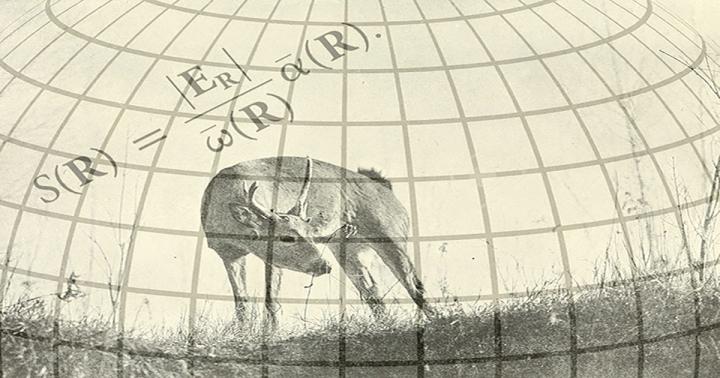
Credit: KU News Service
LAWRENCE — In the latest issue of The American Naturalist, University of Kansas investigator Jorge Sobero?n offers a new method for ecologists to calculate the correlation between geographic space and the number of species inhabiting that space.
“There’s a problem in ecology that’s been around since the 1920s called the ‘species-area relationship,'” said Sobero?n, a University Distinguished Professor at the KU Biodiversity Institute and Department of Ecology & Evolutionary Biology. “Ecologists noticed that the more space you assemble, the more species you will discover. And that’s a mathematical relationship.”
The “problem” is that there’s not a clear understanding of why the increase in geographic space is always accompanied by an increase in the numbers of species in that space.
“This observed relationship is pretty universal,” Sobero?n said. “You can do it for islands or continental masses, in the tropics or in temperate regions — wherever you do a plot of area versus number of species you get an increasing line. But why? Most explanations are based on the idea that the more individuals you sample, the more likely it is that they belong to a different species.”
But Sobero?n’s new approach to species-area relationship is different. Rather than performing a headcount of animals (or plants) within a given geographic area, the KU researcher proposes calculating the number of “Grinnellian niches,” or conditions that support the existence of species in that area.
He said the method, expressed by mathematical formulae, could offer a more accurate roll call of species.
“What I did was to apply a theory we have been developing here at KU for the last 10 years, which is called ‘Grinnellian-niche theory,'” Sobero?n said. “Instead of concentrating on counting individuals, I explained this pattern in terms of the requirements of species for different climatic combinations. Different species have different climatic requirements, and if you can model that you can place the different requirements — which are called ‘niches’ — in environmental niche space. And when you increase the area you’re looking at you are also increasing niche space. That’s the bottom line.”
According to Sobero?n, examples of niches could include water availability or the right temperature range.
“Some species tolerate very hot weather — some species require less hot weather,” he said. “Some species can tolerate very dry environments; other species require water in different amounts. So, this combination of, say, from what lowest temperature to what highest temperature. From what driest environment to what wettest environment, from what acidity in the soil, and so on — you derive these combinations of requirements, they’re called niches.”
The new approach refines the understanding of the species-area relationship because it accounts for factors beyond simply the size of an area. For instance, Sobero?n said the Grinnellian-niche approach could account for variations in environment, such as temperature, that occur more powerfully north-to-south than east-to-west.
“Latitudinal effects are just one of the many things that conventional theories ignore,” Sobero?n said. “But they play a very prominent role in the theory I’ve published, because it matters a lot whether you are moving, say, from Alaska to Central America, or vice versa. You encounter different species, different sets of tolerances and different niches. But in traditional theories, that doesn’t matter because you just care about how much area — the distinction is not made whether that’s tropical area or temperate area or polar area. But for me that’s a very major thing.”
To hone his theoretical approach, Sobero?n performed the Grinnellian analysis for North American mammals, then compared results with massive databases of known populations of species for the same region, subdivided into grids.
“There’s an organization called the International Union for Conservation of Nature that has been convening meetings of experts from all over the world to draw the various distributions of terrestrial vertebrates — mammals, birds, reptiles and amphibians,” the KU researcher said. “We have databases which are publicly available with distributions, already established by these experts. This is the work of decades. In fact, anyone can download them. They are public. I chose to look at the mammals because, well, I am slightly familiar with mammals and I have friends that are very familiar with mammals and I could ask questions of them. So, I downloaded IUCN database, which I used to test — and I also downloaded a GBIF (Global Biodiversity Information Facility) database, which is a huge database of observations of species. Those I used to do the calculations.”
Sobero?n said his new approach to biogeography could aid species conservation and species management across a spectrum of commercial and ecological efforts.
“It’s a matter of universal concern, what species live in a particular place,” he said. “Those species may be species of conservation interest — maybe you don’t want tigers to go extinct, or gorillas. But there are also species of economic interest for people. For instance, there are plagues and diseases of crops, and you don’t want to have those in your fields. There are species that transmit diseases for people, for instance, mosquitoes. So, the general problem of ‘why did you find this species in a particular place?’ is important for people. We care about certain species, and we don’t want to have other species near us. And this combination of the ones that we’d like to keep, and the ones that we don’t want to be close to us, is an instance of this general problem that I am dealing with in the paper.”
###
Media Contact
Brendan Lynch
[email protected]
785-864-8855
Original Source
https:/
Related Journal Article
http://dx.