

• HOME
  • NEWS
  • EXPLORE
    • CAREER
      • Companies
      • Jobs
    • EVENTS
    • iGEM
      • News
      • Team
    • PHOTOS
    • VIDEO
    • WIKI
  • BLOG
  • COMMUNITY
    • FACEBOOK
    • INSTAGRAM
    • TWITTER
Tuesday, May 19, 2026
BIOENGINEER.ORG
No Result
View All Result
  • Login
  • HOME
  • NEWS
  • EXPLORE
    • CAREER
      • Companies
      • Jobs
        • Lecturer
        • PhD Studentship
        • Postdoc
        • Research Assistant
    • EVENTS
    • iGEM
      • News
      • Team
    • PHOTOS
    • VIDEO
    • WIKI
  • BLOG
  • COMMUNITY
    • FACEBOOK
    • INSTAGRAM
    • TWITTER
  • HOME
  • NEWS
  • EXPLORE
    • CAREER
      • Companies
      • Jobs
        • Lecturer
        • PhD Studentship
        • Postdoc
        • Research Assistant
    • EVENTS
    • iGEM
      • News
      • Team
    • PHOTOS
    • VIDEO
    • WIKI
  • BLOG
  • COMMUNITY
    • FACEBOOK
    • INSTAGRAM
    • TWITTER
No Result
View All Result
Bioengineer.org
No Result
View All Result
Home NEWS Science News Biology

Regional Earth system modeling: Review and future directions

Bioengineer by Bioengineer
June 29, 2018
in Biology
Reading Time: 2 mins read
0
Share on FacebookShare on TwitterShare on LinkedinShare on RedditShare on Telegram
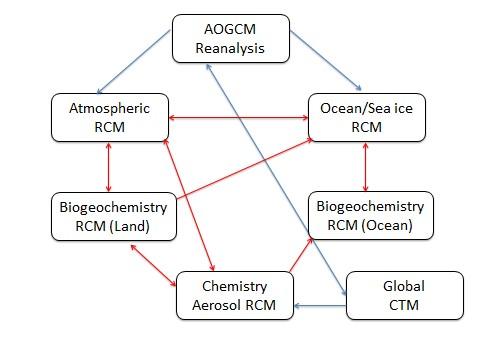
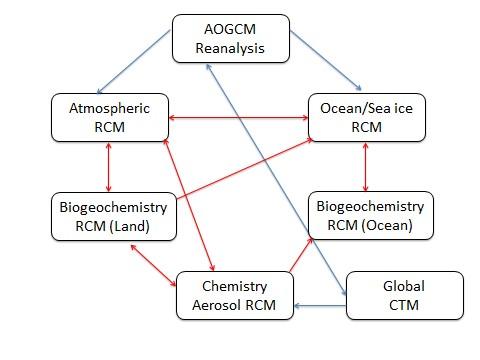
IMAGE

Credit: Filippo Giorgi

The regional climate modeling community is actively engaged in the development of regional earth system models (RESMs), applicable in different regional contexts. In a paper published in Atmospheric and Oceanic Science Letters, Prof. Filippo Giorgi from the Abdus Salam International Centre for Theoretical Physics in Italy, and Xuejie Gao from the Institute of Atmospheric Physics, Chinese Academy of Sciences in Beijing, review recent progress in, and future directions for, the field of regional earth system modeling.

But what is an RESM? Professor Gao explains: "Previously, RCMs [regional climate models] were atmosphere-only. However, the climate system consists of more than just the atmosphere. Hence, RESMs have emerged, which also take into account other key components of the earth system–for instance, the ocean, land, and sea ice".

The basic structure of a coupled RESM is illustrated in the Figure. Currently, several coupled RESMs exist, varying in their sets of components, and have been applied to a wide range of different regions, including East Asia and China. Some models include multiple earth system components, such as the atmosphere, ocean, sea ice, hydrology, land and/or marine biogeochemistry, while others adopt a simpler set of constituent models.

"Clearly, the development of RESMs is still in its infancy, but will undoubtedly receive increasing attention in the coming years," adds Prof. Gao. Indeed, the paper highlights that more work and intercomparison studies are needed to assess the transferability of these coupled models. The inclusion of an interactive biosphere has been limited so far, but the interest in this aspect is growing and is especially important within the context of future climate change, which may lead to pronounced changes in natural ecosystems.

Aside from fully coupling the atmosphere, ocean, cryosphere, biosphere, and chemosphere, the next challenge in RESM modeling is the inclusion of the human factor, as concluded by the authors. Human activities are currently considered in most model experiments as external players in the climate system, either as forcings or as receptors (e.g., impacts). However, there is a two-way interaction between human societies and the natural environment. In an era where humans are now a key component of the climate system, these processes will have to be included in the next generation of earth system models.

###

Media Contact

Zheng Lin
[email protected]
86-108-299-5053
@aasjournal

http://english.iap.cas.cn/

Original Source

http://english.iap.cas.cn/RE/201806/t20180629_194599.html http://dx.doi.org/10.1080/16742834.2018.1452520


Share12Tweet8Share2ShareShareShare2

Related Posts

Newly Discovered “Happy-Face” Spider Species Found in the Indian Himalayas — Biology

Newly Discovered “Happy-Face” Spider Species Found in the Indian Himalayas

May 19, 2026
Fischer’s Blue Butterflies Less Attractive on Non-Native Diet, Study Finds — Biology

Fischer’s Blue Butterflies Less Attractive on Non-Native Diet, Study Finds

May 19, 2026

How One Protein Uses Embryonic Brain Language to Maintain Plasticity in Adult Neurons

May 19, 2026

Scientists Can Now Monitor America’s Dolphin Populations Using DNA Floating in Seawater

May 19, 2026
Please login to join discussion

POPULAR NEWS

  • Research Indicates Potential Connection Between Prenatal Medication Exposure and Elevated Autism Risk

    845 shares
    Share 338 Tweet 211
  • New Study Reveals Plants Can Detect the Sound of Rain

    731 shares
    Share 292 Tweet 182
  • Salmonella Haem Blocks Macrophages, Boosts Infection

    62 shares
    Share 25 Tweet 16
  • Breastmilk Balances E. coli and Beneficial Bacteria in Infant Gut Microbiomes

    58 shares
    Share 23 Tweet 15

About

We bring you the latest biotechnology news from best research centers and universities around the world. Check our website.

Follow us

Recent News

Nanotechnology amplifies the effectiveness of natural biopesticides

Omega-3 Boosts Erectile Function in Tamoxifen Rats

Hybrid Reasoning Boosts Manufacturing Perception and Autonomy

Subscribe to Blog via Email

Enter your email address to subscribe to this blog and receive notifications of new posts by email.

Join 82 other subscribers
  • Contact Us

Bioengineer.org © Copyright 2023 All Rights Reserved.

Welcome Back!

Login to your account below

Forgotten Password?

Retrieve your password

Please enter your username or email address to reset your password.

Log In
No Result
View All Result
  • Homepages
    • Home Page 1
    • Home Page 2
  • News
  • National
  • Business
  • Health
  • Lifestyle
  • Science

Bioengineer.org © Copyright 2023 All Rights Reserved.