


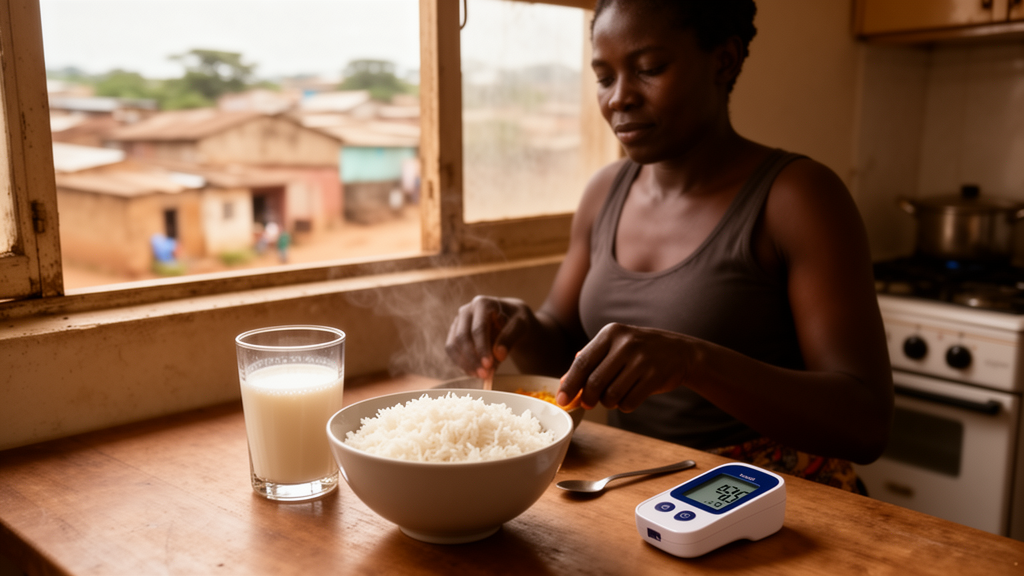
Adults living with type 2 diabetes in Kinshasa who ate diets dominated by refined grains and sweetened dairy products showed measurably worse blood sugar control, according to a cross-sectional study of more than 500 patients attending primary and secondary health facilities in the Congolese capital. The research, published in BMC Nutrition, found that 86.8 percent of participants — 442 out of 509 with available data — had uncontrolled diabetes, defined as glycated haemoglobin at or above 7 percent. The finding arrives amid rapid urbanisation across sub-Saharan Africa, where shifting food environments are increasingly blamed for undermining glycaemic control among diabetic patients.
The survey, conducted in April 2025, recruited a random sample of 540 adults with type 2 diabetes from 27 primary and 27 secondary health facilities in Kinshasa. Researchers assessed dietary practices with an adapted qualitative seven-day food-frequency questionnaire covering 20 food groups. Principal component analysis was then applied to identify underlying dietary patterns, and survey-clustered generalised linear models examined how adherence to each pattern, measured in quintiles, related to mean HbA1c. The models adjusted for sociodemographic characteristics, lifestyle factors and household food insecurity, allowing the team to isolate the dietary signal from confounding influences.
Four distinct dietary patterns emerged from the analysis, together explaining 36.8 percent of the total variance in eating habits. The first was a vegetable, fish and plant-rich pattern; the second a mixed protein and staple pattern; the third a refined-grain and dairy-sweet pattern; and the fourth an oil and dairy pattern. The refined-grain and dairy-sweet pattern stood out: higher adherence was consistently associated with higher HbA1c. Compared with participants in the lowest quintile, those in the second quintile had an adjusted Exp(β) of 1.10 (95 percent CI 1.02–1.18), those in the third quintile 1.09 (95 percent CI 1.03–1.15), and those in the fourth quintile 1.08 (95 percent CI 1.01–1.16).
No clear associations with HbA1c were observed for the other three dietary patterns. The vegetable, fish and plant-rich pattern, the mixed protein and staple pattern, and the oil and dairy pattern did not show statistically meaningful links to blood sugar control in the adjusted models.
Beyond diet, two other factors shaped HbA1c in the analysis. A diabetes duration longer than five years was associated with higher HbA1c, with an adjusted Exp(β) of 1.05 (95 percent CI 1.01–1.10), indicating that longer disease duration compounds the difficulty of achieving control. Age, by contrast, showed an inverse association: each additional year of age was linked to a slightly lower HbA1c, with an adjusted Exp(β) of 0.9965 (95 percent CI 0.994–0.999).
The study also documented a stark socioeconomic backdrop. Forty percent of participants reported severe household food insecurity, and 60.9 percent were classified as obese or overweight. These figures sit alongside the finding that poor glycaemic control was widespread even among patients who reported adhering to dietary guidance.
The research team was led by Steve Botomba of the University of Kinshasa, working with Christiane Horwood, Branly K. Mbunga, Marie-Claire Muyer, Lyn Haskins, Nickson Poka, Mala Ali Mapatano and Pierre Z. Akilimali. The article was published under open access terms on 22 October 2026 and carries a permanent DOI, though the version shared early is subject to further edits before the final Version of Record replaces it.
Methodologically, the cross-sectional design captures a single moment in time, meaning the associations reported here describe correlation rather than proven causation. The use of a qualitative food-frequency questionnaire, while practical at scale, relies on participant recall and cannot quantify precise nutrient intake.
The findings carry direct implications for diabetes care in urban Africa. The authors argue for integrating culturally adapted nutrition counselling and affordable food-based interventions into routine diabetes management, rather than relying on generic dietary advice that patients cannot follow in their actual food environments.
Subject of Research: Dietary patterns and their association with glycated haemoglobin among adults with type 2 diabetes in Kinshasa, DR Congo
Article Title: Dietary patterns and their association with glycated haemoglobin among adults with type 2 diabetes mellitus in urban DR Congo in 2025: a cross-sectional study
Article References: Botomba, S., Horwood, C., Mbunga, B. K., Muyer, M.-C., Haskins, L., Poka, N., Mapatano, M. A., & Akilimali, P. Z. (2026). Dietary patterns and their association with glycated haemoglobin among adults with type 2 diabetes mellitus in urban DR Congo in 2025: a cross-sectional study. BMC Nutrition. https://doi.org/10.1186/s40795-026-01527-6
Image Credits: AI Generated
DOI: 10.1186/s40795-026-01527-6
Keywords: type 2 diabetes, HbA1c, dietary patterns, Kinshasa, DR Congo, food insecurity, refined grains, cross-sectional study, glycaemic control, urban nutrition, BMC Nutrition, public health
News Source: Daisy Hatcher. (October 28, 2026). Refined-Grain and Sweet-Dairy Diet Linked to Poor Blood Sugar Control in Kinshasa Adults With Type 2 Diabetes. Scienmag.



