Once plastic products are used and discarded, they can linger in oceans, collecting in large “garbage patches” and harming sea life. One potential solution, a biodegradable polymer called polylactide (PLA), has so far not fully lived up to its promise, showing little sign of breakdown once in seawater. In a new study in the Journal of the American Chemical Society, researchers set out to address this issue by incorporating RNA-inspired breaking points to the polymer.
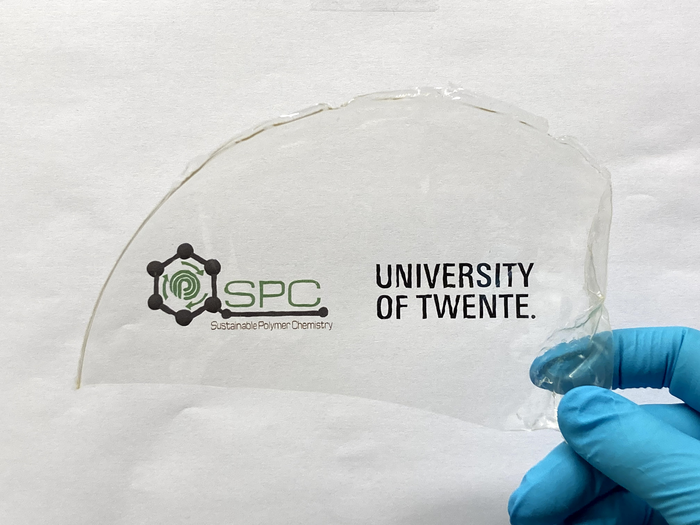
Credit: Frederik Wurm
Once plastic products are used and discarded, they can linger in oceans, collecting in large “garbage patches” and harming sea life. One potential solution, a biodegradable polymer called polylactide (PLA), has so far not fully lived up to its promise, showing little sign of breakdown once in seawater. In a new study in the Journal of the American Chemical Society, researchers set out to address this issue by incorporating RNA-inspired breaking points to the polymer.
By some estimates, conventional plastic can take hundreds of years to decompose in the ocean, but no one really knows how long it will continue to clutter the seas. One replacement material, PLA, can be manufactured from natural sources, such as corn and potato starch. It can rapidly degrade under specific conditions, such as when composted, and is often used in compostable tableware and cutlery. However, studies of PLA in seawater and in soil found no significant signs of degradation after at least three years. Researchers have developed several approaches for making faster-degrading PLA, but these have drawbacks, such as altering the material’s properties. It turns out that water can easily break apart the biological molecule RNA, thanks to a process called transesterification. So, taking inspiration from this process, Frederik Wurm and colleagues wanted to introduce chemical groups to PLA to make it easier for the polymer to break down in the ocean.
The researchers added breaking points to PLA during its synthesis by incorporating transesterification sites similar to those found in RNA. They created different versions of the modified PLA, containing enough of these sites to account for 3-15% of the polymers. In experiments, they immersed films of the new PLAs in artificial seawater and measured the change in weight of the films, as well as the release of lactic acid, a degradation product of PLA. The polymer with the highest concentration of breaking points, 15%, broke down completely to lactic acid after two weeks. Polymers with lower concentrations took longer, and some could require as much as several years, they calculated. These results showed that the degradation rate can be tailored, depending on the amount of breaking points in the material. The potential applications aren’t limited to PLA, according to the researchers. Adding breaking points may speed the decomposition of other plastic polymers and become a key strategy for preventing further marine pollution, they write.
###
The authors acknowledge funding from the German Research Foundation.
The abstract that accompanies this paper can be viewed here.
The American Chemical Society (ACS) is a nonprofit organization chartered by the U.S. Congress. ACS’ mission is to advance the broader chemistry enterprise and its practitioners for the benefit of Earth and all its people. The Society is a global leader in promoting excellence in science education and providing access to chemistry-related information and research through its multiple research solutions, peer-reviewed journals, scientific conferences, eBooks and weekly news periodical Chemical & Engineering News. ACS journals are among the most cited, most trusted and most read within the scientific literature; however, ACS itself does not conduct chemical research. As a leader in scientific information solutions, its CAS division partners with global innovators to accelerate breakthroughs by curating, connecting and analyzing the world’s scientific knowledge. ACS’ main offices are in Washington, D.C., and Columbus, Ohio.
To automatically receive news releases from the American Chemical Society, contact [email protected].
Follow us: Twitter | Facebook | LinkedIn | Instagram
Journal
Journal of the American Chemical Society
DOI
10.1021/jacs.1c07508
Article Title
RNA-Inspired and Accelerated Degradation of Polylactide in Seawater