Solving one environmental problem could create another
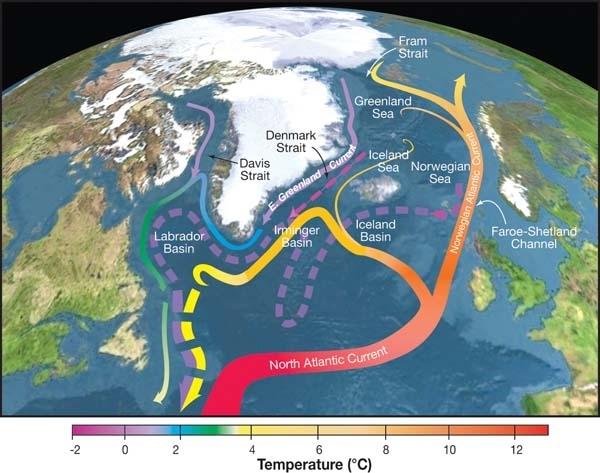
Credit: R. Curry, Woods Hole Oceanographic Institution/Science/USGCRP
Humans must reduce carbon dioxide and aerosol pollution simultaneously to avoid weakening the ocean’s ability to keep the planet cool, new research shows.
Aerosol pollution refers to particles in the air emitted by vehicles and factories that burn fossil fuels. This pollution contributes to asthma, bronchitis, and long-term irritation of the respiratory tract, which can lead to cancer.
“The conundrum,” explained UC Riverside climate scientist and study co-author Robert Allen, “is that aerosols cause poor air quality and lead to premature deaths. However, these particles have a net cooling impact on the climate, so when you cut them that leads to a net warming effect.”
Much research has examined aerosol impacts on air quality and land surface temperatures. Less explored is the way aerosols might impact the oceans, which is the focus of a UC Riverside study now published in the journal Science Advances.
The research team created detailed computer models to determine the impact on oceans under two different scenarios — one in which there is only a reduction in aerosols, and another scenario in which greenhouse gases like carbon dioxide and methane are also reduced.
“The first scenario leads to the surprising result that fewer aerosols in the atmosphere could shift the region where most of the ocean is taking up heat, from the Southern Ocean toward the North Atlantic,” Allen said.
In particular, the Atlantic meridional overturning circulation, or AMOC, would be disturbed as aerosols are removed from the atmosphere, the study found. The AMOC pulls warm water further north and pushes colder water south, ensuring the climate on land areas at higher latitudes, such as Europe, are relatively mild.
Roughly half the carbon dioxide humans put into the atmosphere — mostly through fossil fuel combustion and deforestation — stays there, and the remaining half is taken up by land and vegetation, as well as the ocean.
One of the ways the ocean takes up our carbon dioxide emissions is through AMOC circulation.
“A projected decline in manmade aerosols potentially induces a weakening of the AMOC, which plays an important role in ocean heat uptake and storage in the North Atlantic,” said Wei Liu, an assistant professor of climate change and sustainability at UCR.
In addition, the researchers said a rise in sea level would occur if the North Atlantic Ocean were to get warmer.
This current study focused on ocean heat uptake and circulation via the AMOC. However, Allen explained the study did not attempt to rigorously identify the mechanisms by which aerosol reductions weaken the AMOC. Those mechanisms will be the focus of future studies.
Ultimately, the researchers conclude that even without a more in-depth explanation of the weakening mechanisms, it is necessary to reduce greenhouse gases and aerosols in tandem.
The Intergovernmental Panel on Climate Change recommends making every attempt to prevent the planet from reaching 1.5 degrees Celsius above pre-industrial levels in order to mitigate the worst effects of global warming.
Humans have already increased carbon dioxide levels by almost 50% since the 1850s, and it continues to increase worldwide. Stabilizing carbon dioxide at current levels would require zero net emissions before the year 2070, which is ambitious, but critical.
“Assuming complete removal, aerosols at most will cause warming of about 1 K,” said Allen. “However, aerosol-induced warming, as well as the associated ocean circulation changes, can be moderated by rigorous cuts in greenhouse gases including methane and carbon dioxide.”
###
Media Contact
Jules Bernstein
[email protected]
Original Source
https:/
Related Journal Article
http://dx.