• HOME
  • NEWS
  • EXPLORE
    • CAREER
      • Companies
      • Jobs
    • EVENTS
    • iGEM
      • News
      • Team
    • PHOTOS
    • VIDEO
    • WIKI
  • BLOG
  • COMMUNITY
    • FACEBOOK
    • INSTAGRAM
    • TWITTER
Wednesday, April 1, 2026
BIOENGINEER.ORG
No Result
View All Result
  • Login
  • HOME
  • NEWS
  • EXPLORE
    • CAREER
      • Companies
      • Jobs
        • Lecturer
        • PhD Studentship
        • Postdoc
        • Research Assistant
    • EVENTS
    • iGEM
      • News
      • Team
    • PHOTOS
    • VIDEO
    • WIKI
  • BLOG
  • COMMUNITY
    • FACEBOOK
    • INSTAGRAM
    • TWITTER
  • HOME
  • NEWS
  • EXPLORE
    • CAREER
      • Companies
      • Jobs
        • Lecturer
        • PhD Studentship
        • Postdoc
        • Research Assistant
    • EVENTS
    • iGEM
      • News
      • Team
    • PHOTOS
    • VIDEO
    • WIKI
  • BLOG
  • COMMUNITY
    • FACEBOOK
    • INSTAGRAM
    • TWITTER
No Result
View All Result
Bioengineer.org
No Result
View All Result
Home NEWS Science News Biology

Rediscovery of rare marine amoeba Rhabdamoeba marina

Bioengineer by Bioengineer
November 17, 2023
in Biology
Reading Time: 2 mins read
0
Light and electron micrographs of Rhabdamoeba marina
Share on FacebookShare on TwitterShare on LinkedinShare on RedditShare on Telegram

Tsukuba, Japan—Rhabdamoeba marina (R. marina) is a small marine amoeba, first discovered and described in England in 1921. The amoeboid cells of R. marina, characterized by their near immobility, can produce flagellated cells with two rearward-extending flagella through budding under conditions of prey scarcity. Despite these distinct characteristics, the taxonomic classification of R. marina has remained unverified because only two cases have been documented, including the original description. Researchers successfully established a culture strain of R. marina from seawater sourced from the coast of Tottori Prefecture, Japan. Analyzing the genetic sequence of this strain, they found that R. marina does not align with its previously assumed taxonomic group but is closely related to chlorarachnid algae within the phylum Cercozoa. Therefore, the researchers have advocated for the reclassification of R. marina into the class Chlorarachnea.
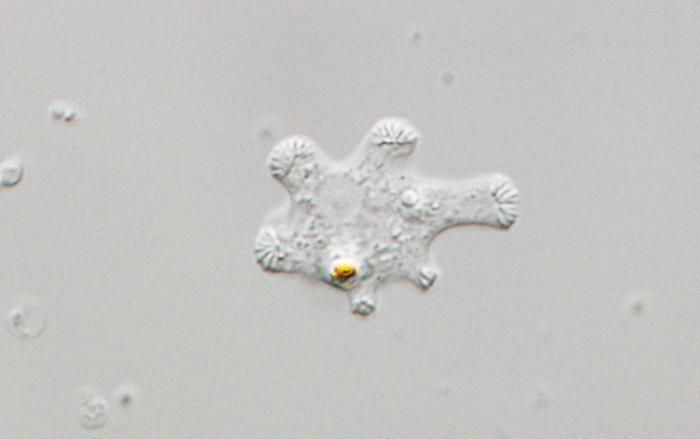
Light and electron micrographs of Rhabdamoeba marina

Credit: University of Tsukuba

Tsukuba, Japan—Rhabdamoeba marina (R. marina) is a small marine amoeba, first discovered and described in England in 1921. The amoeboid cells of R. marina, characterized by their near immobility, can produce flagellated cells with two rearward-extending flagella through budding under conditions of prey scarcity. Despite these distinct characteristics, the taxonomic classification of R. marina has remained unverified because only two cases have been documented, including the original description. Researchers successfully established a culture strain of R. marina from seawater sourced from the coast of Tottori Prefecture, Japan. Analyzing the genetic sequence of this strain, they found that R. marina does not align with its previously assumed taxonomic group but is closely related to chlorarachnid algae within the phylum Cercozoa. Therefore, the researchers have advocated for the reclassification of R. marina into the class Chlorarachnea.

Through this study, the gene sequence of R. marina—a scarcely encountered and rare amoeba–has been unveiled for the first time, and its phylogenetic position has been clarified. The study highlights the importance of observing environmental samples for the rediscovery of unicellular organisms such as R. marina that lack genetic data. Such efforts are indispensable for understanding microbial diversity.

###
This work was supported by JSPS KAKENHI, Grant Numbers 19H03282 and 18J02091.


Original Paper

Title of original paper:
Rhabdamoeba marina is a heterotrophic relative of chlorarachnid algae

Journal:
The Journal of Eukaryotic Microbiology

DOI:
10.1111/jeu.13010

Correspondence

Assistant Professor SHIRATORI, Takashi
Institute of Life and Environmental Sciences, University of Tsukuba

Related Link

Institute of Life and Environmental Sciences


Journal

Journal of Eukaryotic Microbiology

DOI

10.1111/jeu.13010

Article Title

Rhabdamoeba marina is a heterotrophic relative of chlorarachnid algae

Article Publication Date

8-Nov-2023
Share12Tweet8Share2ShareShareShare2

Related Posts

Do Your Genes Influence How Lifestyle Choices Affect Aging?

Do Your Genes Influence How Lifestyle Choices Affect Aging?

April 1, 2026
Combining Single-Cell Multiomics Unlocks Precise Identification of Rare Cell Types and States

Combining Single-Cell Multiomics Unlocks Precise Identification of Rare Cell Types and States

March 31, 2026

Genetically Engineered Marmosets Pave the Way for Advancements in Human Deafness Research

March 31, 2026

How Great Hammerhead Sharks Outsmart Ocean Temperature Swings: Insights from FIU Researchers

March 31, 2026

POPULAR NEWS

  • blank

    Revolutionary AI Model Enhances Precision in Detecting Food Contamination

    96 shares
    Share 38 Tweet 24
  • Imagine a Social Media Feed That Challenges Your Views Instead of Reinforcing Them

    1006 shares
    Share 398 Tweet 249
  • Promising Outcomes from First Clinical Trials of Gene Regulation in Epilepsy

    51 shares
    Share 20 Tweet 13
  • Popular Anti-Aging Compound Linked to Damage in Corpus Callosum, Study Finds

    43 shares
    Share 17 Tweet 11

About

We bring you the latest biotechnology news from best research centers and universities around the world. Check our website.

Follow us

Recent News

FGFR2b Links to Biomarkers, Tumor Diversity, Survival

Frailty, Malnutrition Link Falls to Daily Functioning

Dactylides D, E: Novel 22-Membered Polyol Macrolides

Subscribe to Blog via Email

Enter your email address to subscribe to this blog and receive notifications of new posts by email.

Join 78 other subscribers
  • Contact Us

Bioengineer.org © Copyright 2023 All Rights Reserved.

Welcome Back!

Login to your account below

Forgotten Password?

Retrieve your password

Please enter your username or email address to reset your password.

Log In
No Result
View All Result
  • Homepages
    • Home Page 1
    • Home Page 2
  • News
  • National
  • Business
  • Health
  • Lifestyle
  • Science

Bioengineer.org © Copyright 2023 All Rights Reserved.