• HOME
  • NEWS
  • EXPLORE
    • CAREER
      • Companies
      • Jobs
    • EVENTS
    • iGEM
      • News
      • Team
    • PHOTOS
    • VIDEO
    • WIKI
  • BLOG
  • COMMUNITY
    • FACEBOOK
    • INSTAGRAM
    • TWITTER
Saturday, May 16, 2026
BIOENGINEER.ORG
No Result
View All Result
  • Login
  • HOME
  • NEWS
  • EXPLORE
    • CAREER
      • Companies
      • Jobs
        • Lecturer
        • PhD Studentship
        • Postdoc
        • Research Assistant
    • EVENTS
    • iGEM
      • News
      • Team
    • PHOTOS
    • VIDEO
    • WIKI
  • BLOG
  • COMMUNITY
    • FACEBOOK
    • INSTAGRAM
    • TWITTER
  • HOME
  • NEWS
  • EXPLORE
    • CAREER
      • Companies
      • Jobs
        • Lecturer
        • PhD Studentship
        • Postdoc
        • Research Assistant
    • EVENTS
    • iGEM
      • News
      • Team
    • PHOTOS
    • VIDEO
    • WIKI
  • BLOG
  • COMMUNITY
    • FACEBOOK
    • INSTAGRAM
    • TWITTER
No Result
View All Result
Bioengineer.org
No Result
View All Result
Home NEWS Science News Biology

Red panda population genomics confirms two phylogenetic species and different evolutionary histories

Bioengineer by Bioengineer
March 3, 2020
in Biology
Reading Time: 2 mins read
0
IMAGE
Share on FacebookShare on TwitterShare on LinkedinShare on RedditShare on Telegram

IMAGE

Credit: IOZ


The red panda (Ailurus fulgens) is an endangered mammal endemic to the Himalaya and Hengduan Mountains, and its distribution spans China, Myanmar, Bhutan, India and Nepal. Prior to 1902, all red pandas were classified as one species. However, in 1902, scientists established two subspecies, based on their morphological differences: the Himalayan subspecies (A. f. fulgens) and the Chinese subspecies (A. f. styani).

More recent research on their morphological differences and geographical distribution, however, led the taxonomist Colin Groves to reclassify the two subspecies as two distinct species: the Himalayan red panda (A. fulgens) and the Chinese red panda (A. styani). Despite this change, the evolutionary histories of Himalayan and Chinese red pandas have remained unclear and controversy has persisted about whether they should be classified as two distinct species or not.

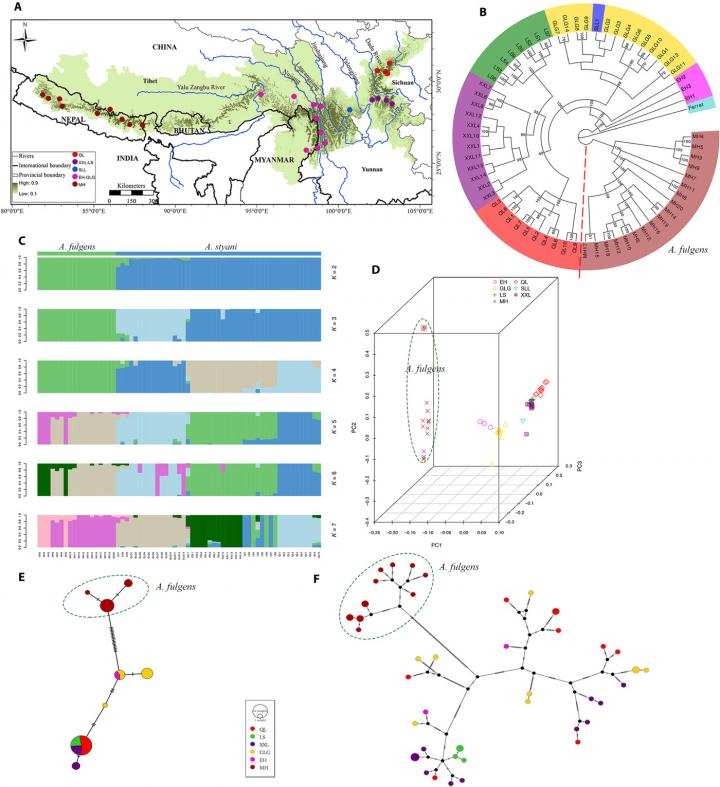
In order to help clarify these questions, a research team led by Prof. WEI Fuwen from the Institute of Zoology of the Chinese Academy of Sciences, used population genomics methods to analyze the genome resequencing data of 65 wild red pandas (including both Himalayan and Chinese red pandas) from seven geographical populations; mitochondrial genomes of 49 red pandas; and Y chromosome single-nucleotide polymorphism (SNP) data from 49 male individuals.

All results from these three types of markers found substantial genetic divergence between the two species, and no sharing was found for the haplotypes of mitochondrial genome and Y chromosome SNPs.

These findings clearly support Groves’ classification of red pandas into two phylogenetic species. Further analysis also found that the Yalu Zangbu River, rather than the Nujiang River, is most likely the geographical boundary between the two species. This explains previous observations that the discriminating morphological characteristics were inconsistent with their geographical distributions.

Furthermore, the research team reconstructed the demographic and divergence histories of the two species based on the genome resequencing data. The results revealed clearly different demographic histories for the two species: The Chinese red panda had experienced two population bottlenecks and one large population expansion, whereas the Himalayan red panda had experienced three bottlenecks and one very small expansion. These two species started to diverge after the serious population bottleneck caused by the Penultimate Glaciation (0.3 to 0.13 Mya).

In contrast to the Chinese red panda, the Himalayan red panda has less genetic diversity, higher linkage disequilibrium and a higher genetic load, thus highlighting the urgency of protecting this endangered species. These findings have important conservation implications for wild red panda conservation, pedigree construction and interbreeding avoidance for captive red pandas.

###

The study, entitled “Genomic evidence for two phylogenetic species and long-term population bottlenecks in red pandas,” was published online in Science Advances on Feb. 27.

This study was supported by the grants from Chinese Academy of Sciences, the National Natural Science Foundation of China, Ministry of Ecology and Environment of China, and etc.

Media Contact
HU Yibo
[email protected]

Original Source

http://english.cas.cn/

Related Journal Article

http://dx.doi.org/10.1126/sciadv.aax5751

Tags: BiologyEvolutionGenesGenetics
Share12Tweet8Share2ShareShareShare2

Related Posts

Uncovering C. elegans Immunity via Genetic Screens — Biology

Uncovering C. elegans Immunity via Genetic Screens

May 16, 2026
Single mother must adapt swiftly — the survival of her colony depends on it — Biology

Single mother must adapt swiftly — the survival of her colony depends on it

May 15, 2026

Why Are Nearly Everyone Right-Handed? It Might Be Linked to How We Learned to Walk

May 15, 2026

Excessive Neuronal Activity Initiates Severe Autoimmune Brain Disorder

May 15, 2026
Please login to join discussion

POPULAR NEWS

  • Research Indicates Potential Connection Between Prenatal Medication Exposure and Elevated Autism Risk

    844 shares
    Share 338 Tweet 211
  • New Study Reveals Plants Can Detect the Sound of Rain

    730 shares
    Share 291 Tweet 182
  • Salmonella Haem Blocks Macrophages, Boosts Infection

    62 shares
    Share 25 Tweet 16
  • Breastmilk Balances E. coli and Beneficial Bacteria in Infant Gut Microbiomes

    58 shares
    Share 23 Tweet 15

About

We bring you the latest biotechnology news from best research centers and universities around the world. Check our website.

Follow us

Recent News

Uncovering C. elegans Immunity via Genetic Screens

Congenital Heart Disease’s Lasting Impact on Brain Health

Metabolic Stress Worsens Parkinson’s via Mitochondrial Ferroptosis

Subscribe to Blog via Email

Enter your email address to subscribe to this blog and receive notifications of new posts by email.

Join 82 other subscribers
  • Contact Us

Bioengineer.org © Copyright 2023 All Rights Reserved.

Welcome Back!

Login to your account below

Forgotten Password?

Retrieve your password

Please enter your username or email address to reset your password.

Log In
No Result
View All Result
  • Homepages
    • Home Page 1
    • Home Page 2
  • News
  • National
  • Business
  • Health
  • Lifestyle
  • Science

Bioengineer.org © Copyright 2023 All Rights Reserved.