• HOME
  • NEWS
  • EXPLORE
    • CAREER
      • Companies
      • Jobs
    • EVENTS
    • iGEM
      • News
      • Team
    • PHOTOS
    • VIDEO
    • WIKI
  • BLOG
  • COMMUNITY
    • FACEBOOK
    • INSTAGRAM
    • TWITTER
Friday, July 3, 2026
BIOENGINEER.ORG
No Result
View All Result
  • Login
  • HOME
  • NEWS
  • EXPLORE
    • CAREER
      • Companies
      • Jobs
        • Lecturer
        • PhD Studentship
        • Postdoc
        • Research Assistant
    • EVENTS
    • iGEM
      • News
      • Team
    • PHOTOS
    • VIDEO
    • WIKI
  • BLOG
  • COMMUNITY
    • FACEBOOK
    • INSTAGRAM
    • TWITTER
  • HOME
  • NEWS
  • EXPLORE
    • CAREER
      • Companies
      • Jobs
        • Lecturer
        • PhD Studentship
        • Postdoc
        • Research Assistant
    • EVENTS
    • iGEM
      • News
      • Team
    • PHOTOS
    • VIDEO
    • WIKI
  • BLOG
  • COMMUNITY
    • FACEBOOK
    • INSTAGRAM
    • TWITTER
No Result
View All Result
Bioengineer.org
No Result
View All Result
Home NEWS Science News Chemistry

Red, green and blue single-mode lasing in heterogeneously coupled system

Bioengineer by Bioengineer
August 31, 2020
in Chemistry
Reading Time: 2 mins read
0
IMAGE
Share on FacebookShare on TwitterShare on LinkedinShare on RedditShare on Telegram

IMAGE

Credit: by Yuxiang Du, Chang-Ling Zou, Chunhuan Zhang, Kang Wang, Chan Qiao, Jiannian Yao, and Yong Sheng Zhao

Miniaturized lasers capable of emitting over the full visible spectrum have been demonstrated to be an essential tool for versatile photonic devices ranging from sensors to full-color laser display panels. For most of these devices, multicolor microlasers with high spectral purity are of great importance because the laser emission at multiple frequencies can lead to temporal fluctuations and false signaling. Single-mode microlasers, due to the advantages of low noise and good monochromaticity, hold a promising potential in promoting the advancement of functional photonic devices. Up to now, several strategies have been developed to achieve single-mode lasers. However, most of these strategies allow us to achieve single-mode lasers operate in only one gain region because of the intrinsic difficulties in simultaneously fabricating distinct materials. As a key requirement of the fields of photonics and optoelectronics, multicolor single-mode microlasers capable of emitting over the full visible spectrum, particularly the red, green and blue (RGB) color regions, still remains a big challenge.

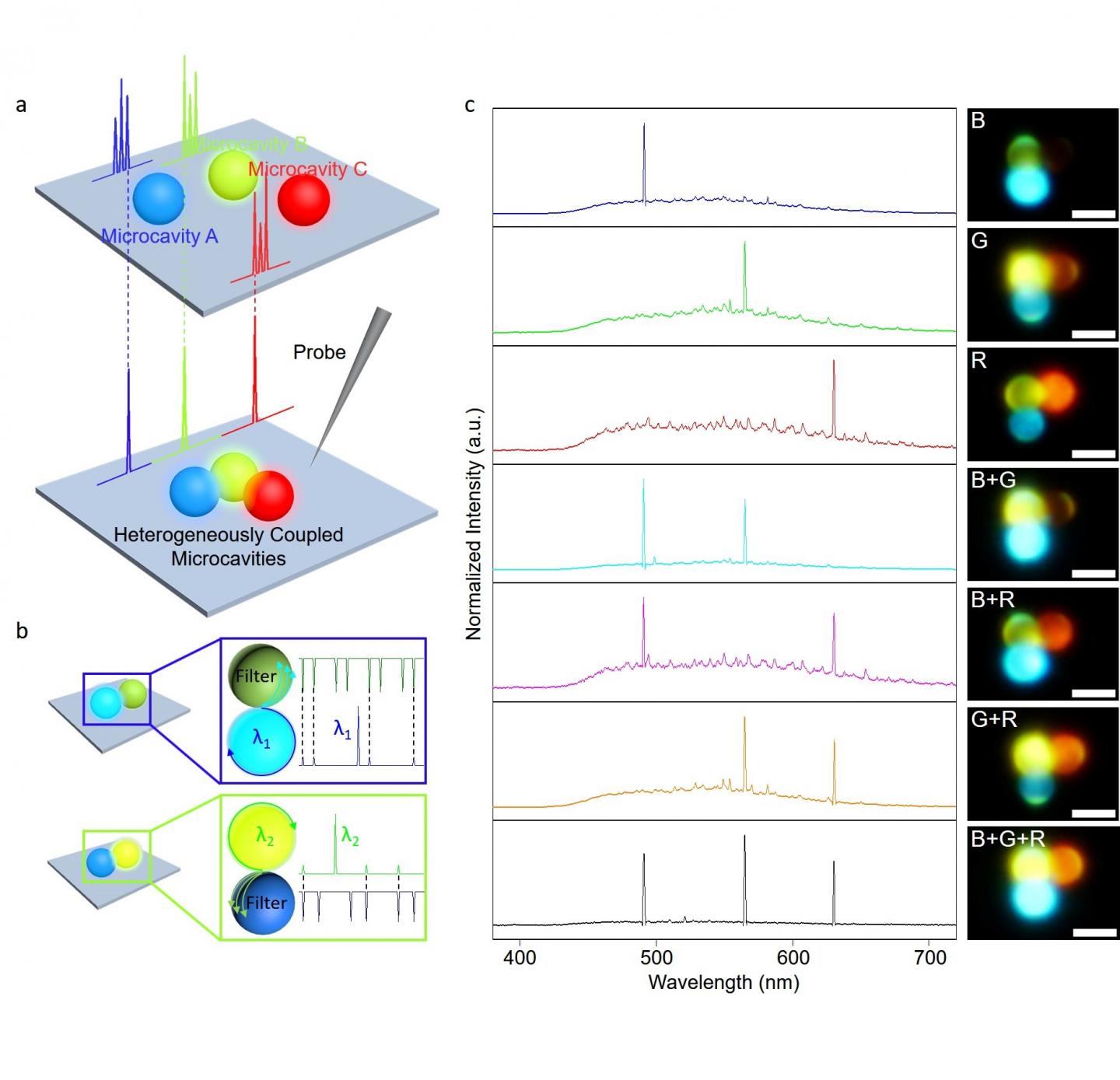
In a new paper published in Light Science & Application, a team of scientists, led by Professor Yong Sheng Zhao from Key Laboratory of Photochemistry, Institute of Chemistry, Chinese Academy of Sciences and co-workers have demonstrated tunable red, green and blue single-mode laser in an optimized heterogeneously coupled cavities constructed with three spherical microcavities incorporated with distinct gain media. The microcavities with perfect circle boundary and smooth surface were applied as high-quality WGM resonators. Benefiting from the outstanding flexibilities, RGB lasing was obtained by doping the corresponding dyes into different WGM microcavities. Different color-emissive spherical cavities were integrated to form a heterogeneously coupled system by using a strategy of nanoarchitectonics. In such a heterogeneously coupled system, each individual microsphere serves as not only the laser source but also the filter for the other resonator, which would enable the output of single-mode laser from individual microcavities. Furthermore, we fabricated heterogeneously coupled system, which permits optical coupling between multiple resonators, thereby realizing tunable RGB single-mode microlasers. The results demonstrate a unique approach for the modulation of lasing modes in heterogeneously coupled cavities and shed new light on the generation of microlasers capable of emitting over the full visible spectrum with high spectral purity for optoelectronic integrated system.

“Benefiting from the doping flexibility of organic materials, the color of the single-mode lasers output from the heterogeneously coupled structure can be freely designed by doping different gain media into the spherical microcavities” they added.

“We believe that the reported work will provide insights into the achievements of heterogeneous microstructures with advanced functionalities, which will not only inspire people to reunderstand the connection between photonic functions and nanoarchitectonics, but also lead to innovation of concepts and structure design of functional elements for photonic integrated circuits.” the scientists forecast.

###

Media Contact
Yuxiang Du
[email protected]

Related Journal Article

http://dx.doi.org/10.1038/s41377-020-00392-7

Tags: Chemistry/Physics/Materials SciencesOptics
Share12Tweet8Share2ShareShareShare2

Related Posts

Graz University of Technology Deciphers the Structural Secrets of MOF Thin Films — Chemistry

Graz University of Technology Deciphers the Structural Secrets of MOF Thin Films

July 2, 2026
Breaking Thermodynamic Limits: Wavelength-Driven Catalysis Advances Ammonia Synthesis — Chemistry

Breaking Thermodynamic Limits: Wavelength-Driven Catalysis Advances Ammonia Synthesis

July 2, 2026

From Quantum Mechanics to AI-Powered Materials Discovery: MARVEL Marks 12 Years of Transforming Computational Science

July 2, 2026

Djire Recognized with National Award for Outstanding Contributions in Research and Teaching

July 2, 2026
Please login to join discussion

POPULAR NEWS

  • Detection of EDCs in Breast Milk and Infant Urine Up to Six Months Highlights Early Exposure Risks

    77 shares
    Share 31 Tweet 19
  • Saying Goodbye to PGY-6: Pediatric Fellowship Realities

    103 shares
    Share 41 Tweet 26
  • New Drug Candidate Developed at McMaster Shows Potential for Treating Brain Cancer

    58 shares
    Share 23 Tweet 15
  • KTU Researchers Explore Ultrasound’s Role in Enhancing Blood Flow Beyond Diagnostics

    53 shares
    Share 21 Tweet 13

About

BIOENGINEER.ORG

We bring you the latest biotechnology news from best research centers and universities around the world. Check our website.

Follow us

Recent News

Steatosis Drives Liver Metastasis Diversity in CRC

Unlocking the Mysteries of Alzheimer’s Disease

Pensoft Introduces New Peer-Reviewed Journal of Regeneration to Advance Restorative Biology Across Species

Subscribe to Blog via Email

Enter your email address to subscribe to this blog and receive notifications of new posts by email.

Join 83 other subscribers
  • Contact Us

Bioengineer.org © Copyright 2023 All Rights Reserved.

Welcome Back!

Login to your account below

Forgotten Password?

Retrieve your password

Please enter your username or email address to reset your password.

Log In
No Result
View All Result
  • Homepages
    • Home Page 1
    • Home Page 2
  • News
  • National
  • Business
  • Health
  • Lifestyle
  • Science

Bioengineer.org © Copyright 2023 All Rights Reserved.