Credit: Callum Kingwell
A team working at the Smithsonian Tropical Research Institute (STRI) found evidence to support a long-debated mode of evolution, revealing how evolution captures environmental variation to teach old genes new tricks: Sweat bees switch from solitary to social behavior, repurposing ancient sets of genes that originally evolved to regulate the development of other traits.
Honeybees, ants and other social insects are known for striking differences between workers and queens that encompasses their behavior, reproduction and physical stature: from brains to brawn. These differences arise when there are environmental influences such as changes in diet or social interactions. But how do responses to the environment contribute to evolution? This question was posed by psychologists and biologists over a century ago and then generally neglected because it is very difficult to test.
More recently it was given serious attention by an emeritus staff scientist at the Smithsonian Tropical Research Institute (STRI), Mary Jane West-Eberhard, in her seminal book Developmental Plasticity and Evolution (2003). West-Eberhard’s work on the subject has led to a reexamination of the role of the environment in evolution.
Even though most of the 20,000 species of bees live their entire lives alone, highly sophisticated social systems have evolved multiple times. It has long been suspected that response to environmental cues may have been the initial spark that ignited the evolution of complex social lifestyles, but evidence was lacking until now.
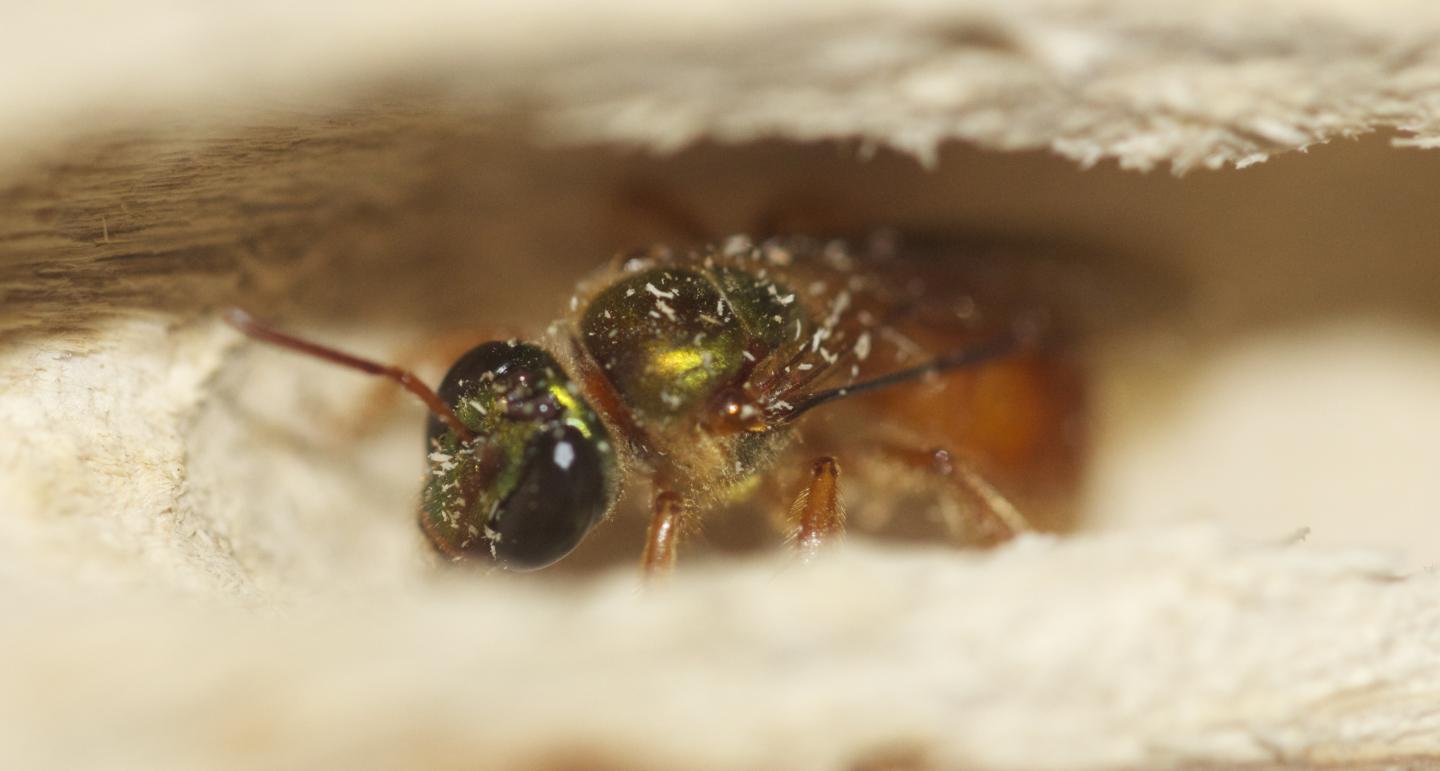
This team based their work on Barro Colorado Island, Panama. A nocturnal sweat bee, Megalopta genalis, lives there, and its social biology has been studied intensively, because females seem to teeter on the brink of sociality. An individual bee can either live alone in a hollow stick or become a queen to lord over one, or sometimes a few, of her oppressed daughters, who go to work for her.
STRI staff scientist Bill Wcislo explained why this species can provide unique insights. “Most species are either social, or they are solitary,” Wcislo said. “And for species that do vary, if you want to compare social and solitary within species, the different social forms usually live in different environments at different altitudes or latitudes, so they have different diets or other environmental factors. But because there’s a single species on Barro Colorado Island that can do either the social or solitary thing, we can compare them in a place where all other things are equal: same season, same climate, same food plants, in short, the same external environment.”
The team compared the sets of M. genalis genes involved in diverse processes, including those that differentiate social and solitary individuals. They found that the genes involved in regulating social behavior are largely derived from tinkering with ancient developmental processes that are central to normal development of young and to sex determination. The way a bee responds to different environmental conditions changes the way their genes are expressed and gives evolution a chance to act on individuals that are genetically the same but behaving differently.
“If the first step of evolving a new trait is always the appearance of a new genetic variant, then we would expect to find the genes related to social behavior in this species to be limited in scope and recently evolved,” said Karen Kapheim, assistant professor at Utah State University and STRI Research Associate, who led the study. “We found just the opposite.”
New traits–even highly complex lifestyles like social behavior–can evolve through the recycling of old genes. This helps to solve a long-standing debate among evolutionary biologists: Is the first step of evolution always a new genetic variant resulting from mutations? Or can environmental variance lead the way, with the genetics catching up? The answer to the latter question appears to be yes.
###
Researchers involved in this study are affiliated with STRI, Utah State University, Princeton University, Kunming Institute of Zoology, Chinese Academy of Sciences, China’s National Genebank, the University of Copenhagen, The Francis Crick Institute, York University, the Institute of Molecular Biology and Biotechnology, Greece; the University of Lausanne, the Swiss Institute of Bioinformatics, Cornell University, Martin-Luther-University Halle-Wittenberg and the U.S. Department of Agriculture-ARS Honey Bee Breeding, Genetics and Physiology Laboratory.
Media Contact
Elisabeth king
[email protected]
Related Journal Article
http://dx.