


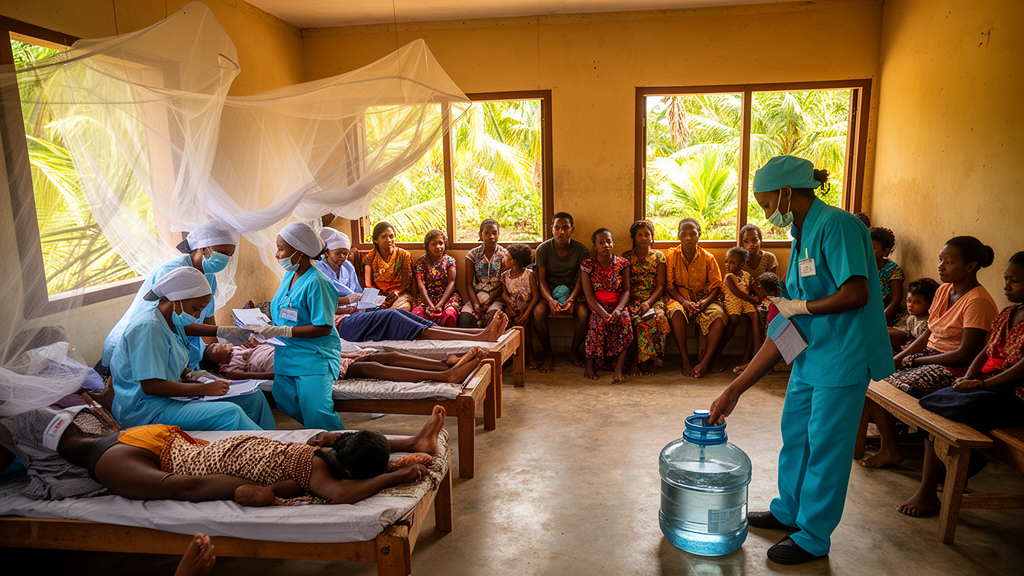
Timor-Leste is in the grip of a severe dengue outbreak that has overwhelmed hospitals in the capital, Dili. As of 6 February 2026, Dili had reported more than one thousand confirmed cases and five pediatric deaths. Hospitals have exceeded bed capacity, with patients receiving care in chairs in overcrowded wards, and essential medical supplies, including intravenous fluids, laboratory reagents and basic monitoring devices, are in acute shortage. This is the third major dengue outbreak to strike Dili since 2020, and researchers warn that the pattern reflects recurring health system strain rather than isolated events.
The current crisis is described in a letter published in New Microbes and New Infections, in which a team of public health researchers sets out the scale of the emergency and proposes three specific measures. The authors are careful to note that their recommendations are based on public surveillance reports and preliminary outbreak data, not on primary data collected by the authors themselves, and are presented as policy proposals rather than empirical conclusions.
The numbers underline how repeatedly the country has been hit. In the 2022 outbreak, Dili recorded 3,904 dengue cases and 35 deaths, a case fatality rate of 0.9 percent. Preliminary data from the current 2026 outbreak indicate approximately 1,000 cases with 5 pediatric deaths, a case fatality rate of 0.5 percent. While the current case fatality rate is lower, the authors argue it remains clinically significant, and the continued occurrence of pediatric deaths is concerning. They also caution that direct comparison between the two outbreaks is limited by denominator underreporting during surge periods.
Dengue management is well established, and early diagnosis, monitoring and supportive care substantially reduce mortality. Yet during recent outbreaks hospital capacity has been exceeded and essential supplies have run short, with persistent diagnostic and laboratory constraints, suggesting deficits in surge capacity, supply-chain resilience and surveillance infrastructure. Recurrent outbreaks in a single setting, the authors write, indicate recurring health system strain rather than isolated events.
Timor-Leste has made notable gains in laboratory capacity in recent years, including expanded serological and molecular diagnostic capabilities at the National Health Laboratory. However, during outbreak surges molecular testing remains centralized in a single facility in Dili, creating diagnostic bottlenecks. Routine serotype surveillance is not conducted between outbreaks, impeding early warning of severe disease risk. Meanwhile, the Ministry of Health has recently initiated a Wolbachia-infected mosquito deployment program in Dili, which the authors describe as a promising integrated vector control strategy, though one in its early stages that does not yet replace the need for emergency surge capacity, supply chain resilience or sustained surveillance.
The first proposed measure is that the Ministry of Health should request technical deployment through the ASEAN Coordinating Centre for Humanitarian Assistance on disaster management, known as the AHA Centre. The ASEAN regional mechanism for disaster health management explicitly includes response to public health emergencies, including disease outbreaks, and enables rapid deployment of clinical logistics and emergency medical teams. Such a request would address the immediate lack of surge clinical logistics and emergency medical team capacity identified in the letter.
The second proposal is directed at the World Health Organization: the authors suggest that WHO consider treating Timor-Leste’s recurrent dengue outbreaks as a single protracted emergency rather than discrete events. WHO defines protracted emergencies as those persisting for more than six months, but current grading criteria do not formally account for cumulative health system strain from recurrent seasonal outbreaks, which the authors say obscures the need for multi-year surge support. They emphasize that this policy proposal aims to highlight cumulative health-system strain and is not based on an empirical analysis of WHO grading criteria.
The third measure calls on development partners to prioritize establishing sustainable serotype surveillance in Dili and Baucau. Without knowledge of circulating serotypes, the country cannot anticipate severe dengue risk or prepare for future vaccine introduction. The proposed measures are paired with a summary of current gaps: decentralized molecular testing capacity and a strengthened laboratory network to replace centralized testing, sustainable serotype surveillance between outbreaks, and reclassification of recurrent outbreaks so that cumulative health system strain is no longer obscured.
The authors argue that these interventions are feasible, aligned with existing regional frameworks, and do not require new institutions or treaties. What is required, they contend, is recognition that Timor-Leste’s dengue crisis is not seasonal but structural. Beyond publication, the authors commit to submitting these recommendations formally to the Timor-Leste Ministry of Health, the WHO Country Office and the AHA Centre. Their warning is stark: without sustained, pre-positioned response capacity, the next outbreak may follow the next rains. Globally, dengue incidence is increasing, and small island states in Southeast Asia and the Pacific are disproportionately vulnerable, a context in which the interval between major outbreaks in Timor-Leste has shortened and health system strain has accumulated.
Subject of Research: Recurrent dengue outbreaks in Timor-Leste and proposed public health emergency response measures.
Article Title: Recurrent Dengue Outbreaks in Timor-Leste as an Escalating Public Health Emergency: An Urgent Call for Action
Article References: Cabuhat, K. S. P., Ong, C. J. N., Ogaya, J. B., Pacheco, C. D. R., Nazari, R., & Lucero-Prisno, D. E., III (2026). Recurrent Dengue Outbreaks in Timor-Leste as an Escalating Public Health Emergency: An Urgent Call for Action. New Microbes and New Infections, Article 101879. https://doi.org/10.1016/j.nmni.2026.101879
Image Credits: AI Generated
DOI: 10.1016/j.nmni.2026.101879
Keywords: dengue, Timor-Leste, Dili, public health emergency, outbreak response, AHA Centre, WHO, serotype surveillance, Wolbachia, hospital capacity, Southeast Asia, health system strain
News Source: Phoebe Ingram. (October 29, 2026). Recurrent Dengue Outbreaks in Timor-Leste Escalate into a Structural Public Health Emergency. Scienmag.



