“This achievement was possible because we at HZB have built up expertise in both silicon heterojunction technology and perovskite solar cells and work very closely together,” says Prof. Dr. Steve Albrecht, who leads a research group on perovskite tandem solar cells at HZB. For example, the perovskite experts from the HySPRINT Innovation Lab and the silicon experts from the PV Competence Centre (PVcomB) have already set several efficiency world records for tandem solar cells.
Credit: Johannes Beckedahl/Lea Zimmerman/HZB.
“This achievement was possible because we at HZB have built up expertise in both silicon heterojunction technology and perovskite solar cells and work very closely together,” says Prof. Dr. Steve Albrecht, who leads a research group on perovskite tandem solar cells at HZB. For example, the perovskite experts from the HySPRINT Innovation Lab and the silicon experts from the PV Competence Centre (PVcomB) have already set several efficiency world records for tandem solar cells.
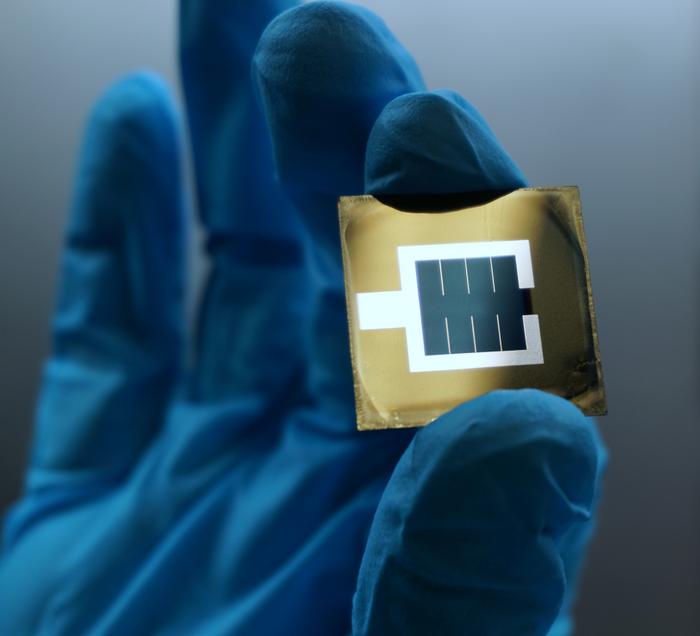
The tandem solar cell, now described in detail for the first time in the journal Science, also made headlines in December 2022 when it set a new world record for efficiency, converting 32.5% of incident sunlight into electrical energy. This world record stood until mid-April 2023, when it was broken by a group from the PV Lab at the KAUST research centre in Saudi Arabia. The research field is extremely competitive, with many groups worldwide working in this area. Now the HZB team has again been the first to present a solid and scientifically rigorous peer-reviewed technical publication with precise data sets from the measurements as well as detailed information on the structure of the tandem cell.
Albrecht and his team relied primarily on a significantly improved perovskite compound and a sophisticated surface modification using a novel piperazinium iodide molecule developed by postdoctoral researchers Dr Silvia Mariotti and Dr Eike Köhnen. This largely suppressed charge recombination and significantly reduced the associated losses. Using special measurement techniques, the researchers were able to analyse the fundamental processes at the interfaces and in the individual layers of the tandem cell in detail and then further optimise them based on a deeper understanding. The developments were then combined and transferred to tandem solar cells, with further adjustments to the top electrode for improved optics.
Many experts from different institutes were involved in the production and development of the tandem cells: For example, a group from the University of Potsdam carried out advanced optoelectronic measurements of the single and tandem cells; the novel molecules for modifying the surface were synthesised at the Joxe Mari Korta Centre in San Sebastian, Spain; and a team from Kaunas Technical University in Lithuania helped processing the new perovskite compounds with very high film quality. Only by combining all the modifications was it possible to achieve maximum values for photovoltage (open circuit voltage) and photocurrent, and thus efficiency.
Impressive development in recent years
Over the past few years, various research institutes and photovoltaic companies around the world have been continuously improving the efficiency of solar cells. The last two years in particular have been very exciting: teams from the HZB achieved a record value of just under 30% (29.8%) for tandem solar cells made of silicon and perovskite at the end of 2021. This was achieved by introducing special periodic nanostructures into the solar cells. In the summer of 2022, the Ecole Polytechnique Fédérale de Lausanne (EPFL) in Switzerland reported a certified tandem cell with 31.3% efficiency. From December 2022 to mid-April 2023, the world record was back at HZB with 32.5%, until the KAUST Photovoltaics Laboratory in Saudi Arabia demonstrated a perovskite silicon tandem cell with 33.2% in the laboratory. KAUST even managed to increase this to 33.7% in May 2023. “We are very excited about these tremendous advances in our scientific discipline,” says Albrecht. “They give us hope that this technology can make an important contribution to a sustainable energy supply in the fight against climate change in the coming years, because the upscaling and industrial production of perovskite/silicon tandem solar cells is also feasible”.
HZB’s scientific director, Prof. Bernd Rech, says: “The solar cell efficiency of silicon/perovskite tandem cells is now in the range previously only achieved by expensive III/V semiconductors.” The technologies for manufacturing such tandem solar cells are already available in principle and potentially low cost; the focus now is on further improvements in the area of stability in outdoor use.
Journal
Science
Method of Research
Experimental study
Subject of Research
Not applicable
Article Title
Interface engineering for high-performance, triple-halide perovskite–silicon tandem solar cells
Article Publication Date
6-Jul-2023
COI Statement
none