• HOME
  • NEWS
  • EXPLORE
    • CAREER
      • Companies
      • Jobs
    • EVENTS
    • iGEM
      • News
      • Team
    • PHOTOS
    • VIDEO
    • WIKI
  • BLOG
  • COMMUNITY
    • FACEBOOK
    • INSTAGRAM
    • TWITTER
Friday, December 26, 2025
BIOENGINEER.ORG
No Result
View All Result
  • Login
  • HOME
  • NEWS
  • EXPLORE
    • CAREER
      • Companies
      • Jobs
        • Lecturer
        • PhD Studentship
        • Postdoc
        • Research Assistant
    • EVENTS
    • iGEM
      • News
      • Team
    • PHOTOS
    • VIDEO
    • WIKI
  • BLOG
  • COMMUNITY
    • FACEBOOK
    • INSTAGRAM
    • TWITTER
  • HOME
  • NEWS
  • EXPLORE
    • CAREER
      • Companies
      • Jobs
        • Lecturer
        • PhD Studentship
        • Postdoc
        • Research Assistant
    • EVENTS
    • iGEM
      • News
      • Team
    • PHOTOS
    • VIDEO
    • WIKI
  • BLOG
  • COMMUNITY
    • FACEBOOK
    • INSTAGRAM
    • TWITTER
No Result
View All Result
Bioengineer.org
No Result
View All Result
Home NEWS Science News

Record-breaking laser link could help us test whether Einstein was right

Bioengineer by Bioengineer
January 22, 2021
in Science News
Reading Time: 2 mins read
0
IMAGE
Share on FacebookShare on TwitterShare on LinkedinShare on RedditShare on Telegram

IMAGE

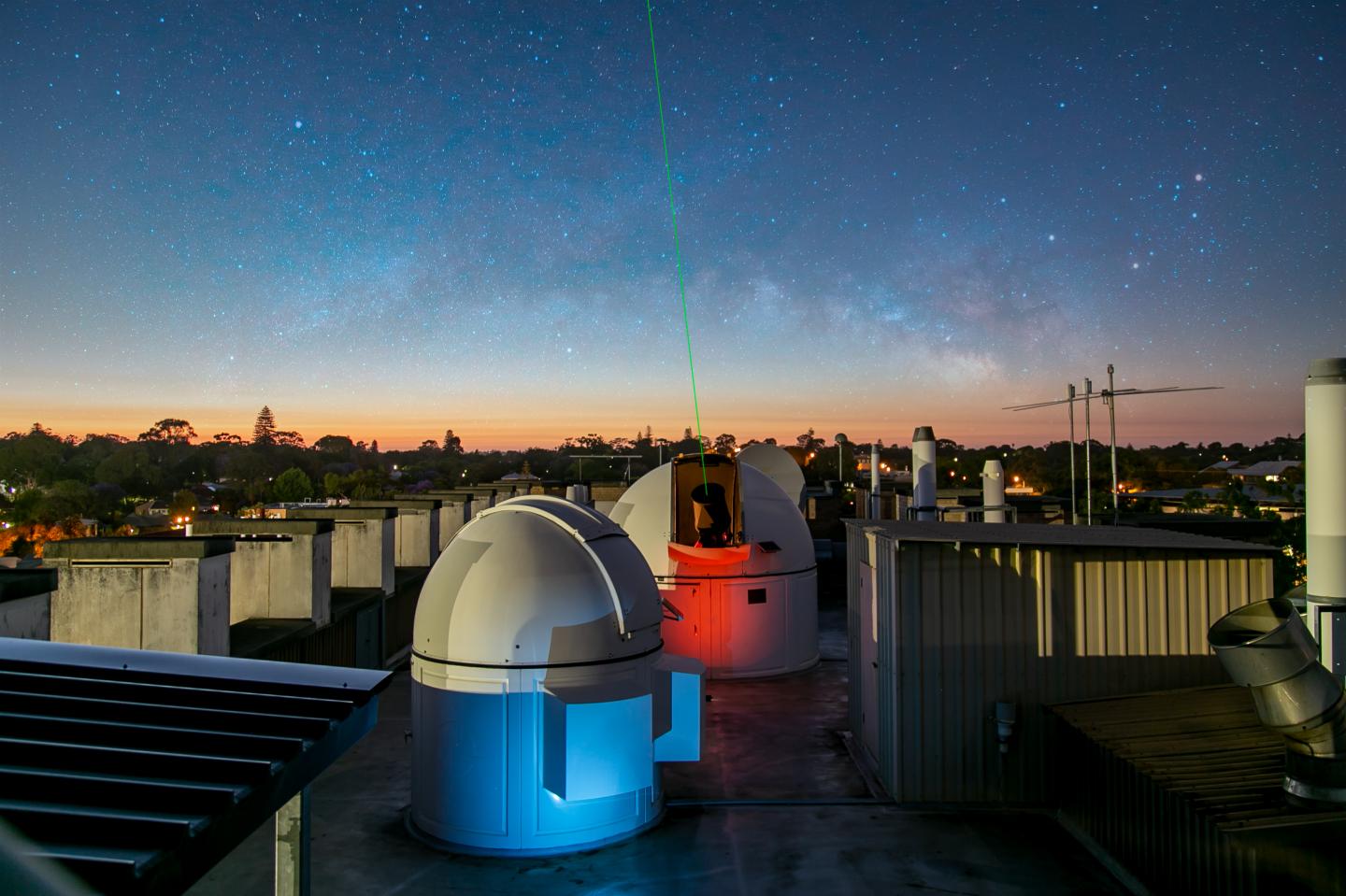
Credit: ICRAR

Scientists from the International Centre for Radio Astronomy Research (ICRAR) and The University of Western Australia (UWA) have set a world record for the most stable transmission of a laser signal through the atmosphere.

In a study published today in the journal Nature Communications, Australian researchers teamed up with researchers from the French National Centre for Space Studies (CNES) and the French metrology lab Systèmes de Référence Temps-Espace (SYRTE) at Paris Observatory.

The team set the world record for the most stable laser transmission by combining the Aussies’ ‘phase stabilisation’ technology with advanced self-guiding optical terminals.

Together, these technologies allowed laser signals to be sent from one point to another without interference from the atmosphere.

Lead author Benjamin Dix-Matthews, a PhD student at ICRAR and UWA, said the technique effectively eliminates atmospheric turbulence.

“We can correct for atmospheric turbulence in 3D, that is, left-right, up-down and, critically, along the line of flight,” he said.

“It’s as if the moving atmosphere has been removed and doesn’t exist.

“It allows us to send highly-stable laser signals through the atmosphere while retaining the quality of the original signal.”

The result is the world’s most precise method for comparing the flow of time between two separate locations using a laser system transmitted through the atmosphere.

ICRAR-UWA senior researcher Dr Sascha Schediwy said the research has exciting applications.

“If you have one of these optical terminals on the ground and another on a satellite in space, then you can start to explore fundamental physics,” he said.

“Everything from testing Einstein’s theory of general relativity more precisely than ever before, to discovering if fundamental physical constants change over time.”

The technology’s precise measurements also have practical uses in earth science and geophysics.

“For instance, this technology could improve satellite-based studies of how the water table changes over time, or to look for ore deposits underground,” Dr Schediwy said.

There are further potential benefits for optical communications, an emerging field that uses light to carry information.

Optical communications can securely transmit data between satellites and Earth with much higher data rates than current radio communications.

“Our technology could help us increase the data rate from satellites to ground by orders of magnitude,” Dr Schediwy said.

“The next generation of big data-gathering satellites would be able to get critical information to the ground faster.”

The phase stabilisation technology behind the record-breaking link was originally developed to synchronise incoming signals for the Square Kilometre Array telescope.

The multi-billion-dollar telescope is set to be built in Western Australia and South Africa from 2021.

###

Media Contact
Kirsten Gottschalk
[email protected]

Original Source

https://www.icrar.org/laser-time/

Related Journal Article

http://dx.doi.org/10.1038/s41467-020-20591-5

Tags: AstronomyAstrophysicsChemistry/Physics/Materials SciencesOpticsSatellite Missions/ShuttlesSpace/Planetary ScienceTechnology/Engineering/Computer Science
Share12Tweet8Share2ShareShareShare2

Related Posts

Advancing Pediatric Sarcopenia Diagnosis: New Insights

Advancing Pediatric Sarcopenia Diagnosis: New Insights

December 26, 2025

Assessing Social Networks in Autistic Preschool Communication Support

December 26, 2025

Exploring Contraceptive Knowledge Among Northern Cyprus Nursing Students

December 26, 2025

Temperature and Heat Penetration in Canned vs. Pouched Whelk

December 26, 2025
Please login to join discussion

POPULAR NEWS

  • Nurses’ Views on Online Learning: Effects on Performance

    Nurses’ Views on Online Learning: Effects on Performance

    70 shares
    Share 28 Tweet 18
  • NSF funds machine-learning research at UNO and UNL to study energy requirements of walking in older adults

    71 shares
    Share 28 Tweet 18
  • Unraveling Levofloxacin’s Impact on Brain Function

    54 shares
    Share 22 Tweet 14
  • Exploring Audiology Accessibility in Johannesburg, South Africa

    51 shares
    Share 20 Tweet 13

About

We bring you the latest biotechnology news from best research centers and universities around the world. Check our website.

Follow us

Recent News

Advancing Pediatric Sarcopenia Diagnosis: New Insights

Assessing Social Networks in Autistic Preschool Communication Support

Exploring Contraceptive Knowledge Among Northern Cyprus Nursing Students

Subscribe to Blog via Email

Enter your email address to subscribe to this blog and receive notifications of new posts by email.

Join 71 other subscribers
  • Contact Us

Bioengineer.org © Copyright 2023 All Rights Reserved.

Welcome Back!

Login to your account below

Forgotten Password?

Retrieve your password

Please enter your username or email address to reset your password.

Log In
No Result
View All Result
  • Homepages
    • Home Page 1
    • Home Page 2
  • News
  • National
  • Business
  • Health
  • Lifestyle
  • Science

Bioengineer.org © Copyright 2023 All Rights Reserved.