Reconstructing the bacterial genomes recovered from the calcified plaque of human and Neanderthal remains has offered new insights into previously undescribed Pleistocene bacterial metabolites, researchers report. The approach expands researchers ability to study microbial natural products, which has otherwise been mostly limited to studying living bacteria. Bioactive small molecules produced by microbes, often called natural products, have been an important source of diverse functional compounds for industry and medicine, including many antimicrobials. Characterizing the natural products encoded in biosynthetic gene clusters (BGCs) once produced by the microbiota of the ancient microbiome would provide valuable insight into previously unknown metabolites, as well as their role in the nutrition and health of early hominins. Although recent advances in paleogenomics have illuminated past genomic diversity in humans, the functions and biosynthetic capabilities of this rapidly growing paleome remain elusive. Martin Klapper and colleagues searched for biosynthetic gene clusters in metagenomic datasets extracted from calcified dental plaque, or dental calculus, from ancient human and Neandertal remains spanning roughly the past 100,000 years. They reconstructed 459 bacterial metagenome-assembled genomes (MAGs). Some of the MAGs were more than 90,000 years older than the previously oldest reconstructed MAGs. Within this sample, Klapper et al. discovered a previously undescribed Pleistocene-era bacterial species within the genus Chlorobium, which contained a BGC shared by seven Middle and Upper Paleolithic individuals. Using heterologous expression techniques to reconstruct the biosynthetic action of these ancient BGCs, the authors found that they produced previously unreported metabolites, namely 5-alkylfuran-3-carboxylic acid products that the authors dub paleofurans. According to the authors, the findings demonstrate the paleobiotechnological approach’s potential in future natural product exploration in ancient metagenomes. “By merging metagenomics, genome mining, gene synthesis, and metabolic analyses with the field of [ancient DNA] research, we chart a path for the discovery of ancient natural products to gain evolutionary insights on their formation and origin, as well as to inform their potential future applications,” write Klapper et al.
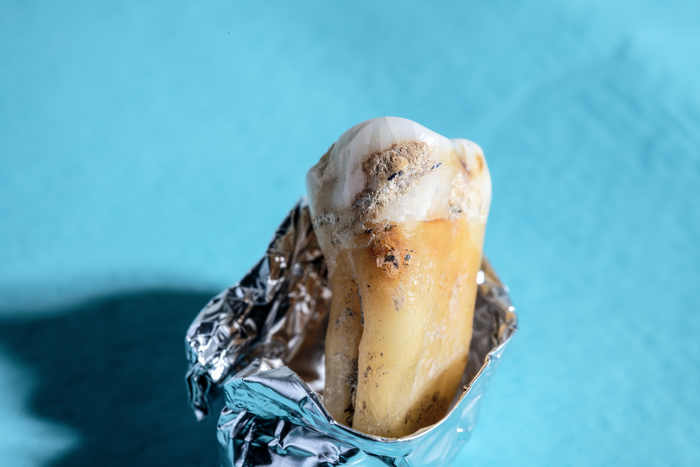
Credit: Werner Siemens Foundation, Felix Wey
Reconstructing the bacterial genomes recovered from the calcified plaque of human and Neanderthal remains has offered new insights into previously undescribed Pleistocene bacterial metabolites, researchers report. The approach expands researchers ability to study microbial natural products, which has otherwise been mostly limited to studying living bacteria. Bioactive small molecules produced by microbes, often called natural products, have been an important source of diverse functional compounds for industry and medicine, including many antimicrobials. Characterizing the natural products encoded in biosynthetic gene clusters (BGCs) once produced by the microbiota of the ancient microbiome would provide valuable insight into previously unknown metabolites, as well as their role in the nutrition and health of early hominins. Although recent advances in paleogenomics have illuminated past genomic diversity in humans, the functions and biosynthetic capabilities of this rapidly growing paleome remain elusive. Martin Klapper and colleagues searched for biosynthetic gene clusters in metagenomic datasets extracted from calcified dental plaque, or dental calculus, from ancient human and Neandertal remains spanning roughly the past 100,000 years. They reconstructed 459 bacterial metagenome-assembled genomes (MAGs). Some of the MAGs were more than 90,000 years older than the previously oldest reconstructed MAGs. Within this sample, Klapper et al. discovered a previously undescribed Pleistocene-era bacterial species within the genus Chlorobium, which contained a BGC shared by seven Middle and Upper Paleolithic individuals. Using heterologous expression techniques to reconstruct the biosynthetic action of these ancient BGCs, the authors found that they produced previously unreported metabolites, namely 5-alkylfuran-3-carboxylic acid products that the authors dub paleofurans. According to the authors, the findings demonstrate the paleobiotechnological approach’s potential in future natural product exploration in ancient metagenomes. “By merging metagenomics, genome mining, gene synthesis, and metabolic analyses with the field of [ancient DNA] research, we chart a path for the discovery of ancient natural products to gain evolutionary insights on their formation and origin, as well as to inform their potential future applications,” write Klapper et al.
Journal
Science
DOI
10.1126/science.adf5300
Article Title
Natural products from reconstructed bacterial genomes of the Middle and Upper Paleolithic
Article Publication Date
4-May-2023