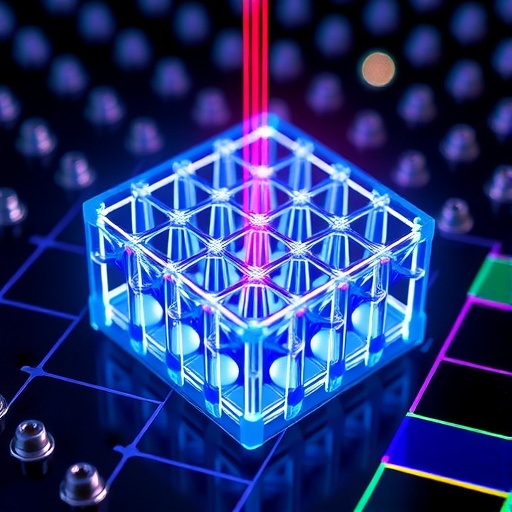
Artificial intelligence is accelerating the demand for faster, more energy-efficient computing, but the hardware used to process visual information has not advanced at the same pace. Conventional electronic processors must convert optical signals into electrical data before analyzing them, creating delays and consuming substantial energy. Optical analog computing offers a different route: light can be manipulated directly to perform mathematical operations at high speed and with low energy consumption. Yet many optical processors remain fixed-function devices, designed to perform only one operation. A new study from researchers at Nanjing University in China introduces a reconfigurable optical device that can rapidly switch between edge detection, second-order spatial differentiation, and ordinary bright-field imaging.
Published in Light: Science & Applications, the study describes a ferroelectric chiral nanostructure based on ferroelectric liquid crystals, or FLCs. The device is designed to control how light is transformed as it passes through a carefully patterned optical medium. Rather than relying on a permanent optical configuration, the researchers use an external electric field to alter the orientation of the liquid-crystal molecules. By reversing the polarity of the applied voltage, the system can switch between distinct imaging functions, potentially allowing one compact optical component to perform several tasks in real time.
The central material is a chiral ferroelectric liquid crystal with a naturally twisted molecular arrangement. In an ordinary chiral liquid crystal, molecules tend to form a helix, with their orientations gradually rotating through the material. For the new device, the researchers apply an appropriate electric field that suppresses this natural helical structure. Once the helix is suppressed, the molecules rotate preferentially in a direction determined by the polarity of the voltage. A positive voltage drives the molecular orientation one way, while a negative voltage drives it in the opposite direction. This electrically controlled reconfiguration changes the optical response of the nanostructure without requiring mechanical movement or physical replacement of components.
The team combined this electrically switchable behavior with a precisely engineered spatial distribution of the optical axis. The optical axis describes the direction in which the material interacts most strongly with polarized light. By using photopatterning techniques to arrange this axis across the device, the researchers created a spatially varying optical response capable of performing differentiation on an image. In optical computing, spatial differentiation highlights changes in intensity or phase across neighboring regions of an image. Because abrupt changes commonly occur at object boundaries, the process can reveal edges while suppressing relatively uniform areas.
Under a positive voltage of approximately 5 volts, the device operates as an optical spatial differentiator. It can perform first- or second-order differentiation, depending on the optical configuration, producing images in which boundaries and fine structural changes become highly visible. The first derivative emphasizes transitions in intensity, while the second derivative can provide stronger contrast around edges and reveal more detailed variations in an object’s structure. This type of processing is normally performed digitally after an image has been captured, but the FLC device carries out the operation directly as light passes through the optical system.
When the voltage is reversed to approximately -5 volts, the same device switches into a bright-field imaging mode. Instead of emphasizing only changes and boundaries, it allows a direct view of the object’s transmitted image. This dual functionality is particularly important for microscopy and machine vision, where users may need both a conventional image and a processed image of the same sample. A bright-field view provides overall morphological information, while a differentiated image can make boundaries, membranes, defects, or other fine features easier to identify. Switching between the two modes can therefore provide complementary information without changing the microscope or interrupting observation.
The response speed of the device is one of its most notable characteristics. The researchers report an average switching time of approximately 62 microseconds under a 2-kilohertz driving condition. This is roughly three orders of magnitude faster than conventional nematic liquid-crystal devices, whose molecular reorientation is generally slower. Such a rapid response could allow optical systems to alternate between imaging functions almost instantaneously. In a biological microscope, for example, an operator or automated system could switch between bright-field observation and edge-enhanced imaging during the same experiment, potentially supporting the observation of dynamic or living specimens.
The device also demonstrated substantial operational stability. According to the researchers, it retained identical performance after more than 1.8 million switching cycles, suggesting that repeated electrical reconfiguration did not significantly degrade its optical behavior. The response curve also remained unchanged after 200 days. In addition, the system maintained robust performance across variations in temperature and humidity and operated across a broad wavelength range from 490 to 630 nanometers. This visible-light bandwidth includes much of the spectrum commonly used in optical microscopes, cameras, and laboratory imaging systems.
The researchers tested the differentiator with both intensity-based samples and phase objects, which alter the phase of light without necessarily producing strong differences in brightness. Demonstrations included onion epidermal cells and a standard resolution test chart. In these experiments, the device clearly accentuated the boundaries of cellular and test-pattern structures while also retaining the ability to provide direct bright-field images. The ability to process phase objects is especially significant for biological imaging, because many transparent cells are difficult to distinguish using intensity alone. Optical differentiation can expose subtle boundaries that may otherwise remain hidden in a conventional image.
The new architecture could help move optical computing beyond static demonstrations toward flexible systems capable of adapting to changing tasks. A single component that performs differentiation and bright-field imaging could be integrated into existing microscopes, cameras, and machine-vision platforms without requiring a large redesign. Its high speed may also support real-time edge extraction, neuromorphic photonics, automated inspection, and low-latency visual recognition. In biological research, rapid switching could enable simultaneous observation of an object’s overall morphology and its regional boundaries. In industrial systems, the same principle could help detect surface defects or structural discontinuities while preserving a conventional view for verification. By combining ferroelectric switching, chiral nanostructure engineering, and analog optical processing, the study establishes a platform for fast, multifunctional image manipulation and points toward optical processors that respond dynamically to the demands of intelligent machines.
Subject of Research: Reconfigurable ferroelectric chiral nanostructures for fast-switchable optical spatial differentiation and bright-field imaging.
Article Title: Reconfigurable ferroelectric chiral nanostructures enable fast-switchable optical spatial differentiation
Web References: https://doi.org/10.1038/s41377-026-02363-w
References: Light: Science & Applications, DOI: 10.1038/s41377-026-02363-w
Image Credits: Peng Chen et al.
Keywords
Optical computing, ferroelectric liquid crystals, chiral nanostructures, spatial differentiation, edge detection, bright-field imaging, photonics, machine vision, neuromorphic photonics, bio-microscopy
Tags: dynamic reconfiguration of optical functionsedge detection in optical systemselectrically tunable nanostructuresferroelectric nanostructures for optical computinglight manipulation with ferroelectric liquid crystalslow-energy high-speed optical processingmultifunctional optical imaging componentsoptical analog computingoptical differentiationreconfigurable ferroelectric nanostructuresspatial differentiation using nanostructuresswitchable optical devices