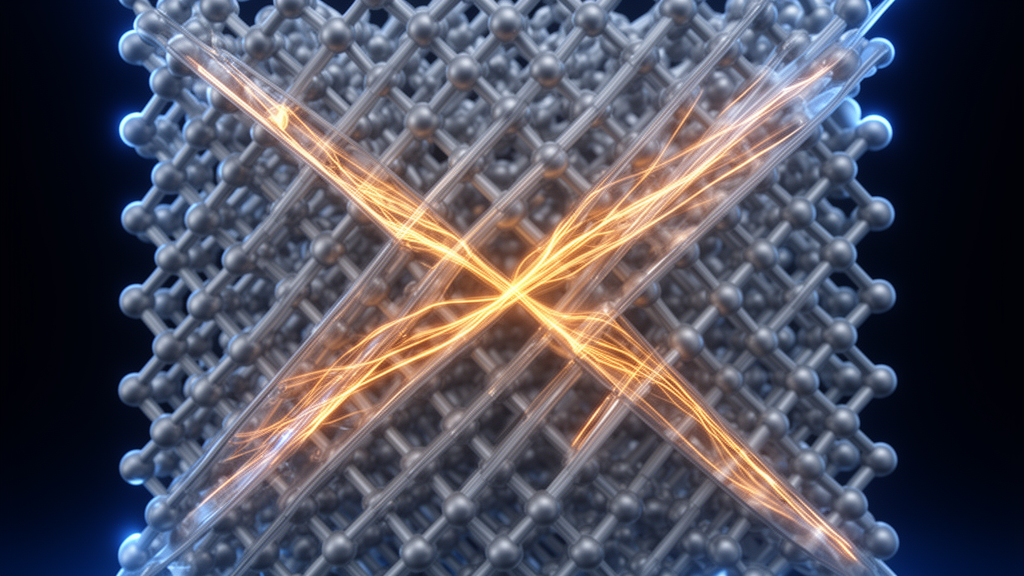
Using in-situ straining transmission electron microscopy, a team observed that intersections between stacking faults formed on different {111} crystal planes strongly impede the glide of Shockley partial dislocations, driving dislocation pile-up and localized strain concentration. Their observations, published in Applied Microscopy, also captured rare, transient cross-slip events in which piled-up partial dislocations briefly recombine into a screw-type perfect dislocation, slip onto a secondary {111} plane, and then dissociate again into partials. The work offers direct mechanistic insight into how low stacking-fault energy austenitic steels achieve their exceptional strain hardening.
High-manganese austenitic steels have long attracted attention because they combine high strength with remarkable ductility, a pairing that stems from their ability to maintain a high strain-hardening rate during plastic deformation. In these alloys, the stacking-fault energy of the austenite phase governs much of the deformation behavior: it controls how readily perfect dislocations split into partials, how extensively stacking faults form, and whether strain-induced ε-martensitic transformation occurs. When the stacking-fault energy is low, plastic deformation is accommodated primarily by Shockley partial dislocations, which trail planar stacking faults behind them as they glide across {111} planes. As strain accumulates, interactions among these faults can create continuous fault sequences that serve as precursors for ε-martensite.
Despite decades of study, the dynamic interplay between stacking faults formed on different {111} planes and the mobility of partial dislocations has remained poorly resolved. Most previous investigations relied on post-mortem microstructural characterization, examining specimens only after deformation was complete. Such static snapshots cannot establish whether dislocations were actually arrested at stacking-fault intersections during deformation, nor can they reveal the conditions under which partial dislocations might overcome these obstacles. Direct experimental evidence linking stacking-fault interactions to dislocation-level strain hardening has therefore been limited, and the role of intersections as dynamic barriers had not been clearly established.
To close this gap, the researchers employed in-situ straining transmission electron microscopy on a high-manganese austenitic steel with a nominal composition of Fe–25Mn–0.4C (wt.%), an alloy designed to stabilize austenite at room temperature while keeping the stacking-fault energy low enough to favor stacking-fault formation and strain-induced ε-martensitic transformation. The alloy was produced by vacuum induction melting, homogenized at 1200 °C for 5 hours, hot-forged into plates, and solution-treated at 1050 °C for 1 hour followed by water quenching to suppress carbide precipitation and retain a fully austenitic microstructure. The initial microstructure was confirmed to consist predominantly of FCC austenite, with no detectable thermally induced martensite within the resolution of the analysis.
Specimen preparation was tailored to the demanding requirements of in-situ deformation inside an electron microscope. Thin foils were produced by mechanical grinding followed by twin-jet electrochemical polishing, and elongated strip-type specimens of roughly 3 mm by 12 mm were punched from the polished foils using a custom method adapted from earlier in-situ TEM studies of high-Mn steels. The punched samples were electropolished in a perchloric acid–methanol (9:1) solution at −20 °C to create electron-transparent regions. Deformation was applied with a dedicated Gatan straining holder under displacement-controlled, quasi-static loading, with the estimated strain rate on the order of 10⁻⁴ to 10⁻³ s⁻¹, within the typical range for in-situ TEM deformation experiments. Imaging was performed at 200 kV, primarily in bright-field mode to visualize dislocation activity with high temporal resolution, and observations focused on grains oriented near low-index zone axes so that stacking faults on different {111} planes and their intersections could be clearly identified.
The real-time recordings showed that plastic deformation in the alloy is governed predominantly by Shockley partial dislocation activity. Immediately after yielding, numerous dislocation segments nucleated and propagated over extended distances, and Burgers vector analysis confirmed that they were 1/6⟨112⟩ Shockley partials rather than perfect dislocations. Each moving partial left behind a planar defect consistent with a stacking fault, indicating that plastic strain was primarily accommodated through stacking-fault formation. This dominance of partial dislocations is consistent with the alloy’s low stacking-fault energy of approximately 20 mJ·m⁻², which promotes wide dissociation of perfect dislocations into leading and trailing partials. In contrast to moderate- or high-SFE FCC alloys, where the trailing partial readily follows the leading partial and restores perfect stacking, the in-situ observations showed that trailing partial motion was frequently suppressed, allowing stacking faults to remain stable and accumulate progressively with increasing strain.
As deformation proceeded, stacking faults formed on multiple {111} planes within individual grains, and the activation of multiple slip variants produced a three-dimensional network of intersecting faults. The average grain size of the alloy was about 15 μm, and the authors note that grain boundaries in low-SFE austenitic alloys are known to serve as important sources for the emission of Shockley partial dislocations, so the observed fault formation was considered to be influenced at least in part by grain-boundary-mediated nucleation. Grain size may also affect the frequency of dislocation–stacking-fault interactions by controlling the mean free path of dislocations, thereby contributing to the development of localized deformation structures and strain-hardening behavior.
The central observation of the study came during continued straining, when partial dislocations gliding on one {111} plane were frequently seen to decelerate or become arrested upon encountering a stacking fault formed on a different {111} plane. Because the process was captured in real time, the researchers describe the causal relationship as unequivocal: obstruction occurred precisely at the geometric intersection between stacking faults. These interactions took place entirely within grain interiors and evolved dynamically during deformation, ruling out conventional obstacles such as precipitates or grain boundaries. The blocking behavior is consistent with the established understanding that Shockley partial dislocations are crystallographically confined to their original {111} planes and have intrinsically limited cross-slip capability in low-SFE alloys, since cross-slip requires recombination of leading and trailing partials into a perfect dislocation followed by redissociation on another {111} plane, a process that is energetically unfavorable under typical conditions.
Complementary low-angle annular dark-field scanning transmission electron microscopy, acquired with an annular detector using a typical inner collection angle of about 20–30 mrad, provided additional support. In LAADF mode, image intensity is sensitive to strain-induced diffuse scattering, so regions with greater lattice distortion appear brighter. The pronounced intensity enhancement observed at stacking-fault intersections indicated significant local strain accumulation, which further increases the energetic barrier for dislocation transmission across the intersection. As the density of stacking faults increased with deformation, the number of intersection sites rose correspondingly, meaning these obstacles continuously emerge during plastic flow. The resulting accumulation of partial dislocations at these sites enhances local stress concentration and, the authors argue, contributes substantially to the high work-hardening capability characteristic of low-SFE austenitic steels, though they caution that no direct macroscopic stress–strain data were available from the in-situ experiments themselves.
Yet the intersections proved not to be strictly impenetrable. In a limited number of cases, captured in frame-by-frame analysis, localized and transient cross-slip events occurred at intersection sites only after pronounced pile-up of partial dislocations. The resulting stress concentration locally reduced the separation distance between leading and trailing partials, facilitating their temporary recombination into a perfect dislocation segment that remained pinned at the intersection as a fixed anchoring point. According to the Thomson tetrahedron construction, recombination of two Shockley partials on a given {111} slip system produces a perfect dislocation with a ⟨110⟩ Burgers vector, and at the observed intersection geometry the line direction of the recombined segment coincided with this direction. The recombined dislocation therefore inherently assumed screw character, with its line vector parallel to its Burgers vector, making cross-slip onto a secondary {111} variant crystallographically permissible. Once transferred, the perfect segment redissociated into leading and trailing Shockley partials due to the low stacking-fault energy, resuming glide on the secondary variant and leaving a stacking fault on that plane. The full sequence runs: partial blocking, stress accumulation, recombination into a screw-type perfect dislocation, cross-slip, and redissociation on the secondary plane.
The authors emphasize that these cross-slip events are spatially limited and transient, and do not negate the overall hardening effect; instead, they provide a localized stress-relief pathway within an otherwise strongly hardened microstructure. Stacking-fault intersections thus exhibit a dual but asymmetric mechanical function, primarily serving as strengthening barriers while secondarily enabling stress-activated dislocation reconfiguration when a critical local stress threshold is exceeded. The researchers also note important limitations: the observations were obtained from thin TEM specimens, where free-surface effects, image forces, surface relaxation, and reduced dimensional constraint may influence dislocation behavior and the apparent strength of obstacles, so caution is required when extrapolating to bulk deformation, although the fundamental interaction mechanisms are expected to remain qualitatively relevant. The role of interstitial carbon, known to affect stacking-fault stability and dislocation mobility, was not directly assessed and is flagged for future systematic study.
Subject of Research: In-situ TEM study of stacking-fault intersection effects on partial dislocation motion and strain hardening in high-Mn austenitic steel
Article Title: In-situ TEM observation of stacking-fault intersection–controlled partial dislocation dynamics in high-Mn austenitic steel
Article References: Kim, S.-D. (2026). In-situ TEM observation of stacking-fault intersection–controlled partial dislocation dynamics in high-Mn austenitic steel. Applied Microscopy, 56(1), Article 12. https://doi.org/10.1186/s42649-026-00135-9
Image Credits: AI Generated
DOI: 10.1186/s42649-026-00135-9
Keywords: in-situ TEM, stacking faults, partial dislocations, high-Mn austenitic steel, cross-slip, strain hardening, stacking-fault energy, LAADF-STEM, dislocation pile-up, Shockley partials, {111} slip planes, Fe-25Mn-0.4C
News Source: Denise Maddox. (October 29, 2026). Real-Time TEM Reveals Stacking-Fault Intersections Blocking and Redirecting Dislocations in High-Mn Steel. Scienmag.