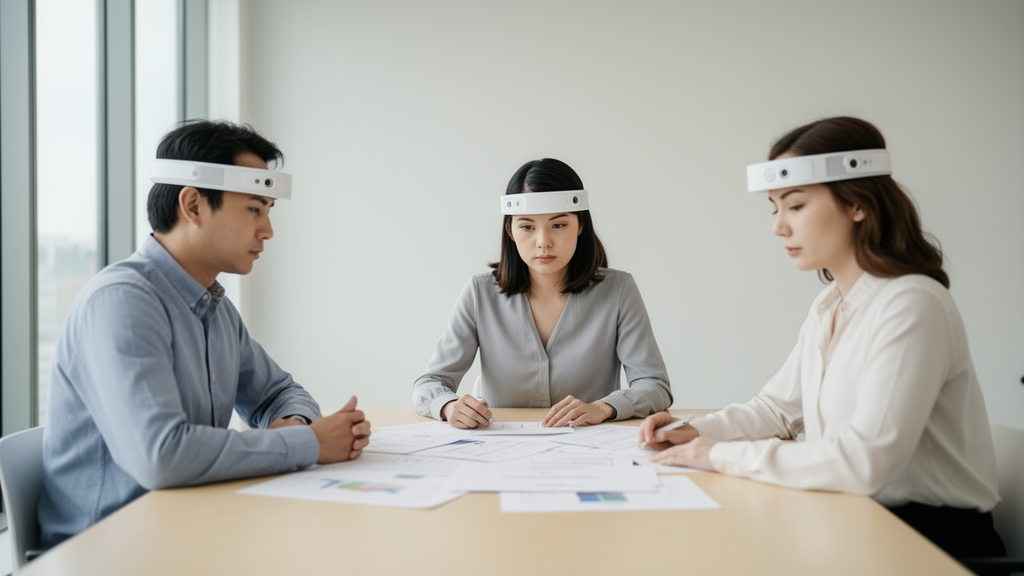
When a surgical team works through a crisis, when firefighters navigate a burning building, or when pilots respond to an emergency in the cockpit, their success depends on something invisible: a shared understanding of what is happening, what is about to happen, and what each teammate needs. Scientists call this team situation awareness, and for decades it has been measured in ways that are clumsy at best. Teams fill out questionnaires after the fact, relying on memories that fade and distort within minutes. Or researchers freeze the task to quiz participants, a technique that may alter the very awareness it is meant to assess. Now, a systematic review published in Frontiers in Neuroergonomics has mapped out how wearable sensors, speech analysis, and brain imaging could finally allow researchers to monitor team awareness continuously, objectively, and without interrupting the work itself.
The review, conducted by Emanuela Zhecheva of Radboud University and TNO Netherlands Organisation for Applied Scientific Research, together with Eric Groen, Pim Haselager, and Anne-Marie Brouwer, tackled a deceptively hard problem. Team situation awareness is an umbrella concept, too broad and abstract to be captured by any single sensor reading. To make it tractable, the researchers adapted a theoretical framework originally proposed by Paul Salmon and colleagues, breaking team awareness down into two underlying processes that might be measurable with unobtrusive technology: shared mental models and team coordination. A shared mental model is the common knowledge structure a team holds about its goals, expectations, and how the task should unfold. Team coordination is the joint effort to align actions toward that common goal. The two are deeply intertwined: shared knowledge makes coordination smoother, and successful coordination strengthens shared understanding.
With this framework in hand, the team searched the Web of Science database for peer-reviewed studies published between 2000 and 2025 that linked behavioral or physiological measurements to these two processes. After screening thousands of records following the PRISMA protocol for systematic reviews, they retained 19 studies on shared mental models and 33 on team coordination. The studies spanned a remarkable range of settings: laboratory cognitive tasks such as gaming, programming, and creative design; controlled physical tasks like piano duets and juggling; and real-world environments including surgery, basketball, and firefighter training. Both co-located teams working in the same room and physically distributed teams collaborating across locations were represented.
The measurement technologies themselves fell into two broad families. On the behavioral side, researchers analyzed verbal communication, tracked eye movements with eye-tracking devices, and recorded bodily behavior such as head movements and facial expressions. On the physiological side, they recorded heart rate and heart rate variability, brain activity through electroencephalography (EEG) and functional near-infrared spectroscopy (fNIRS), breathing patterns, and electrodermal activity, which reflects the activity of the sympathetic nervous system and rises with stress and arousal. Cardiac measures appeared in 42 percent of the shared mental model studies and verbal communication in 47 percent, making these the most popular tools for that construct. For team coordination, fNIRS featured in 27 percent of studies and cardiac measures in 30 percent.
One concept dominated the coordination literature: interpersonal synchrony, the temporal alignment and interdependence of physiological or behavioral activity between teammates. It appeared in 70 percent of the coordination studies. When teammates’ heart rates rise and fall together, when their breathing rates converge, or when their brains show correlated activity in regions supporting attention and social processing, researchers interpret this as a signature of shared mental states and coordinated effort. During real-time cardiac surgery, for example, one study found synchronized negative peaks in heart rate variability between team members during the most demanding phases, which the authors linked to shared mental models and coordinated action. Another study of medical simulation training found higher heart rate variability synchrony in teams with stronger coordination, suggesting that well-coordinated teams maintain synchronized levels of calmness under pressure.
The verbal communication findings were equally revealing, though nuanced. Teams with strong shared mental models tended to exchange more knowledge, offer more acknowledgment statements like confirming or appreciating a teammate’s contribution, and produce fewer task-irrelevant statements. They also showed a distinctive communication strategy: rather than asking teammates for information, they pushed unsolicited information, anticipating what others needed to know before being asked. Communication patterns mattered too. In studies of online gaming and doubles tennis, action-oriented statements were followed by further action-oriented statements in teams with strong shared models, revealing structured, predictable exchanges. Yet some measures were inconsistent across studies. Overall speaking frequency decreased with stronger shared mental models in several studies but increased in others, particularly among distributed teams where verbal communication becomes indispensable for maintaining shared understanding across physical distance.
Brain imaging added another layer of insight. EEG studies found increased frontal theta power, a brain rhythm associated with attention and workload, in teams developing stronger shared models. The fNIRS studies, which track oxygenated hemoglobin as a proxy for neural activity, formed the largest category of coordination measures. Synchrony appeared most often in frontal regions supporting executive control and goal maintenance, and in social brain areas such as the temporoparietal junction, which is involved in inferring others’ intentions. Intriguingly, some of the strongest coordination signatures were asymmetrical: activity in one teammate’s dorsolateral prefrontal cortex synchronized with activity in another teammate’s posterior superior temporal gyrus, a pattern the researchers interpreted as one member formulating strategies while the other inferred them. In leader-follower structures, this unidirectional information flow contrasted with the symmetrical synchrony seen in decentralized teams.
Perhaps the most striking conclusion of the review is a negative one: neither shared mental models nor team coordination can be measured as single, unified constructs with one unobtrusive measure. The same signal can mean different things in different contexts. Heart rate synchrony, for instance, was positively associated with coordination in some studies, negatively in others, and absent in low-arousal tasks where heart rates never rose enough to be informative. The authors argue that interpretation depends on the task phase, the challenge level, and the specific demands of the moment. Their proposed solution is to begin every measurement effort with a systematic task analysis, identifying exactly when and how team awareness processes should manifest in a given task, and only then selecting the measures that can detect them. They also highlight a surprisingly neglected category: task-related behavioral actions such as key presses and interface interactions, which no included study used as a primary indicator despite their obvious potential.
The practical implications could be far-reaching. A continuous, automatic, unobtrusive measure of team awareness could transform team training in aviation, medicine, defense, and emergency response, allowing instructors to see in real time when a team’s shared understanding is fraying and intervene before errors occur. Biofeedback based on physiological synchrony might even help teams become aware of their own coordination dynamics. The path forward, the authors caution, requires validating these measures against established techniques such as the Situation Awareness Global Assessment Technique, and embracing multimodal approaches that combine complementary signals. But the direction is clear: the invisible glue that holds high-performing teams together may soon become visible, one heartbeat, one word, and one glance at a time.
Subject of Research: Unobtrusive behavioral and physiological measurement of shared mental models and team coordination underlying team situation awareness
Article Title: Review on unobtrusive estimation of team processes underlying team situation awareness: shared mental models and team coordination
Article References: Zhecheva, E., Groen, E., Haselager, P., & Brouwer, A.-M. (2026). Review on unobtrusive estimation of team processes underlying team situation awareness: shared mental models and team coordination. Frontiers in Neuroergonomics, 7, Article 1864518. https://doi.org/10.3389/fnrgo.2026.1864518
Image Credits: AI Generated
DOI: 10.3389/fnrgo.2026.1864518
Keywords: team situation awareness, shared mental models, team coordination, interpersonal synchrony, heart rate variability, fNIRS, EEG, eye-tracking, verbal communication, neuroergonomics, wearable sensors, systematic review
News Source: Glenn Wilkins. (October 15, 2026). Reading Minds Together: Wearables Offer a New Window Into Team Awareness. Scienmag.