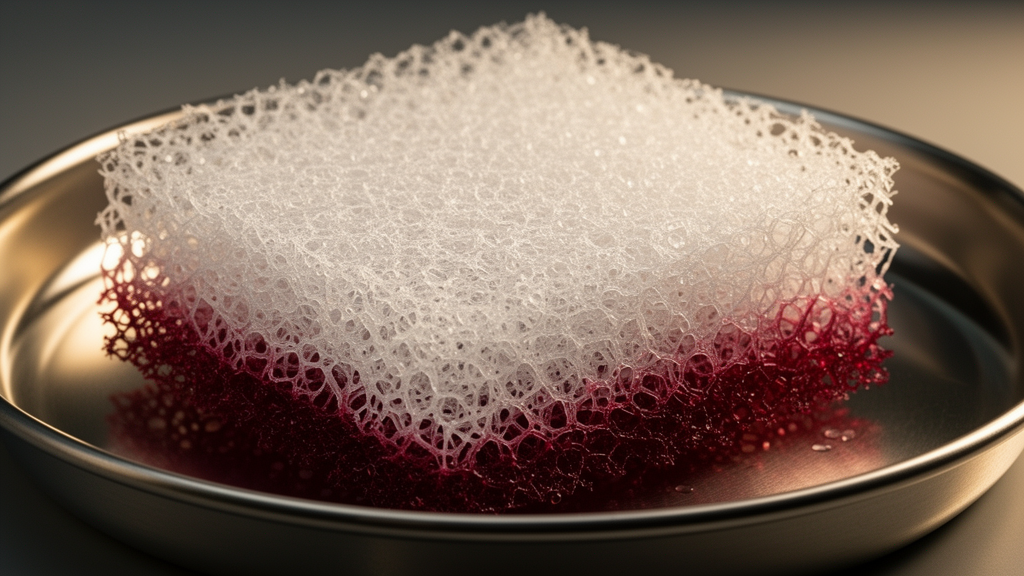
Porous chitosan materials provide significant biomedical potential, yet conventional aqueous fabrication approaches remain constrained by low chitosan content, complex chemical modification procedures, and energy-intensive drying methods. To overcome these long-standing processing obstacles, investigators report a reactive deep eutectic solvent strategy designed to synthesize ureido-modified chitosan foam. This chemical manufacturing approach establishes a simplified and scalable preparation route for fabricating high-performance hemostatic biomaterials without encountering the standard constraints that hinder traditional aqueous techniques.
In the reported procedure, protonated chitosan at twenty weight percent is dispersed inside a deep eutectic solvent consisting of choline chloride and urea mixed at a one-to-two molar ratio. The solvent formulation also contains dodecyl trimethyl ammonium chloride, serving as a surfactant at a molar ratio of zero-point-four relative to choline chloride. To initiate structure formation, the blended mixture is foamed through high-shear dispersing and subsequently heated in an oven at one hundred and five degrees Celsius.
During the oven heating process, urea molecules react to graft ureido groups onto the chitosan polymer chains through a transamidation reaction mechanism. Within this pathway, protonated amino groups located on the chitosan chains operate directly as internal proton donors that enable the chemical reaction to proceed. These newly grafted ureido functional groups rebuild the hydrogen-bond network to establish the foam skeleton, while the air bubbles stabilized by dodecyl trimethyl ammonium chloride generate the porous internal structure.
Following the completion of the heating stage, researchers remove the residual deep eutectic solvent components from the prepared material through ethanol washing. Once the residual solvent components are washed away, the resulting ureido-modified chitosan foam is dried under ambient conditions. This sequence combines high chitosan content, oven heating, and ambient drying, bypassing the complex modifications and intensive drying steps that characterize conventional aqueous synthesis routes.
Physical testing revealed that the fabricated ureido-modified chitosan foam achieves a porosity of 88.74 percent alongside a compressive modulus of 7.3 megapascals. Furthermore, the material demonstrates ultra-fast blood absorption characteristics, absorbing a seven-microliter blood droplet within 0.021 seconds. By integrating a reactive deep eutectic solvent with ambient drying, the researchers demonstrated a scalable and simplified route toward high-performance hemostatic materials capable of rapid fluid uptake and structural stability.
Subject of Research: Scalable fabrication of hemostatic chitosan foam using reactive deep eutectic solvents
Article Title: Reactive deep eutectic solvent enabling scalable fabrication of ultra-fast hemostatic chitosan foam
Article References: Liu, Z., Ni, Y., He, H., Deng, L., Lu, J., You, X., & Wang, L. (2026). Reactive deep eutectic solvent enabling scalable fabrication of ultra-fast hemostatic chitosan foam. Advanced Composites and Hybrid Materials. https://doi.org/10.1007/s42114-026-02198-4
Image Credits: AI Generated
DOI: 10.1007/s42114-026-02198-4
Keywords: chitosan, hemostatic foam, deep eutectic solvents, choline chloride, urea, dodecyl trimethyl ammonium chloride, transamidation, ureido modification, biomaterials, blood absorption, compressive modulus, porosity, ambient drying, high-shear dispersing, hydrogen-bond network, porous biomaterials
News Source: Denise Maddox. (November 25, 2026). Reactive Deep Eutectic Solvent Yields Scalable Ultra-Fast Hemostatic Chitosan Foam. Scienmag.