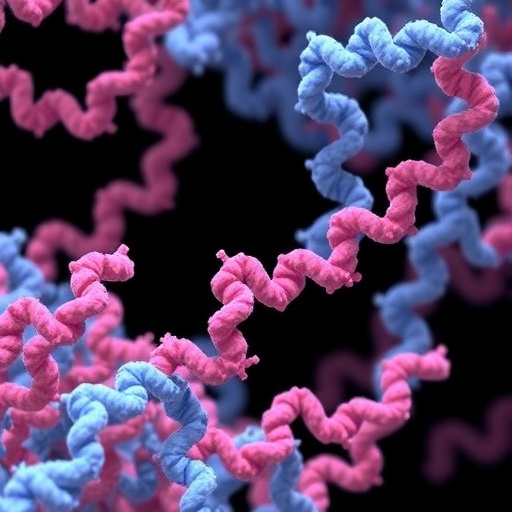
Intrinsically disordered proteins (IDRs)—segments that do not adopt a single stable 3D structure—are common across life and perform crucial cellular jobs. Yet while scientists can now design folded proteins with increasing precision, designing IDRs that reliably produce desired behaviors has remained far harder. A new study in Nature reports a computational strategy aimed at closing this gap.
The research introduces GOOSE (Generate disOrdered prOteins Specifying propErties), a framework built to rationally design IDR sequences and predict how they will behave as ensembles rather than fixed structures. Instead of treating disorder as a failure of structure, GOOSE explicitly links sequence features to the distribution of conformations that proteins sample over time in cellular contexts.
A central advance is throughput: the platform enables the generation and testing of thousands of candidate IDR sequences. By systematically varying sequence properties and analyzing the resulting structural ensembles, the team identifies sequence-to-function relationships that were previously difficult to uncover experimentally at scale.
GOOSE also supports “ensemble engineering,” where designers tune the balance of conformations so that an IDR responds to physical or environmental changes. In one set of experiments, the authors designed IDRs that react to structural shifts associated with decreased cell volume, suggesting a route to build disordered sensors that couple biophysical stress to reproducible molecular outcomes.
Beyond responsiveness, the framework can produce scaffold-like IDRs that self-assemble. These scaffolds can recruit specific clients, effectively turning an intrinsically disordered region into a programmable recruitment platform. This offers a computational path toward controlling multicomponent organization without relying on rigid tertiary architecture.
The study further demonstrates that IDRs can be designed for protective roles in harsh conditions. Using GOOSE, the authors create novel disordered sequences intended to shield cells from desiccation-related damage—an ability that disorder is known to support in nature, but that has been challenging to replicate by design.
Overall, the work reframes IDR design as a sequence-driven, ensemble-based problem that is solvable with sufficiently general computational tools. By combining rational design with large-scale sequence exploration, GOOSE turns disordered proteins into a tractable engineering target and a platform for probing how sequence encodes function in dynamic molecular systems.
The article’s DOI is https://doi.org/10.1038/s41586-026-10849-1.
Subject of Research: Rational design of intrinsically disordered proteins (IDRs)
Article Title: Rational design of disordered proteins for sequence–function investigation.
Article References: Hunter, K., Brandt, T., Guadalupe, K. et al. Rational design of disordered proteins for sequence–function investigation. Nature (2026). https://doi.org/10.1038/s41586-026-10849-1
DOI: https://doi.org/10.1038/s41586-026-10849-1
Keywords: intrinsically disordered proteins, IDR design, protein ensembles, sequence–function mapping, computational protein design, GOOSE, self-assembly, cellular volume sensing, desiccation protection
Tags: Computational protein engineeringdisorder in cellular functionsdisorder-to-function relationshipensemble-based protein designenvironment-responsive IDRsGOOSE framework for IDRshigh-throughput IDR testingIDR sequence designintrinsically disordered proteinsrational design of disordered proteinssequence-ensemble relationshipsstructure prediction for IDRs