• HOME
  • NEWS
  • EXPLORE
    • CAREER
      • Companies
      • Jobs
    • EVENTS
    • iGEM
      • News
      • Team
    • PHOTOS
    • VIDEO
    • WIKI
  • BLOG
  • COMMUNITY
    • FACEBOOK
    • INSTAGRAM
    • TWITTER
Saturday, July 11, 2026
BIOENGINEER.ORG
No Result
View All Result
  • Login
  • HOME
  • NEWS
  • EXPLORE
    • CAREER
      • Companies
      • Jobs
        • Lecturer
        • PhD Studentship
        • Postdoc
        • Research Assistant
    • EVENTS
    • iGEM
      • News
      • Team
    • PHOTOS
    • VIDEO
    • WIKI
  • BLOG
  • COMMUNITY
    • FACEBOOK
    • INSTAGRAM
    • TWITTER
  • HOME
  • NEWS
  • EXPLORE
    • CAREER
      • Companies
      • Jobs
        • Lecturer
        • PhD Studentship
        • Postdoc
        • Research Assistant
    • EVENTS
    • iGEM
      • News
      • Team
    • PHOTOS
    • VIDEO
    • WIKI
  • BLOG
  • COMMUNITY
    • FACEBOOK
    • INSTAGRAM
    • TWITTER
No Result
View All Result
Bioengineer.org
No Result
View All Result
Home NEWS Science News Chemistry

Ratiometric fluorescence sensing system provides smarter and faster screening of carbendazim residues

Bioengineer by Bioengineer
March 7, 2023
in Chemistry
Reading Time: 2 mins read
0
Ratiometric Fluorescence Sensing System Provides Smarter and Faster Screening of Carbendazim Residues
Share on FacebookShare on TwitterShare on LinkedinShare on RedditShare on Telegram

Recently, the research team led by Prof. JIANG Changlong from Institute of Solid State Physics (ISSP), Hefei Institutes of Physical Science (HFIPS) of Chinese Academy of Sciences (CAS) proposed a new sensing system for detecting carbendazim residues by utilizing ultrathin graphitic carbon nitride (g-C3N4) nanosheets and rhodamine B (RB).
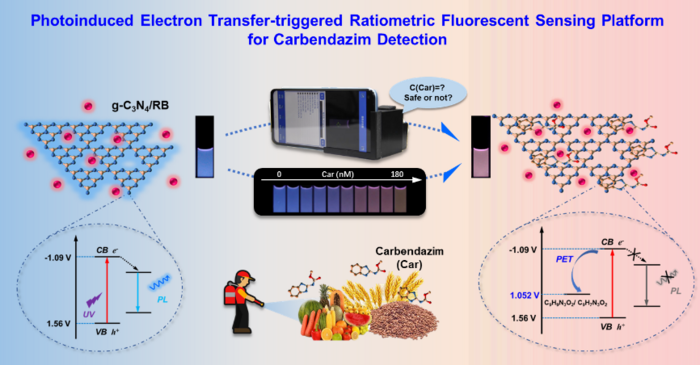
Ratiometric Fluorescence Sensing System Provides Smarter and Faster Screening of Carbendazim Residues

Credit: LIN Dan, ZHANG Qianru

Recently, the research team led by Prof. JIANG Changlong from Institute of Solid State Physics (ISSP), Hefei Institutes of Physical Science (HFIPS) of Chinese Academy of Sciences (CAS) proposed a new sensing system for detecting carbendazim residues by utilizing ultrathin graphitic carbon nitride (g-C3N4) nanosheets and rhodamine B (RB).

The research result has been published in Analytical Chemistry.

Carbendazim, as a common pesticide, belongs to the benzimidazole family, has been widely used in agricultural production. As it degrades slowly in nature, the carbendazim residues could be absorbed by respiration, skin or ingestion into the body easily. At present, the common analytical methods for carbendazim residues detection are still limited to laboratory instruments and immunoassay, etc., which usually suffer from high cost, complex operation and long time. It is important to develop a new method for carbendazim detection with high sensitivity and selectivity.

The novel photoinduced electron transfer-triggered g-C3N4\Rhodamine B sensing system developed in this study was for selective and visual quantitative detection of carbendazim residues.

Scientists found the carbendazim molecules could be enriched onto the g-C3N4 nanosheet through π-π stacking, then the blue-emitting fluorescence of g-C3N4 nanosheet could be quenched through photoinduced electron transfer, while the orange fluorescence of RB remained unchanged.

“Our sensor realized rapid visual response to trace carbendazim residues through sensitive fluorescence changes from blue to purple,” said ZHANG Qianru, first author of the paper. The detection limit (LOD) is as low as 5.89 nM, far below the maximum residue standard.

On this basis, by the aid of 3D printing technology and color recognition, the portable intelligent sensing platform designed by the research team can be successfully applied to the detection of carbendazim in actual samples, and shows good anti-interference ability.

This study not only provides an advanced sensing strategy for sensitivity and rapid carbendazim detection in the field, but also offers new insights into other trace analytes quantitative analysis.


Journal

Analytical Chemistry

Article Title

Photoinduced Electron Transfer-Triggered g-C3N4\Rhodamine B Sensing System for the Ratiometric Fluorescence Quantitation of Carbendazim

Article Publication Date

24-Feb-2023

Share12Tweet8Share2ShareShareShare2

Related Posts

Blue Light and Chemistry Simplify Complex Drug Production Steps

Blue Light and Chemistry Simplify Complex Drug Production Steps

July 10, 2026
New Discovery Promises Brighter, More Energy-Efficient Digital Displays

New Discovery Promises Brighter, More Energy-Efficient Digital Displays

July 10, 2026

New Crystalline 3D Frameworks Linked by Spiroborates Developed

July 10, 2026

IBEC Joins Major European Grant on Living Matter Physics

July 10, 2026

POPULAR NEWS

  • Detection of EDCs in Breast Milk and Infant Urine Up to Six Months Highlights Early Exposure Risks

    77 shares
    Share 31 Tweet 19
  • New Drug Candidate Developed at McMaster Shows Potential for Treating Brain Cancer

    58 shares
    Share 23 Tweet 15
  • KTU Researchers Explore Ultrasound’s Role in Enhancing Blood Flow Beyond Diagnostics

    53 shares
    Share 21 Tweet 13
  • 高齢者の骨粗鬆症治療の持続性比較

    51 shares
    Share 20 Tweet 13

About

We bring you the latest biotechnology news from best research centers and universities around the world. Check our website.

Follow us

Recent News

Ultra-fine bubbles revolutionize future of inkjet printing technology

Polyunsaturated Fatty Acid Synthesis Influences Ferroptosis Sensitivity with Low Arachidonic Acid

Real-Time Pain and Activity Patterns in Older Adults with Chronic Pain

Subscribe to Blog via Email

Success! An email was just sent to confirm your subscription. Please find the email now and click 'Confirm' to start subscribing.

Join 84 other subscribers
  • Contact Us

Bioengineer.org © Copyright 2023 All Rights Reserved.

Welcome Back!

Login to your account below

Forgotten Password?

Retrieve your password

Please enter your username or email address to reset your password.

Log In
No Result
View All Result
  • Homepages
    • Home Page 1
    • Home Page 2
  • News
  • National
  • Business
  • Health
  • Lifestyle
  • Science

Bioengineer.org © Copyright 2023 All Rights Reserved.