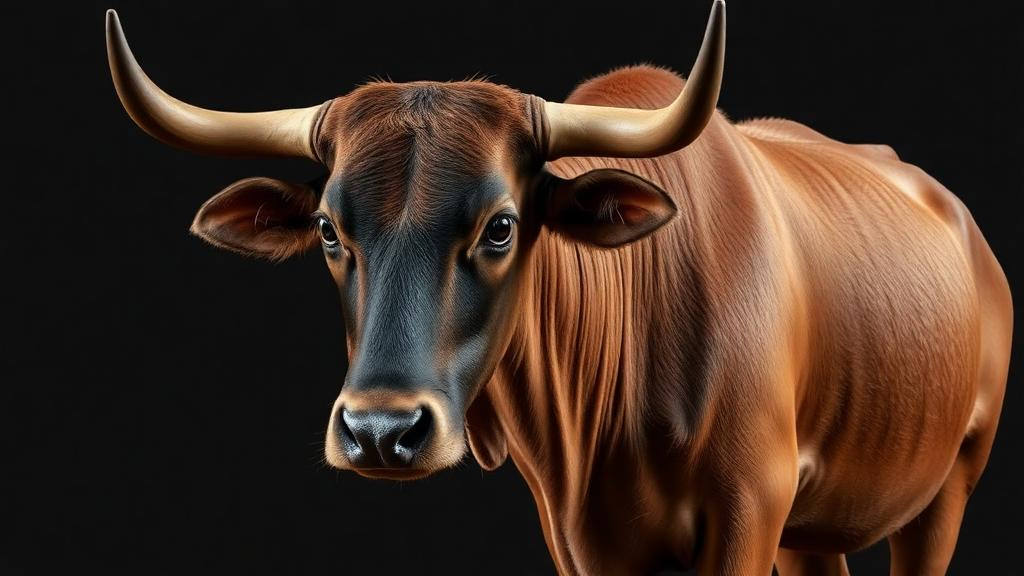
Cytogenetic screening of 46 Kangayam breeding bulls in Tamil Nadu identified one phenotypically healthy animal carrying an unusual Y chromosome with a visible short arm, or p arm. The variant was present consistently in the metaphase spreads examined from the bull and was characterized with two chromosome-banding methods. Although its shape initially resembled a sex-autosomal translocation previously described in cattle, the banding results supported a Y-chromosome polymorphism associated with heterochromatin variation rather than an exchange between the Y chromosome and an autosome.
The investigation was a cytogenetic study conducted during routine screening of Kangayam bulls before their use for semen collection. The sample comprised 14 bulls from the Buffalo Frozen Semen Station, 16 from the Kangayam Cattle Research Station and 16 field-progeny animals tested in Tamil Nadu. Chromosomes were obtained through a short-term lymphocyte culture technique in the Cytogenetics Laboratory of the Department of Animal Genetics and Breeding at Madras Veterinary College in Chennai.
More than 200 metaphase spreads were screened, and chromosome preparations from the exceptional bull were subjected to further analysis with CBG and GTG banding. Forty-five of the screened bulls had a male chromosome complement consisting of 29 pairs of acrocentric autosomes, one large submetacentric X chromosome and the smallest acrocentric Y chromosome. The exceptional bull had a broadly similar complement, but its Y chromosome was classified as subacrocentric because a small p arm was visible.
This contrasted with the typical acrocentric Y chromosome found in the other animals, in which no prominent short arm could be distinguished. The subacrocentric chromosome was unpaired, and it appeared in every spread screened from this bull, indicating a consistent feature of the sampled metaphases rather than an isolated observation in individual cells. The unusual morphology alone did not establish whether the extra arm represented a structural translocation.
A similar chromosome complement had previously been reported in Chainina cattle and interpreted as a reciprocal translocation between the Y chromosome and chromosome 9. That possibility prompted the investigators to examine the Kangayam bull with CBG banding, which stains constitutive heterochromatin, and GTG banding, which distinguishes chromosome regions through a characteristic pattern of light and dark bands. The purpose was to determine whether the visible p arm belonged to the Y chromosome itself or contained a segment derived from an autosome.
CBG analysis showed characteristically dark centromeric bands on all the acrocentric autosomes, while the X chromosome stained lightly across its length. The exceptional Y chromosome behaved differently: it stained darkly throughout most or all of its length and lacked a clearly delineated centromeric band like that seen on the autosomes. Its small extra p arm was also darkly stained, rather than showing the light appearance characteristic of the autosomes.
These observations identified the additional arm as heterochromatic material associated with the Y chromosome, not a translocated autosomal segment. The GTG-banding results provided a second basis for characterizing the chromosome. The Y chromosome retained a recognizable band pattern, but its distribution differed between the subacrocentric variant in the exceptional bull and the typical acrocentric form.
In the variant, the pattern was divided between two visible arms, designated p and q; in the acrocentric form, the bands were situated together on the q arm. All autosomes retained the typical G-banding pattern expected in cattle. The investigators therefore found no indication of a translocation between the Y chromosome and an autosome, while confirming that the visible short arm was part of the Y-chromosome structure.
The result adds a rare observation to evidence that the Y chromosome of zebu cattle can vary in morphology. Earlier work on the Sahiwal, Sindhi, Brahman, Santa Gertrudis and Belmont Red breeds found differences in the position of the centromere relative to the end of the small p arm. In some bulls, no chromatin was visible beyond the centromere; in others, the p arm was distinct.
Sahiwal bulls were also described as having a visible subtelocentric Y chromosome, although that terminology can be problematic because the definitions of acrocentric and subtelocentric belong to different chromosome-classification systems. For the small Kangayam Y chromosome, the researchers used “subacrocentric” to emphasize the visible short arm relative to the typical acrocentric form seen in other breeding sires. Chromosomal rearrangements, including centric fusions, inversions and changes in the amount of heterochromatin, have been associated with the differentiation of chromosome complements across bovid species.
The chromosome complements of Bos indicus and Bos taurus are otherwise highly similar, but the Y chromosome differs in shape: it is generally acrocentric in Bos indicus and submetacentric or metacentric in Bos taurus. Comparative cytogenetic studies have related this morphological difference to a pericentric inversion, while variation in Y-chromosome size among subspecies has been associated with differences in heterochromatin content. The banding evidence in the Kangayam bull is consistent with heterochromatin variation as the explanation for its unusual p arm.
Because the affected animal was phenotypically healthy and the investigators did not classify the chromosome complement as an abnormality, the study reports a possible chromosomal polymorphism rather than a demonstrated reproductive defect. Its scope remains limited: the variant was detected in one of 46 bulls, and the study did not establish that it affects fertility, productivity or the transmission of the chromosome to offspring. The authors state that the productive and reproductive performance of the bull and its descendants should be studied if the bull is used for breeding.
They also note the possibility of culling an animal after screening, making evaluation relevant when a bull is retained. The central finding is the identification, through CBG and GTG banding, of a stable subacrocentric Y-chromosome variant in Kangayam cattle.
Subject of Research: Cytogenetic identification of a subacrocentric Y-chromosome variant in a Kangayam bull
Article Title: A rare chromosomal polymorphism in a Kangayam bull ( Bos indicus ) of south India
Article References: Harshini, V., Kumarasamy, P., & Karthickeyan, S. M. K. (2021). A rare chromosomal polymorphism in a Kangayam bull (Bos indicus) of south India. Comparative Cytogenetics, 15(4), 459-465. https://doi.org/10.3897/compcytogen.v15.i4.71295
Image Credits: AI Generated
DOI: 10.3897/CompCytogen.v15.i4.71295
Keywords: Kangayam cattle, Bos indicus, Y chromosome, chromosome polymorphism, cytogenetics, heterochromatin, CBG banding, GTG banding, Tamil Nadu India, cattle breeding, rare, chromosomal
News Source: Juliet Wilcox. (October 20, 2026). Rare Y-chromosome polymorphism found in one Kangayam bull. Scienmag.