


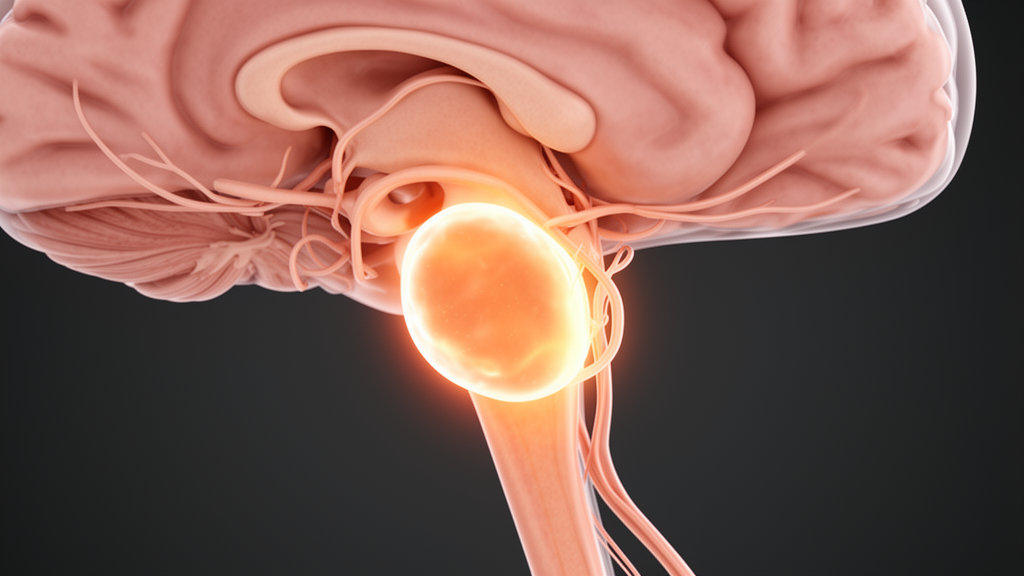
A 46-year-old man presenting with progressive dizziness and difficulty swallowing was found to have a giant ecchordosis physaliphora, a rare benign remnant of the notochord, compressing his brainstem, according to a case report published in Acta Neurochirurgica. The lesion, a 4.6-centimeter mass located in the prepontine retroclival region, is an exceptionally uncommon presentation of an entity that is usually small and asymptomatic.
Magnetic resonance imaging showed the characteristic signal profile of ecchordosis physaliphora: the lesion appeared hypointense on T1-weighted sequences and hyperintense on T2-weighted sequences. Imaging also revealed a clival stalk anchoring the mass, and the lesion showed no enhancement after gadolinium administration, a feature the authors note favors ecchordosis physaliphora over intradural chordoma but does not definitively exclude it.
Histopathological examination confirmed the diagnosis of ecchordosis physaliphora, with retained INI-1 (SMARCB1) expression and a Ki-67 proliferation index of less than 1 percent, findings consistent with its benign nature.
The authors emphasize that giant ecchordosis physaliphora represents a formidable diagnostic and surgical challenge. Because symptomatic cases producing significant neurological compromise are exceptionally uncommon, distinguishing the benign remnant from chordoma remains a critical consideration in management.
The report, published as an open-access case report with a literature review, documents this rare presentation of progressive neurological deficits from a benign congenital remnant.
Subject of Research: A giant benign notochordal remnant causing brainstem compression and progressive neurological deficits
Article Title: Giant ecchordosis physaliphora presenting with progressive neurological deficits: a case report and literature review
Article References: Almutairi, A., Ghoneim, A. H., Alturkustani, M., Khawjah, A., Alyousef, M. A., & Basamh, M. (2026). Giant ecchordosis physaliphora presenting with progressive neurological deficits: a case report and literature review. Acta Neurochirurgica. https://doi.org/10.1007/s00701-026-07057-1
Image Credits: AI Generated
DOI: 10.1007/s00701-026-07057-1
Keywords: ecchordosis physaliphora, notochordal remnant, brainstem compression, retroclival lesion, Kawase transpetrosal approach, MRI, INI-1, SMARCB1, Ki-67, chordoma differential, case report, neurosurgery
News Source: Ophelia Keating. (October 30, 2026). Rare Giant Notochordal Remnant Compresses Brainstem in 46-Year-Old Man. Scienmag.



