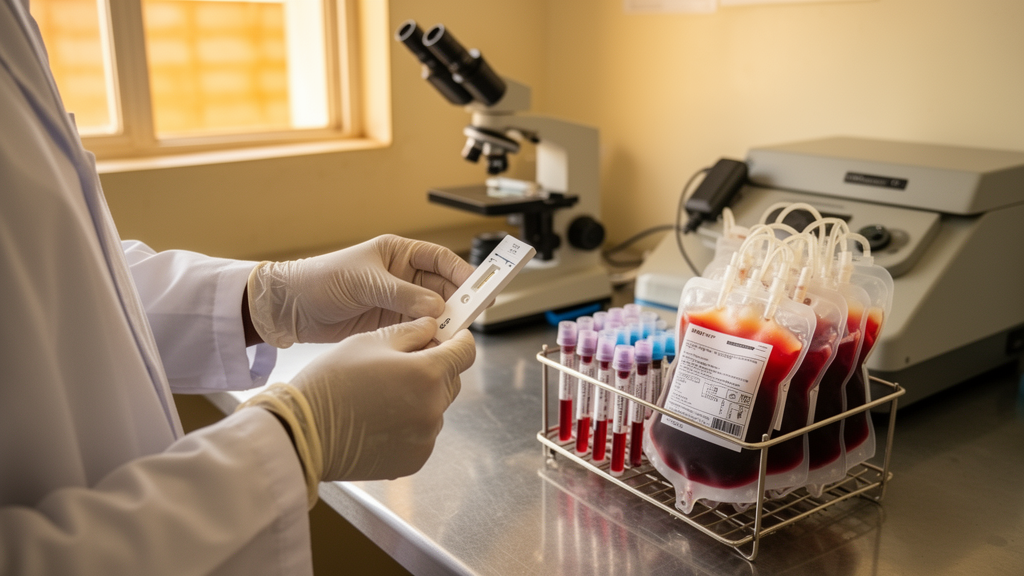
Every unit of blood transfused in Mozambique passes through a screening pipeline that relies almost entirely on rapid antibody tests, a strategy that has long been considered adequate for settings where laboratory infrastructure is scarce. A new study published in PLOS Global Public Health now offers a rigorous, quantitative assessment of just how well that pipeline performs, and its findings carry uncomfortable implications for transfusion safety across much of sub-Saharan Africa. Led by Nédio Mabunda and colleagues, including researchers from Mozambique’s National Institute of Health, the evaluation compared the routine rapid testing algorithm used at Mozambican blood banks with newer rapid assays, a laboratory-based enzyme immunoassay, and a molecular nucleic acid test capable of detecting the virus itself rather than the immune response to it.
The stakes of this comparison are straightforward. HIV is transmissible through transfused blood with exceptionally high efficiency, far higher than through most other routes of exposure, because a transfusion delivers infected blood directly into a recipient’s circulation. A single unscreened or inadequately screened donation can therefore establish infection in a recipient with near certainty. This is why wealthy countries long ago adopted multi-layered screening that combines antibody and antigen detection with molecular testing of pooled samples. In many low- and middle-income countries, however, the cost and technical demands of molecular platforms have kept rapid serological tests at the center of blood safety programs, and Mozambique has been no exception.
The routine algorithm evaluated in the study pairs two rapid tests: the Determine HIV 1/2 assay, which detects antibodies to HIV-1 and HIV-2, followed by the Uni-Gold HIV test as a confirmatory or tie-breaking step. This combination is the standard approach for screening blood donor candidates in Mozambique. The researchers also examined two newer rapid tests, the Determine HIV Early Detect assay and the Meriscreen HIV1-2 Western Blot test, both of which are designed to shorten the window period by adding detection of the p24 viral antigen to antibody detection. As a laboratory-based comparator, the team used the Merilisa HIV Gen 4 enzyme-linked immunosorbent assay combined with Uni-Gold, and as a molecular reference they used the cobas MPX test, a nucleic acid amplification platform that detects viral RNA and can identify infection during the earliest phase before antibodies appear.
When the rapid algorithms were benchmarked against the Merilisa HIV Gen 4 enzyme immunoassay plus Uni-Gold, their performance looked reasonably strong on the surface. The routine Determine HIV 1/2 plus Uni-Gold combination achieved a sensitivity of 85.5 percent and a specificity of 99.6 percent. The Determine HIV Early Detect test reached 88.7 percent sensitivity with 99.5 percent specificity, while the Meriscreen HIV1-2 Western Blot assay performed best among the rapid options at 90.0 percent sensitivity and 99.6 percent specificity. In other words, the newer rapid assays caught a somewhat larger share of infections than the routine algorithm while maintaining the very low false-positive rates that blood banks require to avoid discarding safe donations.
The picture changed dramatically, however, when the researchers measured all of the serological approaches against the cobas MPX molecular test. Sensitivity fell steeply across the board. The routine Determine HIV 1/2 plus Uni-Gold algorithm detected only 64.0 percent of the infections identified by the molecular assay, with 99.1 percent specificity. Determine HIV Early Detect rose to 68.6 percent sensitivity at 99.1 percent specificity, and Meriscreen HIV1-2 Western Blot reached 70.8 percent sensitivity at 99.0 percent specificity. Even the laboratory-based Merilisa HIV Gen 4 plus Uni-Gold combination, which one might expect to approach molecular performance, detected just 66.0 percent of molecularly positive samples at 99.4 percent specificity. These figures mean that a substantial fraction of donations carrying HIV, roughly a third by these comparisons, would pass through serological screening undetected.
The clinical translation of those percentages is sobering. The researchers calculated that the probability of an undetected positive result ranged from 5.6 to 6.7 per 1,000 blood donors across the rapid tests and the Merilisa HIV Gen 4 assay. In a country where tens of thousands of donations are collected annually, that residual risk translates into a meaningful number of potentially infectious units entering the blood supply each year. The source of the discrepancy lies in the biology of HIV infection. Serological tests depend on the host immune response, and there is an unavoidable window period between infection and the appearance of detectable antibodies or antigen. During that window, viral RNA circulates at high levels and the donor is highly infectious, yet antibody-based assays return negative results. Molecular tests close much of that gap by directly detecting viral genetic material.
The study’s design deserves attention because it goes beyond a simple head-to-head comparison of commercial kits. By establishing a molecular reference standard and evaluating multiple testing strategies against it, the team was able to quantify not only relative sensitivity and specificity but also the practical consequence of relying on serology alone: an estimated residual transmission risk per thousand donors. This kind of risk estimate is the currency in which blood safety policy is debated, because it allows program managers to weigh the cost of adding nucleic acid testing against the expected number of transfusion-transmitted infections prevented. The authors argue that their results point directly to the need for molecular HIV testing in blood banks in developing countries as a way to improve transfusion safety and contribute to controlling HIV as a public health problem.
That recommendation is not without challenges. Nucleic acid amplification testing requires sophisticated laboratory infrastructure, trained personnel, cold-chain logistics, reliable electricity, and quality management systems, and it is considerably more expensive per sample than rapid testing. Many programs address the cost by testing donations in minipools, in which multiple samples are combined and screened together, with individual follow-up testing only when a pool is reactive. The cobas MPX platform used as the molecular comparator in this study is precisely the kind of multiplex nucleic acid test that supports such pooled screening strategies, and it can simultaneously detect HIV, hepatitis B virus, and hepatitis C virus, extending the safety benefit beyond HIV alone. Whether such platforms can be sustainably deployed in Mozambique and similar settings will depend on financing, laboratory capacity, and political commitment to blood safety as an integral component of HIV control.
The findings also carry implications for how rapid tests are selected and deployed in the interim. The newer assays that incorporate antigen detection, Determine HIV Early Detect and Meriscreen HIV1-2 Western Blot, outperformed the routine antibody-only algorithm in both comparisons, suggesting that upgrading the rapid testing algorithm could deliver incremental gains while molecular capacity is being built. The differences were modest, however, and the study makes clear that no serological strategy, whether rapid or laboratory-based, can match the sensitivity of direct viral detection during early infection. Specificity remained uniformly high across all tests, above 99 percent in every comparison, which means the problem is not false alarms but silent misses, the most dangerous failure mode in a transfusion setting.
Ultimately, the study provides the kind of local, context-specific evidence that global guidelines often lack. International recommendations on blood screening assume a level of diagnostic capacity that many national programs cannot yet deliver, and country-level performance data are essential for making the economic and public health case for investment. By quantifying the residual risk of HIV transmission through transfusion under the current Mozambican screening algorithm, Mabunda and colleagues have converted an abstract concern into a concrete number that policymakers can act on. As the authors conclude, introducing molecular testing into blood banks in developing countries would improve transfusion safety and strengthen the broader effort to bring HIV under control, a goal that depends on closing every remaining route of transmission, including the one that runs through the blood supply.
Subject of Research: Analytical performance of HIV serological screening tests for blood donor candidates in Mozambique
Article Title: High transmission risk of Human Immunodeficiency Virus in blood transfusions: A critical evaluation of blood bank serological tests in Mozambique
Article References: High transmission risk of Human Immunodeficiency Virus in blood transfusions: A critical evaluation of blood bank serological tests in Mozambique. (n.d.). https://doi.org/10.1371/journal.pgph.0007398
Image Credits: AI Generated
DOI: 10.1371/journal.pgph.0007398
Keywords: HIV, blood transfusion, blood banks, serological tests, rapid diagnostic tests, ELISA, molecular testing, Mozambique, transfusion safety, sub-Saharan Africa, screening, public health
News Source: Ophelia Keating. (October 9, 2026). Rapid HIV Blood Bank Tests in Mozambique Miss a Concerning Share of Infected Donations. Scienmag.