There is a growing demand for portable gas sensors, from both environmental and health sciences as well as industry. Resonant optical sensors, in particular planar micro-resonators, combine high sensitivity and small footprint, which makes them good candidates for these applications. The sensing principle of these guided-wave sensors is based on a variation in their spectral response in the presence of the target molecules. The laser source to be used for probing such spectral shifts should emit a single-mode and polarization-stable beam and should be spectrally tunable over at least a few nanometers.
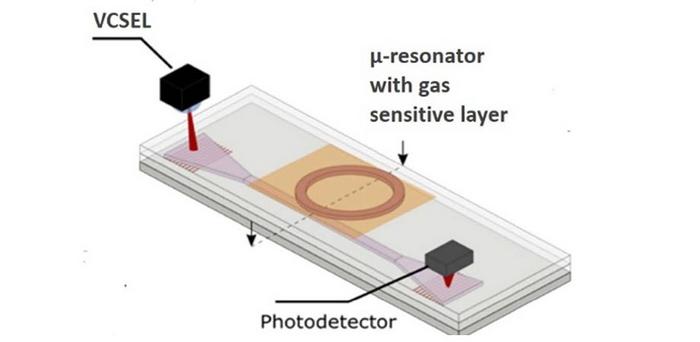
Credit: The authors, doi: 10.1117/1.JOM.3.3.033501.
There is a growing demand for portable gas sensors, from both environmental and health sciences as well as industry. Resonant optical sensors, in particular planar micro-resonators, combine high sensitivity and small footprint, which makes them good candidates for these applications. The sensing principle of these guided-wave sensors is based on a variation in their spectral response in the presence of the target molecules. The laser source to be used for probing such spectral shifts should emit a single-mode and polarization-stable beam and should be spectrally tunable over at least a few nanometers.
A team of researchers based at the University of Toulouse in France aimed at fabricating such a compact optical microsystem for ammonia gas detection using a near infra-red single-mode laser diode source, namely a vertical cavity surface emitting laser, or VCSEL. This kind of semiconductor laser diode is very compact and can be spectrally tuned over few nanometers by simply adjusting the operating current. Moreover, the specific VCSEL chip used in their work includes a grating relief etched at its surface that ensures a good polarization stability of the emitted beam. However, although it is smaller than for a LED or for a standard edge-emitting laser diode, the beam divergence of this VCSEL chip is too large for most practical uses in optical microsystems. In this research, the spot size at the aimed working distance (2 mm) is indeed larger than 250µm. It should be reduced to less than 100µm to ensure an optimal coupling with the detection area. Polarization-stable single-mode VCSEL chips having a reduced divergence are unfortunately not yet commercially available. The challenge lies therefore in finding an accurate method to directly integrate a collimation microlens on a small-sized VCSEL chip (200x200x150 µm3) that is already mounted on a printed circuit board.
In this work, published in the Journal of Optical Microsystems, the researchers demonstrate that 2-photon-polymerization 3D printing can be exploited to fabricate such a microlens in a single step and with a writing time of only 5 minutes. To this aim, they optimized the lens design and fabrication conditions to obtain a sufficient surface quality as well as a suitable focal length. The beam divergence of the laser chip could be reduced from 14.4° to 3°, corresponding to a beam spot size at a distance of 2 mm of only 55µm. They also studied experimentally and theoretically the effects of lens addition on the device spectral properties and proposed a new design to avoid a reduction of the tuning range.
The team’s work demonstrates the interest of 2-photon-polymerization 3D-printing as a fast and accurate technique for VCSEL collimation at a post-mounting stage and paves the way toward the development of optimized laser chips directly integrable in portable optical sensing systems.
Read the Gold Open Access paper by Li et al. “Direct 3D-printing of microlens on single mode polarization-stable VCSEL chip for miniaturized optical spectroscopy,” J. Opt. Microsystems 3(3) 033501 (2023). DOI: 10.1117/1.JOM.3.3.033501.
Journal
Journal of Optical Microsystems
DOI
10.1117/1.JOM.3.3.033501
Article Title
Direct 3D-printing of microlens on single mode polarization-stable VCSEL chip for miniaturized optical spectroscopy
Article Publication Date
13-Jul-2023