Using smart technology to monitor the health, reproductivity, location, and environmental conditions of cattle can help with food safety and supply chain efficiency, but this monitoring adds energy cost to an already highly emissive industry. To combat this, researchers publishing in the journal iScience on December 1 have designed a wearable smart device for cows that captures the kinetic energy created by even their smallest movements and uses it to power smart ranch technology.
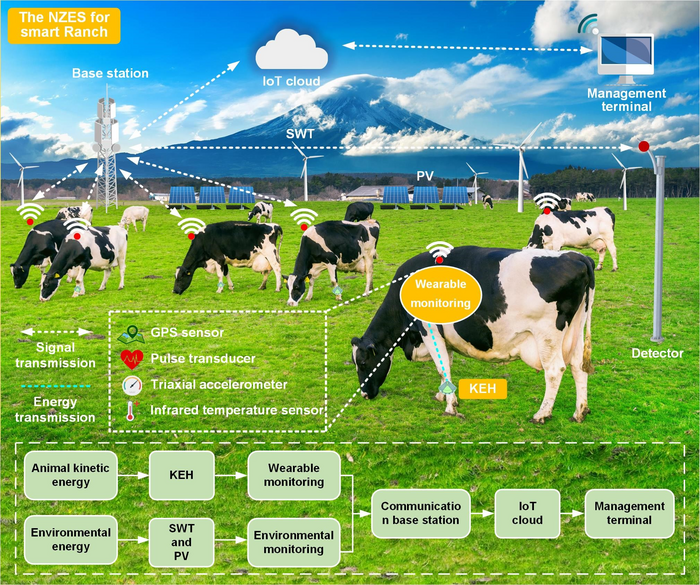
Credit: Kong et al. – iScience
Using smart technology to monitor the health, reproductivity, location, and environmental conditions of cattle can help with food safety and supply chain efficiency, but this monitoring adds energy cost to an already highly emissive industry. To combat this, researchers publishing in the journal iScience on December 1 have designed a wearable smart device for cows that captures the kinetic energy created by even their smallest movements and uses it to power smart ranch technology.
“On a ranch, monitoring environmental and health information of cattle can help prevent diseases and improve the efficiency of pasture breeding and management,” says co-author Zutao Zhang, an energy researcher at Southwest Jiaotong University in China. “This information can include oxygen concentration, air temperature and humidity, amount of exercise, reproductive cycles, disease, and milk production.”
The team’s smart ranch design involves cows wearing small sensory devices around their ankles and necks that are powered by everything cows do as they go about their regular ranch activities. “There is a tremendous amount of kinetic energy that can be harvested in cattle’s daily movements, such as walking, running, and even neck movement,” says co-author Yajia Pan, also an energy researcher at Southwest Jiaotong University. Once captured, the energy is stored in a lithium battery and used to power the device.
“Our kinetic energy harvester specially harvests the kinetic energy of weak motion,” says Zhang. The team’s design is unique because it contains a motion enhancement mechanism that uses magnets and a pendulum to amplify small movements the cows make.
Zhang hopes that implementing smart technology in ranches will be part of a larger effort to improve the world’s food systems. “With the development of 5G technology and the Internet of Things, the operation of the entire industrial chain of the food system is more intelligent and transparent,” he says.
Zhang and his colleagues also tested the devices on humans and found that a light jog was enough to power temperature measurement in the device. The researchers see future applications in sports monitoring, healthcare, smart home, and the construction of human wireless sensor networks.
“Kinetic energy is everywhere in the environment—leaves swaying in the wind, the movement of people and animals, the undulation of waves, the rotation of the earth—these phenomena all contain a lot of kinetic energy,” says Zhang, “We shouldn’t let this energy go to waste.”
###
This work was supported by the National Natural Foundation of China, Science and Technology Projects of Sichuan, and Science and Technology Projects of Chengdu.
iScience, Kong et al., “A near-zero energy system for smart ranch.” https://www.cell.com/iscience/fulltext/S2589-0042(22)01720-5
iScience (@iScience_CP) is an open-access journal from Cell Press that provides a platform for original research and interdisciplinary thinking in the life, physical, and earth sciences. The primary criterion for publication in iScience is a significant contribution to a relevant field combined with robust results and underlying methodology. Visit: http://www.cell.com/iscience. To receive Cell Press media alerts, contact [email protected].
Journal
iScience
DOI
10.1016/j.isci.2022.105448
Method of Research
Experimental study
Subject of Research
Animals
Article Title
A near-zero energy system based on a kinetic energy harvester for smart ranch
Article Publication Date
1-Dec-2022
COI Statement
The author declares no competing interests.