• HOME
  • NEWS
  • EXPLORE
    • CAREER
      • Companies
      • Jobs
    • EVENTS
    • iGEM
      • News
      • Team
    • PHOTOS
    • VIDEO
    • WIKI
  • BLOG
  • COMMUNITY
    • FACEBOOK
    • INSTAGRAM
    • TWITTER
Saturday, May 2, 2026
BIOENGINEER.ORG
No Result
View All Result
  • Login
  • HOME
  • NEWS
  • EXPLORE
    • CAREER
      • Companies
      • Jobs
        • Lecturer
        • PhD Studentship
        • Postdoc
        • Research Assistant
    • EVENTS
    • iGEM
      • News
      • Team
    • PHOTOS
    • VIDEO
    • WIKI
  • BLOG
  • COMMUNITY
    • FACEBOOK
    • INSTAGRAM
    • TWITTER
  • HOME
  • NEWS
  • EXPLORE
    • CAREER
      • Companies
      • Jobs
        • Lecturer
        • PhD Studentship
        • Postdoc
        • Research Assistant
    • EVENTS
    • iGEM
      • News
      • Team
    • PHOTOS
    • VIDEO
    • WIKI
  • BLOG
  • COMMUNITY
    • FACEBOOK
    • INSTAGRAM
    • TWITTER
No Result
View All Result
Bioengineer.org
No Result
View All Result
Home NEWS Science News Chemistry

Radiation damage simulation software developed for defect accumulation mechanisms study in polycrystalline materials

Bioengineer by Bioengineer
May 4, 2023
in Chemistry
Reading Time: 3 mins read
0
Radiation Damage Simulation Software Developed for Defect Accumulation Mechanisms Study in Polycrystalline Materials
Share on FacebookShare on TwitterShare on LinkedinShare on RedditShare on Telegram

Recently, the research group led by Prof. LIU Changsong from Institute of Solid State Physics (ISSP), Hefei Institutes of Physical Science (HFIPS) of Chinese Academy of Sciences (CAS) developed a set of software for simulating the evolution of displacement damage in polycrystalline metals at across time and space scales, which was named object kinetic Monte Carlo-lattice kinetic Monte Carlo (OKMC-LKMC) hybridization simulation software.
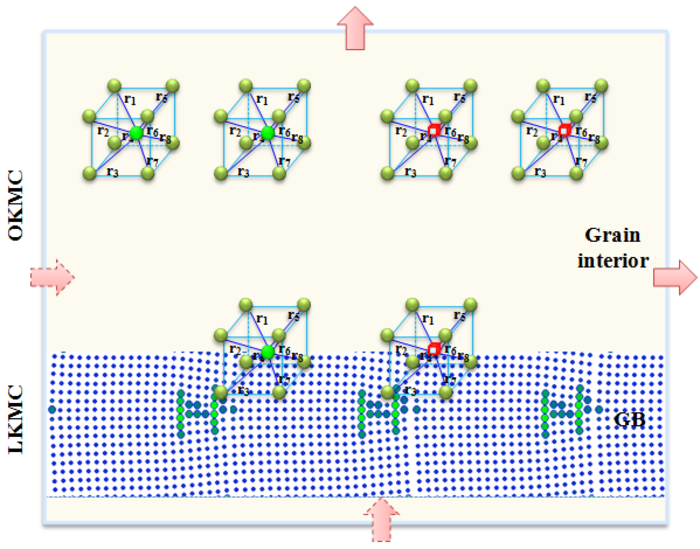
Radiation Damage Simulation Software Developed for Defect Accumulation Mechanisms Study in Polycrystalline Materials

Credit: LI Xiaolin

Recently, the research group led by Prof. LIU Changsong from Institute of Solid State Physics (ISSP), Hefei Institutes of Physical Science (HFIPS) of Chinese Academy of Sciences (CAS) developed a set of software for simulating the evolution of displacement damage in polycrystalline metals at across time and space scales, which was named object kinetic Monte Carlo-lattice kinetic Monte Carlo (OKMC-LKMC) hybridization simulation software.

Using this software, research team explored the accumulation and evolution of vacancies at iron (Fe) grain boundaries (GBs).

The results were published in Journal of Nuclear Materials.

Polycrystalline/Nanocrystalline (PC/NC) Fe was found to exhibit improved radiation resistance.In previous multiscale simulations, GBs were often abstracted as two-dimensional planes without specific structures, and a series of energetic and kinetic parameters were used to characterize the structural characteristics of GBs. However, the diversity of GB character makes GBs exhibit distinct local structures and defect properties. If these properties are simply abstracted as a single interaction parameter, a lot of atomic information related to defects would be missed, thereby affecting the accurate prediction of defect evolution on a long time scale.

The technology developed in this research can not only distinguish the spatial position dependence of defect properties at GBs, but also simulate the evolution of defects away from the GB region in a coarse-grained manner.

Researchers investigated the accumulation mechanisms of Vs at Fe GBs, mainly focused on the interaction processes of Vs with different GBs.

The results clarified the dependence of Vs accumulation on the GB character. At high temperature, the atomic processes of V emission and leakage were discovered in addition to the well-known trapping of the V by the GB. The occurrence of these processes depends on the GB character. Based on the combination of grain size, V formation energy at the GB and migration energy barrier within the GB, the coupling equation of grain size with GB character was proposed.

When this equation is satisfied, the defect emission process that originally occurred in the high energy level region is inhibited by the defect cruise along the GB. This brings about the uncertainty on the relation of the radiation performance to the defect–GB binding strength particularly in the case of a small grain size.

This work reveals new V-GB interaction processes, as well as the coupling between these processes. These results have general significance for other PC systems, which can shed light on the radiation response of PC materials, and provide a mechanism reference for experimentally optimizing the radiation resistance of materials based on GB engineering.


Journal

Journal of Nuclear Materials

Article Title

Vacancy accumulation mechanism at iron grain boundaries: The influence of grain boundary character and its coupling with grain size

Article Publication Date

14-Mar-2023

Share12Tweet8Share2ShareShareShare2

Related Posts

Using Epigenetics to Monitor Environmental Arsenic Exposure — Chemistry

Using Epigenetics to Monitor Environmental Arsenic Exposure

May 1, 2026
Innovative Nanoreactor Design Enhances Catalysis by Optimizing Transport and Reaction Kinetics — Chemistry

Innovative Nanoreactor Design Enhances Catalysis by Optimizing Transport and Reaction Kinetics

May 1, 2026

Swift Creation of Conductive Organic Compounds via Mechanochemistry

May 1, 2026

Scientists Reveal Atomic Mechanism Behind Water-Induced Hydroxylation in CoOx Nanostructures

May 1, 2026

POPULAR NEWS

  • Research Indicates Potential Connection Between Prenatal Medication Exposure and Elevated Autism Risk

    831 shares
    Share 332 Tweet 208
  • New Study Reveals Plants Can Detect the Sound of Rain

    713 shares
    Share 285 Tweet 178
  • Scientists Investigate Possible Connection Between COVID-19 and Increased Lung Cancer Risk

    67 shares
    Share 27 Tweet 17
  • Salmonella Haem Blocks Macrophages, Boosts Infection

    61 shares
    Share 24 Tweet 15

About

We bring you the latest biotechnology news from best research centers and universities around the world. Check our website.

Follow us

Recent News

Mount Sinai Introduces the Marilyn Monroe Mental Health Initiative for Arts Professionals

Innovative Nanoparticle Technique Advances Early Detection of Pancreatic Cancer

New Study Reveals Dangers of Driving After Consuming Cannabis Edibles and Alcohol

Subscribe to Blog via Email

Success! An email was just sent to confirm your subscription. Please find the email now and click 'Confirm' to start subscribing.

Join 82 other subscribers
  • Contact Us

Bioengineer.org © Copyright 2023 All Rights Reserved.

Welcome Back!

Login to your account below

Forgotten Password?

Retrieve your password

Please enter your username or email address to reset your password.

Log In
No Result
View All Result
  • Homepages
    • Home Page 1
    • Home Page 2
  • News
  • National
  • Business
  • Health
  • Lifestyle
  • Science

Bioengineer.org © Copyright 2023 All Rights Reserved.