• HOME
  • NEWS
  • EXPLORE
    • CAREER
      • Companies
      • Jobs
    • EVENTS
    • iGEM
      • News
      • Team
    • PHOTOS
    • VIDEO
    • WIKI
  • BLOG
  • COMMUNITY
    • FACEBOOK
    • INSTAGRAM
    • TWITTER
Sunday, May 17, 2026
BIOENGINEER.ORG
No Result
View All Result
  • Login
  • HOME
  • NEWS
  • EXPLORE
    • CAREER
      • Companies
      • Jobs
        • Lecturer
        • PhD Studentship
        • Postdoc
        • Research Assistant
    • EVENTS
    • iGEM
      • News
      • Team
    • PHOTOS
    • VIDEO
    • WIKI
  • BLOG
  • COMMUNITY
    • FACEBOOK
    • INSTAGRAM
    • TWITTER
  • HOME
  • NEWS
  • EXPLORE
    • CAREER
      • Companies
      • Jobs
        • Lecturer
        • PhD Studentship
        • Postdoc
        • Research Assistant
    • EVENTS
    • iGEM
      • News
      • Team
    • PHOTOS
    • VIDEO
    • WIKI
  • BLOG
  • COMMUNITY
    • FACEBOOK
    • INSTAGRAM
    • TWITTER
No Result
View All Result
Bioengineer.org
No Result
View All Result
Home NEWS Science News Biology

Queen’s University microbiologists unmask the Hannibal route enigma

Bioengineer by Bioengineer
February 11, 2018
in Biology
Reading Time: 2 mins read
0
Share on FacebookShare on TwitterShare on LinkedinShare on RedditShare on Telegram
IMAGE

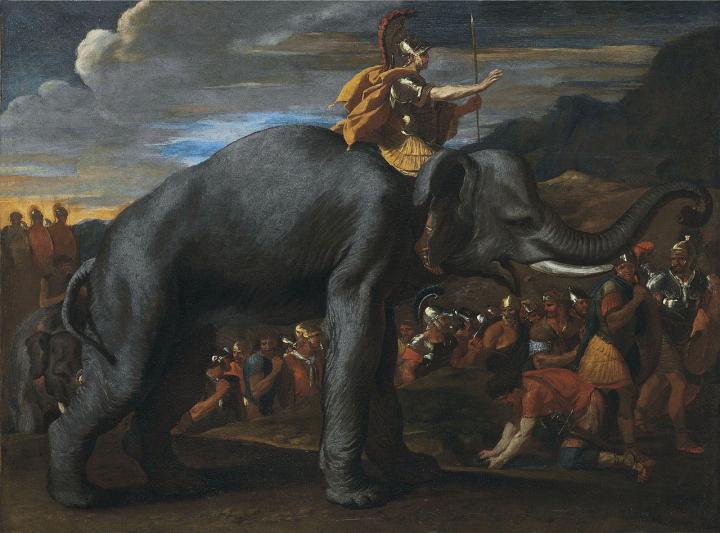
Microbiologists based in the Institute for Global Food Security and School of Biological Sciences at Queen's University Belfast have recently released results that may have answered one of ancient history's greatest enigmas: Where did Hannibal cross the Alps?

Hannibal was the Commander-in-Chief of the Carthaginian army during the Second Punic War with Rome (218 -201 BC). He famously led his troops (thirty thousand men, just thirty seven elephants and over fifteen thousand horses and mules) across the Alps to invade Italia – bringing the Roman army to its knees. While the great general was ultimately defeated at Zama in 202 BC, this campaign is rightly regarded today as one of the finest military endeavours of antiquity. We can say, in retrospect, that these events ultimately shaped the future Roman Republic, eventually with Caesar morphing into the Empire, and therefore into European civilisation as we know it.

For over two thousand years, historians, statesmen and academics have argued about the route Hannibal took across the Alps. Until now, no solid archaeological evidence has been forthcoming. However, this week – publishing on-line in the Journal Archaeometry – Queen's University's microbiologist Dr Chris Allen and his international team of colleagues, led by Professor Bill Mahaney (York University, Toronto), have finally provided solid evidence for the most likely transit route that took Hannibal's forces across the Alps via the Col de Traversette pass (~3000 m). This crossing point was first proposed over a half century ago by the biologist and polymath Sir Gavin de Beer, but has not previously been widely accepted by the academic community.

Using a combination of microbial metagenome analysis, environmental chemistry, geomorphic and pedological investigation, pollen analyses and various other geophysical techniques, the researchers have shown that a 'mass animal deposition' event occurred near the Col de Traversette – that can be directly dated to approximately 2168 cal yr BP, i.e. 218 BC.

Dr Chris Allen, from the Institute for Global Food Security at Queen's University Belfast, said: "The deposition lies within a churned-up mass from a 1-metre thick alluvial mire, produced by the constant movement of thousands of animals and humans. Over 70 per cent of the microbes in horse manure are from a group known as the Clostridia, that are very stable in soil – surviving for thousands of years. We found scientifically significant evidence of these same bugs in a genetic microbial signature precisely dating to the time of the Punic invasion."

The research project was conducted in collaboration with a leading group of researchers, based also in the Republic of Ireland, Canada, USA, France and Estonia.

###

Media inquiries to Claire Kelly, Communications Officer for Research at Queen's University Belfast, on [email protected] and 02890975391

Media Contact

Claire Kelly
[email protected]
@QueensUBelfast

http://www.qub.ac.uk

Share12Tweet8Share2ShareShareShare2

Related Posts

Uncovering C. elegans Immunity via Genetic Screens — Biology

Uncovering C. elegans Immunity via Genetic Screens

May 16, 2026
Single mother must adapt swiftly — the survival of her colony depends on it — Biology

Single mother must adapt swiftly — the survival of her colony depends on it

May 15, 2026

Why Are Nearly Everyone Right-Handed? It Might Be Linked to How We Learned to Walk

May 15, 2026

Excessive Neuronal Activity Initiates Severe Autoimmune Brain Disorder

May 15, 2026
Please login to join discussion

POPULAR NEWS

  • Research Indicates Potential Connection Between Prenatal Medication Exposure and Elevated Autism Risk

    844 shares
    Share 338 Tweet 211
  • New Study Reveals Plants Can Detect the Sound of Rain

    730 shares
    Share 291 Tweet 182
  • Salmonella Haem Blocks Macrophages, Boosts Infection

    62 shares
    Share 25 Tweet 16
  • Breastmilk Balances E. coli and Beneficial Bacteria in Infant Gut Microbiomes

    58 shares
    Share 23 Tweet 15

About

We bring you the latest biotechnology news from best research centers and universities around the world. Check our website.

Follow us

Recent News

Flexible Framework Optimizes Data Center Site Planning

Short-Term Home Cognitive & Physical Training Tested in Seniors

Stress Evolution and Time Control in Retreat Roadways

Subscribe to Blog via Email

Success! An email was just sent to confirm your subscription. Please find the email now and click 'Confirm' to start subscribing.

Join 82 other subscribers
  • Contact Us

Bioengineer.org © Copyright 2023 All Rights Reserved.

Welcome Back!

Login to your account below

Forgotten Password?

Retrieve your password

Please enter your username or email address to reset your password.

Log In
No Result
View All Result
  • Homepages
    • Home Page 1
    • Home Page 2
  • News
  • National
  • Business
  • Health
  • Lifestyle
  • Science

Bioengineer.org © Copyright 2023 All Rights Reserved.