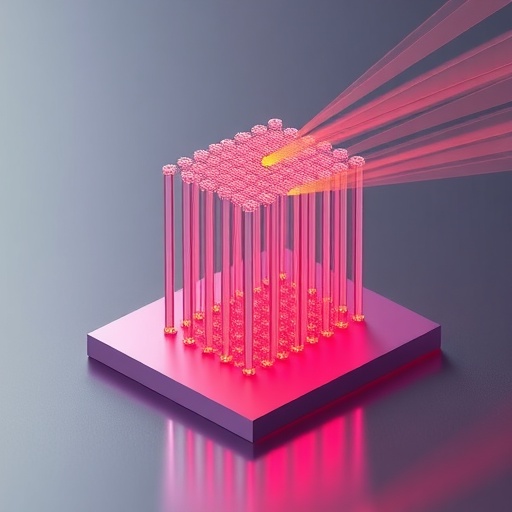
Evaporation-driven power generation promises a simple way to tap atmospheric heat, but practical devices have struggled with a basic bottleneck: the liquid tends to move slowly and without a preferred direction. That sluggish, non-directional flow wastes thermal energy as dissipation, keeping power density disappointingly low.
In a new study, researchers introduce a vertical microrod generator (VMG) designed to change how fluids move at the microscale. Instead of relying on random streaming, the VMG creates a directional Laplace pressure gradient—an engineered pressure difference that encourages fluid to travel rapidly along the device in a chosen direction.
The key advance is how VMG achieves transport without the usual drag-dominated losses. With the flow accelerated by the Laplace pressure gradient, ion transport becomes “quasi-ballistic,” meaning ions move with fewer scattering events than expected in conventional, diffusive regimes. This shift helps the system maintain a more efficient conversion of evaporative energy into electrical output.
A machine-learning-guided design process helps optimize the microrod geometry and operating conditions, targeting the fluid-dynamics and electrokinetic balance needed for high performance. The result is a generator that not only performs better, but does so in a more controllable manner than earlier approaches.
According to the report, the VMG reaches a 21.5% power conversion efficiency. It also delivers 14.3 W m⁻² of power density, a notable step toward making atmospheric thermal harvesting more competitive with low-power off-grid needs.
Durability is another crucial factor for real-world deployment. The VMG maintains stable performance over 30 days under ambient conditions, suggesting that the device does not quickly degrade or lose its fluid-routing advantages over time. Performance also holds strong across environmental variation, retaining over 20% efficiency despite a 30 K ambient temperature span.
To show practical relevance, the researchers integrate VMG arrays capable of powering commercial electronics, including emergency lighting and 36 W ceiling lamps. Such demonstrations highlight how a microrod-based architecture could scale from lab prototypes to useful energy systems.
Overall, the work presents a promising pathway for converting low-power-density atmospheric thermal energy into reliable electricity by combining pressure-gradient engineering with quasi-ballistic ion transport. If the approach scales cleanly, it could help unlock a new class of dependable, low-maintenance power sources.
Subject of Research: Atmospheric evaporation-driven electricity generation via electrokinetic ion transport
Article Title: Quasi-ballistic ion transport in a vertical microrod enabling efficient evaporation-driven power generation
Article References: Wu, M., Wang, T., Zhang, J. et al. Quasi-ballistic ion transport in a vertical microrod enabling efficient evaporation-driven power generation. Nat Energy (2026). https://doi.org/10.1038/s41560-026-02117-3
Image Credits: AI Generated
DOI: https://doi.org/10.1038/s41560-026-02117-3
Keywords: evaporation-driven power generation; vertical microrod generator; Laplace pressure gradient; quasi-ballistic ion transport; streaming potential; machine learning-driven design
Tags: directional Laplace pressure gradientefficient atmospheric heat harvestingelectrokinetic energy conversionevaporation-driven power generationhigh-performance evaporation power systemsion scattering reductionmachine learning optimization in microdevicesmicrofluidic power generatorsmicroscale fluid dynamicsnon-dissipative ion transport mechanismsquasi-ballistic ion flowVertical microrod ion transport