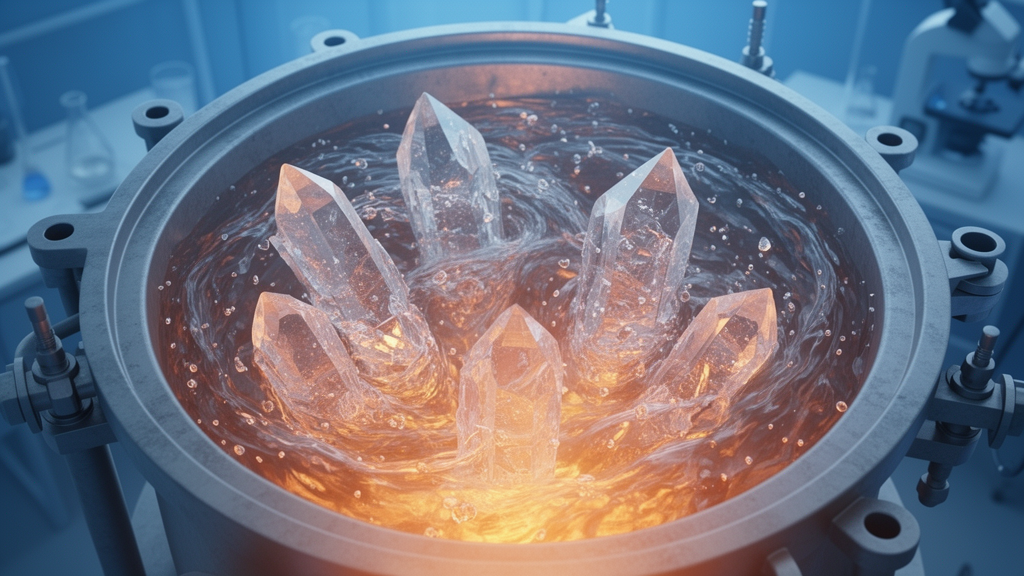
The review, authored by Xian Ye, Shaoliang Sun, Zhaofeng Zhang, Xinhai Li, Shicheng Li, Yilong Yuan and Chenghao Zhong, argues that understanding quartz dissolution is crucial for interpreting geochemical processes not only in supercritical geothermal systems but also in hot dry rock reservoirs, offshore geothermal fields and mid-ocean ridge systems.
At the heart of the paper is a newly compiled database of quartz-water reactions under supercritical conditions. The authors gathered equilibrium constants spanning temperatures from 21 to 800 degrees Celsius and pressures from 0.1 to 100 megapascals, drawn from 14 thermodynamic experiments. They also compiled rate constants from 23 kinetics experiments covering temperatures from 22 to 625 degrees Celsius.
One of the review’s practical contributions is a set of recommendations for future laboratory work. Comparing the different experimental systems used over the years, the authors conclude that instruments should incorporate an assistance device for identifying when equilibrium has actually been reached, along with in situ sampling methods. These design choices, they argue, would improve both the accuracy and the efficiency of water-rock experiments, an important consideration given how difficult such measurements become at supercritical temperatures and pressures.
The review also tackles one of the strangest features of quartz dissolution: its retrograde behavior near the supercritical region and at low fluid densities. In these regimes, dissolving quartz does not simply follow the expected trend of increasing solubility with temperature. The authors interpret this counterintuitive behavior using both the compiled experimental results and theoretical analysis, offering a clearer physical picture of why solubility can reverse direction as conditions change.
On the kinetics side, the team revisited the classic Arrhenius equation, which describes how reaction rates depend on temperature, and renewed its fit to the available data. Recognizing that temperature alone cannot fully explain dissolution rates under supercritical conditions, they proposed a pressure-term framing designed to capture the potential effect of pressure on the rate of quartz dissolution.
The authors are careful to note that this work is not finished. They state that the kinetic phenomena themselves and the new pressure-term kinetic model need further study in the future. The framing is presented as a proposal to be tested, not a settled solution, and the review explicitly positions itself as groundwork rather than a final word on supercritical quartz geochemistry.
What the compiled database does deliver, according to the review, is a foundation for the next generation of models. The authors describe it as laying the groundwork for density-based model development and for numerical prediction of quartz dissolution behavior in supercritical geothermal systems.
By consolidating experimental thermodynamics and kinetics into a single database and flagging both the open questions and the experimental designs needed to answer them, the review offers the geothermal community a common reference point for the work ahead.
Subject of Research: Thermodynamics and kinetics of quartz dissolution under supercritical geothermal conditions
Article Title: A review on thermodynamics and kinetics of quartz dissolution under supercritical geothermal conditions
Article References: Ye, X., Sun, S., Zhang, Z., Li, X., Li, S., Yuan, Y., & Zhong, C. (2026). A review on thermodynamics and kinetics of quartz dissolution under supercritical geothermal conditions. Geothermal Energy. https://doi.org/10.1186/s40517-026-00408-2
Image Credits: AI Generated
DOI: 10.1186/s40517-026-00408-2
Keywords: quartz dissolution, supercritical geothermal, thermodynamics, kinetics, water-rock interaction, geothermal energy, Arrhenius fit, fluid density, hot dry rock, mid-ocean ridge, geochemical modeling, review
News Source: Violet Maxwell. (October 28, 2026). Quartz Dissolution Under Supercritical Geothermal Conditions Gets a Fresh Review. Scienmag.