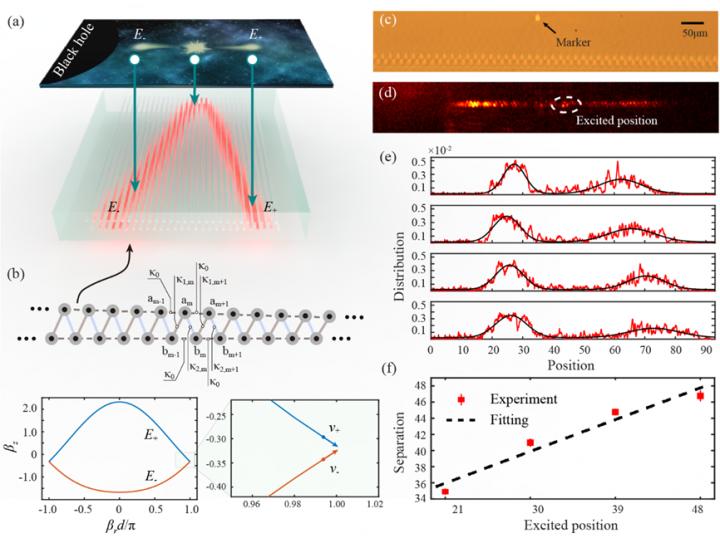
Credit: ©Science China Press
The vast universe can always arise people’s infinite imagination and yearning. Black hole, as one of the most attractive heavenly bodies in the universe, are waiting to be explored and studied. However, due to the limitations of technology, human is still unable to go into the depths of universe, let alone reach the vicinity of a black hole.
Fortunately, based on the equivalence between the metric of curved space-time in general relativity and the electromagnetic parameters in electromagnetic materials, the physical scientist has developed the method of transformation optics to simulate the curved space-time of gravitational field. Now, the scientist is able to study and demonstrate the evolution of particles in curved space-time experimentally. However, up to now, these simulations are limited either in classical regime or in flat space whereas quantum simulation related with general relativity is rarely involved. In the quantum field related with the gravitational effect, there are many striking phenomena, such as Hawking radiation.
Recently, Yao Wang and Xianmin Jin from Shanghai Jiao Tong University and Chong Sheng and Hui Liu from the Nanjing University made an exciting progress in observing particle behavior near the event horizon of block hole.
Based on femtosecond laser direct write technology, the waveguide on-site energy and the coupling between waveguides can be well controlled. Inspired by the concept of transformation optics, the team successfully constructed a one-dimensional artificial black hole using a single-layer non-uniform-coupling photonic waveguide lattice. Comparing to linear time evolution in the flat space, the dynamic behavior of single-photon wave packets near the horizon of a black hole accelerates exponentially, and its exponential index depends on the curvature of the black hole.
The team further designed the two-layer photonic waveguide lattice and experimentally observed the acceleration, generation, and evolution of fermion pairs near the event horizon of the black hole: a single-photon packet with positive energy successfully escaped from the black hole, while a single-photon packet with negative energy was captured. The result, which deviates from the intuition that photons are always trapped by black holes, is found well analogue to Hawking radiation which completely origins from quantum effects associated with gravitational effects. Due to vacuum fluctuations, particle-antiparticle pairs are generated near the event horizon of the black hole. Particles with negative energy fall into the black hole, while particles with negative energy escape. This causes the black hole to lose mass, and it would appear that the black hole has just emitted a particle.
Finally, the team think that higher-dimensional curved space-time can be constructed based on the experimental platform. For example, a two-dimensional waveguide array can be used to simulate three-dimensional space-time, and a two-dimensional waveguide array with photon polarization or frequency can be used to simulate four-dimensional space-time. Furthermore, due to the propagation direction plays the role as the time in our experimental platform, dynamics metric can also be emulated based on this experimental platform, such as FRW metric, a model describing cosmic expansion as time evolution, and gravitational wave, which is the ripple of spacetime.
###
See the article:
Yao Wang, Chong Sheng, Yong-Heng Lu, Jun Gao, Yi-Jun Chang, Xiao-Ling Pang, Tian-Huai Yang, Shi-Ning Zhu, Hui Liu, Xian-Min Jin.
Quantum Simulation of Particle Pair Creation near the Event Horizon
Natl. Sci. Rev. 2020, doi: 10.1093/nsr/nwaa111
https:/
Media Contact
Xian-Min Jin
[email protected]
Related Journal Article
http://dx.