“Cold atomic gases were well known in the past for the ability to ‘program’ the interactions between atoms,” says Professor Jean-Philippe Brantut at EPFL. “Our experiment doubles this ability!” Working with the group of Professor Helmut Ritsch at the University of Innsbruck, they have made a breakthrough that can impact not only quantum research but quantum-based technologies in the future.
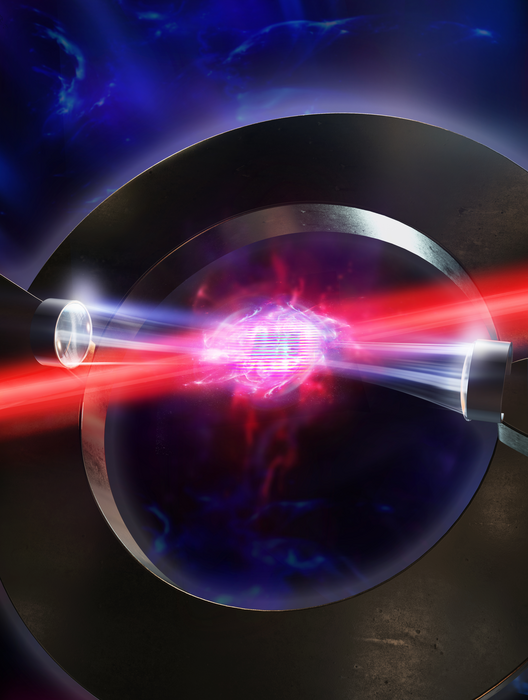
Credit: Innsbruck University/EPFL.
“Cold atomic gases were well known in the past for the ability to ‘program’ the interactions between atoms,” says Professor Jean-Philippe Brantut at EPFL. “Our experiment doubles this ability!” Working with the group of Professor Helmut Ritsch at the University of Innsbruck, they have made a breakthrough that can impact not only quantum research but quantum-based technologies in the future.
Density waves
Scientists have long been interested in understanding how materials self-organize into complex structures, such as crystals. In the often-arcane world of quantum physics, this sort of self-organization of particles is seen in ‘density waves’, where particles arrange themselves into a regular, repeating pattern or ‘order’; like a group of people with different colored shirts on standing in a line but in a pattern where no two people with the same color shirt stand next to each other.
Density waves are observed in a variety of materials, including metals, insulators, and superconductors. However, studying them has been difficult, especially when this order (the patterns of particles in the wave) occurs with other types of organization such as superfluidity – a property that allows particles to flow without resistance.
It’s worth noting that superfluidity is not just a theoretical curiosity; it is of immense interest for developing materials with unique properties, such as high-temperature superconductivity, which could lead to more efficient energy transfer and storage, or for building quantum computers.
Tuning a Fermi gas with light
To explore this interplay, Brantut and his colleagues, the researchers created a “unitary Fermi gas”, a thin gas of lithium atoms cooled to extremely low temperatures, and where atoms collide with each other very often.
The researchers then placed this gas in an optical cavity, a device used to confine light in a small space for an extended period of time. Optical cavities are made of two facing mirrors that reflect incoming light back and forth between them thousands of times, allowing light particles, photons, to build up inside the cavity.
In the study, the researchers used the cavity to cause the particles in the Fermi gas to interact at long distance: a first atom would emit a photon that bounces onto the mirrors, which is then reabsorbed by second atom of the gas, regardless how far it is from the first. When enough photons are emitted and reabsorbed – easily tuned in the experiment – the atoms collectively organize into a density wave pattern.
“The combination of atoms colliding directly with each other in the Fermi gas, while simultaneously exchanging photons over long distance, is a new type of matter where the interactions are extreme,” says Brantut. “We hope what we will see there will improve our understanding of some of the most complex materials encountered in physics.”
Other contributors
EPFL Center for Quantum Science and Engineering
Journal
Nature
DOI
10.1038/s41586-023-06018-3
Article Title
Density-wave ordering in a unitary Fermi gas with photon-mediated interactions.
Article Publication Date
24-May-2023