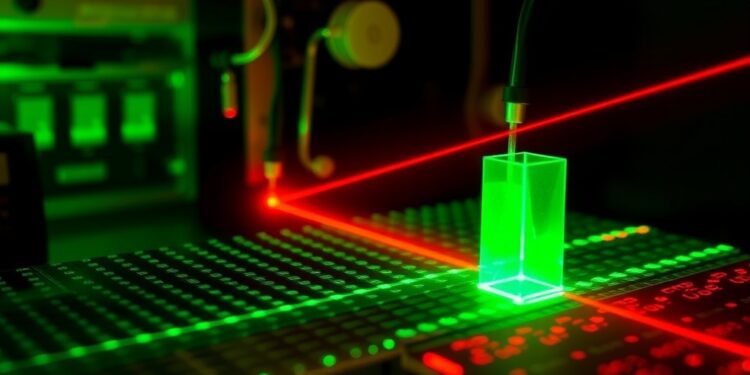

In a groundbreaking advancement at the intersection of quantum physics and gas sensing technology, researchers have successfully implemented the technique of quantum squeezing to enhance the operational efficiency of optical frequency comb lasers. This innovative method represents a significant leap forward in the development of quantum sensors, propelling a new generation of devices tailored for ultra-sensitive gas detection. Such devices could prove vital in various applications, including environmental monitoring as well as healthcare, affirming their versatility and importance in contemporary scientific inquiry.
Fundamentally, optical frequency comb lasers produce light in a multitude of colors or wavelengths simultaneously, analogous to the spacing of teeth on a comb. This characteristic enables these lasers to serve as precise tools for identifying gas molecules, as different gases absorb specific wavelengths of light. The challenge, however, has been to improve measurement accuracy while minimizing the inherent uncertainties that accompany quantum mechanics at microscopic scales. By leveraging quantum squeezing, researchers have elucidated a solution that allows for more accurate detection of gas molecules, mitigating the negative effects of quantum noise that typically encumber these measurements.
In traditional laser systems, light is emitted with a singular wavelength rather than the broad spectrum that frequency combs offer. While this singularity may streamline certain measurements, it severely limits the range and precision required for effective gas sensing in complex environments. The research confronting this limitation harnesses quantum squeezing by manipulating the characteristics of light produced by frequency combs through common optical fibers. Remarkably, this strategy enhances the regularity of photon arrival times—a vital factor in minimizing data uncertainty. The resultant increased coherence in photon delivery allows scientists to make faster and more precise measurements of gas concentrations, which is transformative for practical applications.
The research illustrates that even slight adjustments in the propagation of light through optical systems can yield profound benefits. By procuring a more uniform interval at which photons arrive, researchers diminished random fluctuations often inherent to photon collection. Although this increased precision came with a trade-off in measuring other optical properties—such as frequency oscillation—the overall advantage is noteworthy. Scientifically, this manipulation epitomizes a crucial victory over the randomness that governs behaviors at quantum scales, suggesting the application of sophisticated methodologies can yield tangible results.
Concretely, the study has demonstrated its efficacy using hydrogen sulfide samples, a pungent gas commonly associated with volcanic eruptions. The findings indicated a capacity to detect this molecule nearly twice as rapidly with the quantum-squeezed frequency comb compared to a conventional sensor. The implications of such a discovery reverberate through various fields—prompted by its efficacy, this technology could be employed to detect environmental hazards, thereby equipping regulators and industrial operators with crucial tools necessary for safeguarding public safety.
The ramifications extend beyond environmental monitoring; the implications of squeezed quantum sensors are particularly relevant in medical diagnostics. The same principles of enhanced sensitivity can be applied to identifying biomarkers within breath samples, where quick detection is vital for diseases like COVID-19. With the acceleration of detection time directly correlated to improved patient outcomes, this technology harbors the prospect of positively impacting societal health responses in urgent scenarios.
While the current work outlines promising advances, it remains essential to ensure that these developments transition successfully from laboratory experiments to real-world applications. Researchers emphasize that further work is needed to refine and adapt these sensors to various operating environments. Yet, the groundwork laid out in this study provides a crucial stepping stone towards realizing these sophisticated quantum devices for practical use across numerous sectors, from industry to healthcare.
The concept of quantum speedup—a phenomenon whereby measurements can be made faster and with greater accuracy by manipulating the properties of quantum states—has emerged as a central theme in the research. It resonates with an integral goal not only in physics but in an array of scientific disciplines eager for innovative technologies that can cope with the complexities of real-world phenomena.
Deepening our understanding of quantum behavior not only enhances our capacity to detect and characterize gases but promises a future where quantum-enhanced technologies could extend far beyond their current limitations. The meticulous experiments conducted by the research team, comprising expertise from CU Boulder and Université Laval, underscore a collaborative effort that transcends geographical borders, united by a shared vision to unlock nature’s mysteries through the lens of quantum physics.
In summary, the groundwork laid by these researchers heralds a transformative renaissance in quantum sensing technology. By integrating quantum squeezing techniques with frequency comb laser technology, they have propelled the field toward unprecedented realms of sensitivity and speed. As further investigations are undertaken to translate these laboratory successes into functional sensors, the scientific community stands on the precipice of a new frontier where quantum mechanics could revolutionize gas detection and characterization.
The implications of this research stretch across disciplines, intertwining advanced physics with practical applications that promise significant social benefits. Through continued exploration of quantum phenomena, the frontiers of technology will continually be redefined, underscoring the boundless potential that remains to be discovered in the interplay between matter and light at the most fundamental levels.
Subject of Research: Quantum Sensing Enhancement through Quantum Squeezing
Article Title: Squeezed Dual-Comb Spectroscopy
News Publication Date: 16-Jan-2025
Web References: Journal Science
References: JILA
Image Credits: Not Available
Keywords
Quantum mechanics, Laser light, Photons, Quantum measurement, Uncertainty principle, Optics, Quantum optics, Laser physics, Applied optics.