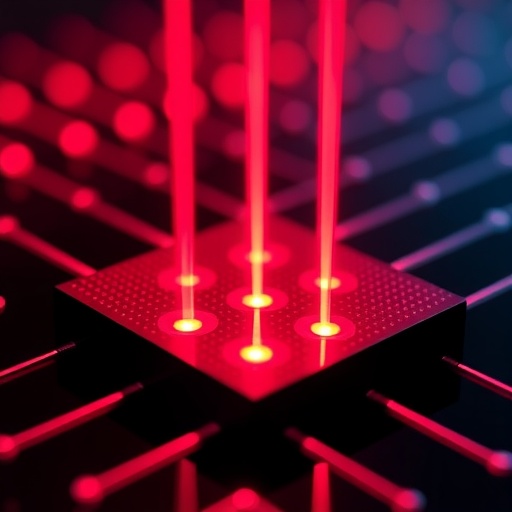
Silicon photonics has emerged as a revolutionary platform poised to transform the future of optical communication, computing, and sensing technologies. However, the full realization of integrated silicon photonic circuits has been hampered by fundamental challenges tied to the practical implementation of optical components on a silicon chip. A critical bottleneck has been the integration of efficient light sources and the reliance on bulky optical isolators, hindering scalability and functionality. A recent breakthrough reported by Pan, Yang, and Chen in Light: Science & Applications heralds a transformative era in silicon photonics by introducing quantum dot lasers that intrinsically eliminate the need for conventional optical isolators, paving the way for fully integrated, compact, and efficient photonic systems.
Silicon’s indirect bandgap has historically precluded it from serving as an efficient light emitter, necessitating hybrid approaches to couple external lasers with silicon circuits. Such configurations suffer from complexity and performance limitations. The innovation brought forth by Pan and colleagues involves the use of quantum dot lasers directly integrated on silicon substrates. Quantum dots, essentially nanoscale semiconductor particles, exhibit discrete energy levels that allow superior carrier confinement and enhanced radiative recombination efficiencies compared to bulk semiconductors. This quantum confinement effect enables laser emission with reduced threshold current and improved temperature stability when fabricated on silicon wafers.
One of the most compelling aspects of this new quantum dot laser technology is its intrinsic unidirectional emission, a property that effectively solves the long-standing problem of optical feedback within photonic circuits. Optical feedback, often arising from reflections at waveguide interfaces and connectors, destabilizes lasers and degrades signal quality. To mitigate this, bulky and expensive optical isolators have traditionally been used to prevent back reflections, but their integration into compact silicon photonic chips remains challenging. The reported quantum dot lasers, however, embody self-isolating behaviors that obviate the need for these isolators, vastly simplifying photonic chip architectures.
This self-isolation capability arises from the unique nonlinear gain dynamics and carrier capture processes within quantum dots, which suppress unwanted feedback and mode instabilities. By engineering the quantum dot active regions and optimizing cavity designs, the research team has demonstrated stable single-mode lasing with negligible susceptibility to back reflections. This intrinsic stability breaks with a decades-old paradigm where external isolators were considered indispensable for laser operation, marking a quantum leap in integrated photonics.
Aside from its fundamental physical advantages, the technology aligns perfectly with the established CMOS fabrication infrastructure. It is well known that one of the thorniest issues in silicon photonics is compatibility with mature semiconductor manufacturing processes. Pan and colleagues have meticulously demonstrated that their quantum dot laser structures can be epitaxially grown on silicon substrates with high crystalline quality, avoiding detrimental defects that traditionally impair device performance. This compatibility implies the potential for mass production and seamless integration with silicon electronic circuits, driving economies of scale and reducing costs.
The implications for optical communication are immense. Current data centers rely heavily on complex, hybrid systems where light sources, modulators, and detectors are assembled from disparate materials and components. The integration of quantum dot lasers directly on silicon chips with self-isolating properties promises to condense these systems into compact photonic integrated circuits with higher reliability, lower power consumption, and enhanced bandwidth. This advance could revolutionize optical interconnects within and between data centers, boosting efficiency, speed, and scalability.
In addition to communication, the new laser technology opens avenues for highly sensitive sensing applications. Silicon photonic biosensors, environmental monitors, and chemical detectors could benefit from the stable, tunable, and compact light sources enabled by quantum dot integration. The absence of optical isolators reduces insertion losses and footprint, critical parameters for portable and high-performance sensing platforms.
The researchers also highlight the versatility of quantum dot lasers for on-chip quantum information processing. Quantum photonic circuits demand highly coherent and stable single-mode sources, and quantum dot technology meets these stringent criteria. Their inherent thermal stability and low noise characteristics underpin the reliable generation of single photons or entangled states, critical for scalable quantum networks and computing architectures.
Beyond the immediate technical merits, this advance symbolizes an important strategic milestone towards the convergence of electronics and photonics on a single silicon platform. The so-called “silicon photonics dream” envisions all-optical chips that can seamlessly perform processing and communication tasks at the speed of light, overcoming the bottlenecks imposed by electrical interconnects. The elimination of optical isolators via quantum dot lasers brings this dream significantly closer to reality.
Moreover, the researchers foresee that this development will spark new design paradigms in photonic integrated circuits. Without the need to allocate precious chip area to optical isolators, engineers have newfound freedom to optimize layout, enhance functionality, and innovate novel device concepts. System-level designs can become more compact and power-efficient, enabling applications in mobile devices, autonomous systems, and next-generation internet infrastructure.
From a fundamental physics perspective, the work sheds light on intricate light-matter interactions and nonlinear dynamics within quantum dot systems when integrated directly on silicon. The interplay between quantum confinement, gain saturation, and cavity feedback creates a rich landscape for exploring new photonic phenomena. These insights could drive further improvements in device performance and inspire alternative quantum photonic devices.
Industry observers are already recognizing the disruptive potential of this technology. The natural scalability of silicon fabrication combined with the elimination of isolators addresses two major hurdles toward commercial silicon photonic systems. Experts anticipate accelerated adoption across telecommunications, data centers, and emerging fields like LiDAR and augmented reality, where photonics plays an increasingly vital role.
While challenges remain, particularly in refining fabrication yield and enhancing the spectral tunability of quantum dot lasers, the research marks a decisive step forward. Continued progress promises a new generation of photonic chips characterized by unprecedented integration density, robustness, and functionality, all underpinned by the unique properties of quantum dot materials grown on silicon.
In conclusion, Pan, Yang, and Chen’s pioneering demonstration of self-isolating quantum dot lasers on silicon represents a watershed moment in photonics. It dissolves long-standing barriers to miniaturization and integration, enabling inherently stable light sources without the need for external optical isolators. This breakthrough not only accelerates the commercial viability of silicon photonic devices but also opens fertile ground for innovations spanning communication, sensing, quantum information, and beyond. It is a vivid illustration of how cutting-edge materials engineering and photonic design can merge to forge the future of optical technologies, fulfilling the promise of a truly integrated silicon photonics ecosystem.
Subject of Research: Quantum dot lasers integrated on silicon photonic chips and their intrinsic optical isolation properties
Article Title: Bridging the gap in silicon photonics: quantum dot lasers and the end of the optical isolator
Article References:
Pan, S., Yang, J. & Chen, S. Bridging the gap in silicon photonics: quantum dot lasers and the end of the optical isolator.
Light Sci Appl 15, 226 (2026). https://doi.org/10.1038/s41377-026-02290-w
Image Credits: AI Generated
Tags: compact photonic system integrationefficient light sources on silicon chipseliminating optical isolators in photonicsenhanced radiative recombination efficiencieshybrid laser-silicon integration challengesintegrated silicon photonic circuitsnanoscale semiconductor quantum dotsnext-generation optical computing componentsoptical communication technology advancementsquantum confinement effect in lasersquantum dot lasers silicon photonicsscalable silicon photonics devices