• HOME
  • NEWS
  • EXPLORE
    • CAREER
      • Companies
      • Jobs
    • EVENTS
    • iGEM
      • News
      • Team
    • PHOTOS
    • VIDEO
    • WIKI
  • BLOG
  • COMMUNITY
    • FACEBOOK
    • INSTAGRAM
    • TWITTER
Wednesday, May 20, 2026
BIOENGINEER.ORG
No Result
View All Result
  • Login
  • HOME
  • NEWS
  • EXPLORE
    • CAREER
      • Companies
      • Jobs
        • Lecturer
        • PhD Studentship
        • Postdoc
        • Research Assistant
    • EVENTS
    • iGEM
      • News
      • Team
    • PHOTOS
    • VIDEO
    • WIKI
  • BLOG
  • COMMUNITY
    • FACEBOOK
    • INSTAGRAM
    • TWITTER
  • HOME
  • NEWS
  • EXPLORE
    • CAREER
      • Companies
      • Jobs
        • Lecturer
        • PhD Studentship
        • Postdoc
        • Research Assistant
    • EVENTS
    • iGEM
      • News
      • Team
    • PHOTOS
    • VIDEO
    • WIKI
  • BLOG
  • COMMUNITY
    • FACEBOOK
    • INSTAGRAM
    • TWITTER
No Result
View All Result
Bioengineer.org
No Result
View All Result
Home NEWS Science News Chemistry

Quantum computing with holes

Bioengineer by Bioengineer
September 6, 2025
in Chemistry
Reading Time: 2 mins read
0
IMAGE
Share on FacebookShare on TwitterShare on LinkedinShare on RedditShare on Telegram

Scientists found a new and promising qubit at a place where there is nothing

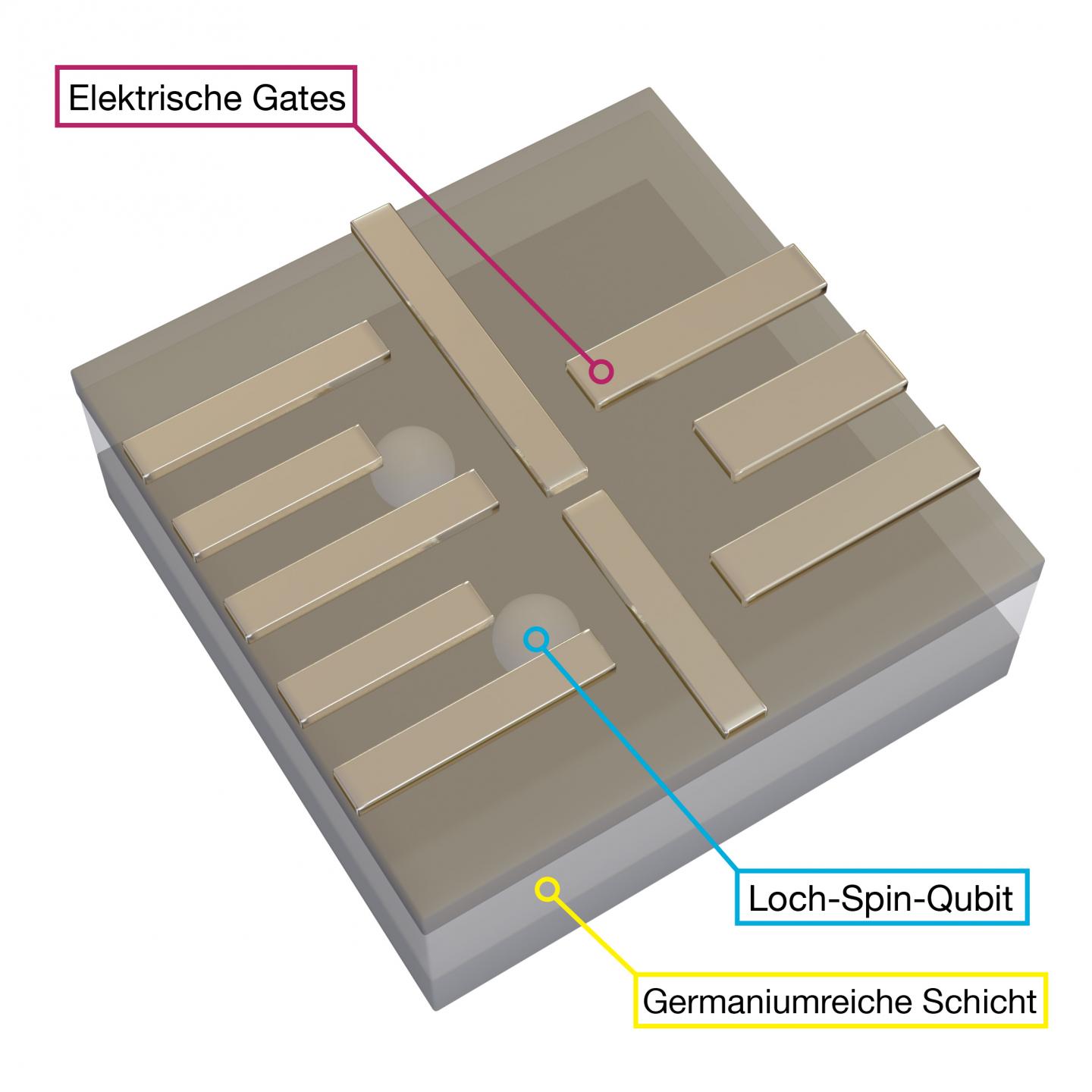
In a study published in Nature Materials and led by Daniel Jirovec from the Katsaros group at IST Austria in close collaboration with researchers from the L-NESS Inter-university Centre in Como, Italy, scientists now have created a new and promising candidate system for reliable qubits.

Spinning Absence

The researchers created the qubit using the spin of so-called holes. Each hole is just the absence of an electron in a solid material. Amazingly, a missing negatively charged particle can physically be treated as if it were a positively charged particle. It can even move around in the solid when a neighboring electron fills the hole. Thus, effectively the hole described as positively charged particle is moving forward.

These holes even carry the quantum-mechanical property of spin and can interact if they come close to each other. “Our colleagues at L-NESS layered several different mixtures of silicon and germanium just a few nanometers thick on top of each other. That allows us to confine the holes to the germanium-rich layer in the middle,” Jirovec explains. “On top, we added tiny electrical wires – so-called gates – to control the movement of holes by applying voltage to them. The electrically positively charged holes react to the voltage and can be extremely precisely moved around within their layer.”

Using this nano-scale control, the scientists moved two holes close to each other to create a qubit out of their interacting spins. But to make this work, they needed to apply a magnetic field to the whole setup. Here, their innovative approach comes into play.

Linking Qubits

In their setup, Jirovec and his colleagues cannot only move holes around but also alter their properties. By engineering different hole properties, they created the qubit out of the two interacting hole spins using less than ten millitesla of magnetic field strength. This is a weak magnetic field compared to other similar qubit setups, which employ at least ten times stronger fields.

But why is that relevant? “By using our layered germanium setup we can reduce the required magnetic field strength and therefore allow the combination of our qubit with superconductors, usually inhibited by strong magnetic fields,” Jirovec says. Superconductors – materials without any electrical resistance – support the linking of several qubits due to their quantum-mechanical nature. This could enable scientists to build new kinds of quantum computers combining semiconductors and superconductors.

###

Media Contact
Patrick Müller
[email protected]

Related Journal Article

http://dx.doi.org/10.1038/s41563-021-01022-2

Tags: Chemistry/Physics/Materials SciencesMaterials
Share12Tweet8Share2ShareShareShare2

Related Posts

How Magnetic Orientation Could Influence the Building Blocks of Life — Chemistry

How Magnetic Orientation Could Influence the Building Blocks of Life

May 20, 2026
Breaking a 200-Year-Old Belief: Novel Surface Design Achieves Two Distinct Wetting States on One Substrate — Chemistry

Breaking a 200-Year-Old Belief: Novel Surface Design Achieves Two Distinct Wetting States on One Substrate

May 20, 2026

Unveiling Sound Waves: Scientists Discover Hidden Behaviors in Acoustic Phenomena

May 20, 2026

Thermal Imaging Uncovers Altermagnetic Domains in RuO2 for the First Time, Paving the Way for Advanced Spintronic Technologies

May 20, 2026
Please login to join discussion

POPULAR NEWS

  • blank

    New Study Reveals Plants Can Detect the Sound of Rain

    732 shares
    Share 292 Tweet 183
  • Research Indicates Potential Connection Between Prenatal Medication Exposure and Elevated Autism Risk

    846 shares
    Share 338 Tweet 212
  • ESMO 2025: mRNA COVID Vaccines Enhance Efficacy of Cancer Immunotherapy

    294 shares
    Share 118 Tweet 74
  • Breastmilk Balances E. coli and Beneficial Bacteria in Infant Gut Microbiomes

    58 shares
    Share 23 Tweet 15

About

We bring you the latest biotechnology news from best research centers and universities around the world. Check our website.

Follow us

Recent News

Revealing Hidden Objects Using Consumer LiDAR

AI System Revolutionizes Scientific Research by Automating Code Generation

Unraveling the Multifaceted Role of H2AK119 Mono-Ubiquitination in Biology and Disease

Subscribe to Blog via Email

Enter your email address to subscribe to this blog and receive notifications of new posts by email.

Join 82 other subscribers
  • Contact Us

Bioengineer.org © Copyright 2023 All Rights Reserved.

Welcome Back!

Login to your account below

Forgotten Password?

Retrieve your password

Please enter your username or email address to reset your password.

Log In
No Result
View All Result
  • Homepages
    • Home Page 1
    • Home Page 2
  • News
  • National
  • Business
  • Health
  • Lifestyle
  • Science

Bioengineer.org © Copyright 2023 All Rights Reserved.