• HOME
  • NEWS
  • EXPLORE
    • CAREER
      • Companies
      • Jobs
    • EVENTS
    • iGEM
      • News
      • Team
    • PHOTOS
    • VIDEO
    • WIKI
  • BLOG
  • COMMUNITY
    • FACEBOOK
    • INSTAGRAM
    • TWITTER
Sunday, May 10, 2026
BIOENGINEER.ORG
No Result
View All Result
  • Login
  • HOME
  • NEWS
  • EXPLORE
    • CAREER
      • Companies
      • Jobs
        • Lecturer
        • PhD Studentship
        • Postdoc
        • Research Assistant
    • EVENTS
    • iGEM
      • News
      • Team
    • PHOTOS
    • VIDEO
    • WIKI
  • BLOG
  • COMMUNITY
    • FACEBOOK
    • INSTAGRAM
    • TWITTER
  • HOME
  • NEWS
  • EXPLORE
    • CAREER
      • Companies
      • Jobs
        • Lecturer
        • PhD Studentship
        • Postdoc
        • Research Assistant
    • EVENTS
    • iGEM
      • News
      • Team
    • PHOTOS
    • VIDEO
    • WIKI
  • BLOG
  • COMMUNITY
    • FACEBOOK
    • INSTAGRAM
    • TWITTER
No Result
View All Result
Bioengineer.org
No Result
View All Result
Home NEWS Science News Chemistry

Quantum computing with graphene plasmons

Bioengineer by Bioengineer
May 6, 2019
in Chemistry
Reading Time: 3 mins read
0
IMAGE
Share on FacebookShare on TwitterShare on LinkedinShare on RedditShare on Telegram

IMAGE

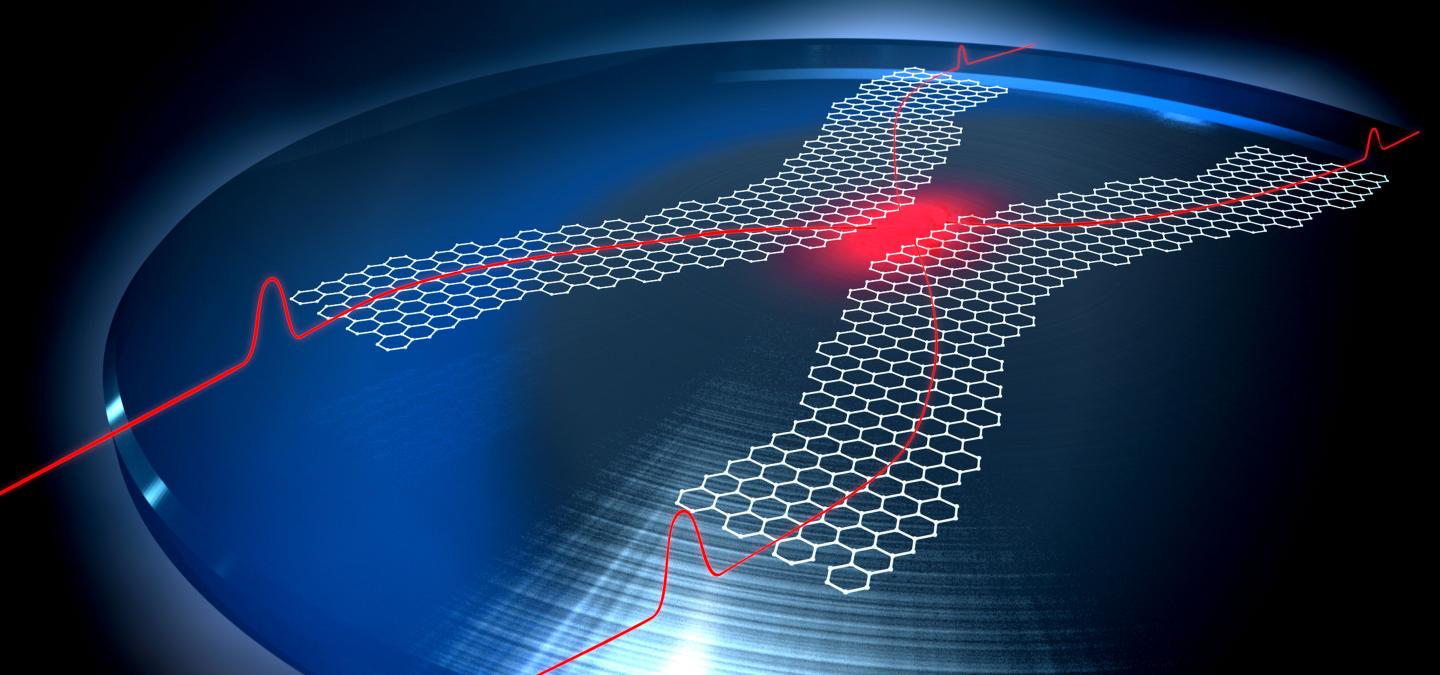
Credit: © University of Vienna, created by Thomas Rögelsperger

A novel material that consists of a single sheet of carbon atoms could lead to new designs for optical quantum computers. Physicists from the University of Vienna and the Institute of Photonic Sciences in Barcelona have shown that tailored graphene structures enable single photons to interact with each other. The proposed new architecture for quantum computer is published in the recent issue of npj Quantum Information.

Photons barely interact with the environment, making them a leading candidate for storing and transmitting quantum information. This same feature makes it especially difficult to manipulate information that is encoded in photons. In order to build a photonic quantum computer, one photon must change the state of a second. Such a device is called a quantum logic gate, and millions of logic gates will be needed to build a quantum computer. One way to achieve this is to use a so-called ‘nonlinear material’ wherein two photons interact within the material. Unfortunately, standard nonlinear materials are far too inefficient to build a quantum logic gate.

It was recently realized that nonlinear interactions can be greatly enhanced by using plasmons. In a plasmon, light is bound to electrons on the surface of the material. These electrons can then help the photons to interact much more strongly. However, plasmons in standard materials decay before the needed quantum effects can take place.

In their new work, the team of scientists led by Prof. Philip Walther at the University of Vienna propose to create plasmons in graphene. This 2D material discovered barely a decade ago consists of a single layer of carbon atoms arranged in a honeycomb structure, and, since its discovery, it has not stopped surprising us. For this particular purpose, the peculiar configuration of the electrons in graphene leads to both an extremely strong nonlinear interaction and plasmons that live for an exceptionally long time.

In their proposed graphene quantum logic gate, the scientists show that if single plasmons are created in nanoribbons made out of graphene, two plasmons in different nanoribbons can interact through their electric fields. Provided that each plasmon stays in its ribbon multiple gates can be applied to the plasmons which is required for quantum computation. “We have shown that the strong nonlinear interaction in graphene makes it impossible for two plasmons to hop into the same ribbon” confirms Irati Alonso Calafell, first-author of this work.

Their proposed scheme makes use of several unique properties of graphene, each of which has been observed individually. The team in Vienna is currently performing experimental measurements on a similar graphene-based system to confirm the feasibility of their gate with current technology. Since the gate is naturally small, and operates at room temperature it should readily lend itself to being scaled up, as is required for many quantum technologies.

###

Publication:

Quantum computing with graphene plasmons, I. Alonso Calafell, J. D. Cox, M. Radonji?, J. R. M. Saavedra, F. J. García de Abajo, L. A. Rozema & P. Walther. npj Quantum Information 5, 37 (2019).
DOI: 10.1038/s41534-019-0150-2

Media Contact
Philip Walther
[email protected]

Original Source

https://medienportal.univie.ac.at/presse/aktuelle-pressemeldungen/detailansicht/artikel/quantum-computing-with-graphene-plasmons/

Related Journal Article

http://dx.doi.org/10.1038/s41534-019-0150-2

Tags: Atomic PhysicsAtomic/Molecular/Particle PhysicsChemistry/Physics/Materials SciencesComputer ScienceInternetNanotechnology/Micromachines
Share12Tweet8Share2ShareShareShare2

Related Posts

Miniature Sensor Uses Light to Detect Touch — Chemistry

Miniature Sensor Uses Light to Detect Touch

May 8, 2026
Iron Minerals Determine Whether Dissolved Organic Matter Fuels Microbes or Becomes Long-Term Carbon Storage — Chemistry

Iron Minerals Determine Whether Dissolved Organic Matter Fuels Microbes or Becomes Long-Term Carbon Storage

May 8, 2026

Kate Evans Appointed Associate Lab Director for Biological and Environmental Systems Science at ORNL

May 8, 2026

Advancing Multiscale Modeling and Overcoming Operational Challenges in Autothermal CO₂-to-Methanol Reactors

May 8, 2026
Please login to join discussion

POPULAR NEWS

  • Research Indicates Potential Connection Between Prenatal Medication Exposure and Elevated Autism Risk

    840 shares
    Share 336 Tweet 210
  • New Study Reveals Plants Can Detect the Sound of Rain

    727 shares
    Share 290 Tweet 181
  • Scientists Investigate Possible Connection Between COVID-19 and Increased Lung Cancer Risk

    68 shares
    Share 27 Tweet 17
  • Salmonella Haem Blocks Macrophages, Boosts Infection

    61 shares
    Share 24 Tweet 15

About

We bring you the latest biotechnology news from best research centers and universities around the world. Check our website.

Follow us

Recent News

Evaluating Digoxin Use in Patients with Symptomatic Rheumatic Heart Disease

Evaluating the Effectiveness and Safety of Digitalis Glycosides in Treating Heart Failure

Urdu Fall Risk Questionnaire Adapted for Elderly

Subscribe to Blog via Email

Enter your email address to subscribe to this blog and receive notifications of new posts by email.

Join 82 other subscribers
  • Contact Us

Bioengineer.org © Copyright 2023 All Rights Reserved.

Welcome Back!

Login to your account below

Forgotten Password?

Retrieve your password

Please enter your username or email address to reset your password.

Log In
No Result
View All Result
  • Homepages
    • Home Page 1
    • Home Page 2
  • News
  • National
  • Business
  • Health
  • Lifestyle
  • Science

Bioengineer.org © Copyright 2023 All Rights Reserved.