• HOME
  • NEWS
  • EXPLORE
    • CAREER
      • Companies
      • Jobs
    • EVENTS
    • iGEM
      • News
      • Team
    • PHOTOS
    • VIDEO
    • WIKI
  • BLOG
  • COMMUNITY
    • FACEBOOK
    • INSTAGRAM
    • TWITTER
Tuesday, May 12, 2026
BIOENGINEER.ORG
No Result
View All Result
  • Login
  • HOME
  • NEWS
  • EXPLORE
    • CAREER
      • Companies
      • Jobs
        • Lecturer
        • PhD Studentship
        • Postdoc
        • Research Assistant
    • EVENTS
    • iGEM
      • News
      • Team
    • PHOTOS
    • VIDEO
    • WIKI
  • BLOG
  • COMMUNITY
    • FACEBOOK
    • INSTAGRAM
    • TWITTER
  • HOME
  • NEWS
  • EXPLORE
    • CAREER
      • Companies
      • Jobs
        • Lecturer
        • PhD Studentship
        • Postdoc
        • Research Assistant
    • EVENTS
    • iGEM
      • News
      • Team
    • PHOTOS
    • VIDEO
    • WIKI
  • BLOG
  • COMMUNITY
    • FACEBOOK
    • INSTAGRAM
    • TWITTER
No Result
View All Result
Bioengineer.org
No Result
View All Result
Home NEWS Science News Chemistry

Quality control mechanism closes the protein production ‘on-ramps’

Bioengineer by Bioengineer
October 8, 2020
in Chemistry
Reading Time: 2 mins read
0
IMAGE
Share on FacebookShare on TwitterShare on LinkedinShare on RedditShare on Telegram

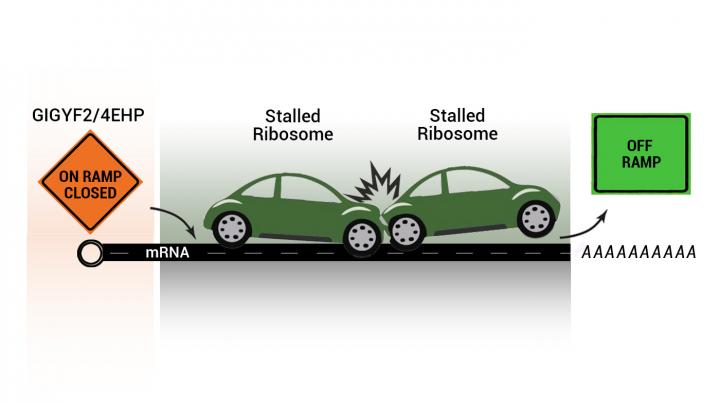
Newly discovered quality control system in the protein production assembly line has implications for neurogenerative disease
IMAGE

Credit: Artwork courtesy of Kamena Kostova and Navid Marvi.

Baltimore, MD– Recent work led by Carnegie’s Kamena Kostova revealed a new quality control system in the protein production assembly line with possible implications for understanding neurogenerative disease.

The DNA that comprises the chromosomes housed in each cell’s nucleus encodes the recipes for how to make proteins, which are responsible for the majority of the physiological actions that sustain life. Individual recipes are transcribed using messenger RNA, which carries this piece of code to a piece of cellular machinery called the ribosome. The ribosome translates the message into amino acids–the building blocks of proteins.

But sometimes messages get garbled. The resulting incomplete protein products can be toxic to cells. So how do cells clean up in the aftermath of a botched translation?

Some quality assurance mechanisms were already known–including systems that degrade the half-finished protein product and the messenger RNA that led to its creation. But Kostova led a team that identified a new tool in the cell’s kit for preventing damage when protein assembly goes awry. Their work was published by Molecular Cell.

Using CRISPR-Cas9-based genetic screening, the researchers discovered a separate, and much needed, device by which the cell prevents that particular faulty message from being translated again. They found two factors, called GIGYF2 and 4EHP, which prevent translation from being initiated on problematic messenger RNA fragments.

“Imagine that the protein assembly process is a highway and the ribosomes are cars traveling on it,” Kostova explained. “If there’s a bad message producing incomplete protein products, it’s like having a stalled car or two on the road, clogging traffic. Think of GIGYF2 and 4EHP as closing the on-ramp, so that there is time to clear everything away and additional cars don’t get stalled, exacerbating the problem.”

Loss of GIGYF2 has previously been associated with neurodegenerative and neurodevelopmental problems. It is possible that these issues are caused by the buildup of defective proteins that occurs without the ability to prevent translation on faulty messenger RNAs.

###

This work was supported by the Howard Hughes Medical Institute, the National Institutes of Health, the NIH Center for RNA Systems Biology, an NIH Directors’ Early Independence Award, a UCSF Genentech Fellowship, HHMI Faculty Scholar award, and Chan Zuckerberg Biohub.

The Carnegie Institution for Science (carnegiescience.edu) is a private, nonprofit organization headquartered in Washington, D.C., with six research departments throughout the U.S. Since its founding in 1902, the Carnegie Institution has been a pioneering force in basic scientific research. Carnegie scientists are leaders in plant biology, developmental biology, astronomy, materials science, global ecology, and Earth and planetary science.

Media Contact
Kamena Kostova
[email protected]

Original Source

https://carnegiescience.edu/news/quality-control-mechanism-closes-protein-production-ramps

Related Journal Article

http://dx.doi.org/10.1016/j.molcel.2020.07.007

Tags: BiochemistryBiologyCell BiologyDevelopmental/Reproductive BiologyGeneticsMolecular Biologyneurobiology
Share12Tweet8Share2ShareShareShare2

Related Posts

Humans and Zebra Finches Share Similar Speech Learning Techniques #ASA190 — Chemistry

Humans and Zebra Finches Share Similar Speech Learning Techniques #ASA190

May 11, 2026
Unveiling Dark Matter Through Molecular Insights — Chemistry

Unveiling Dark Matter Through Molecular Insights

May 11, 2026

From Touch to Sight: A Bioinspired Multisensory Framework Endows Robots with Human-Like Perception

May 11, 2026

Announcing the 2026 Carbon Future Young Investigator Award Winners

May 11, 2026
Please login to join discussion

POPULAR NEWS

  • Research Indicates Potential Connection Between Prenatal Medication Exposure and Elevated Autism Risk

    841 shares
    Share 336 Tweet 210
  • New Study Reveals Plants Can Detect the Sound of Rain

    728 shares
    Share 290 Tweet 182
  • Salmonella Haem Blocks Macrophages, Boosts Infection

    62 shares
    Share 25 Tweet 16
  • Breastmilk Balances E. coli and Beneficial Bacteria in Infant Gut Microbiomes

    57 shares
    Share 23 Tweet 14

About

We bring you the latest biotechnology news from best research centers and universities around the world. Check our website.

Follow us

Recent News

Humans and Zebra Finches Share Similar Speech Learning Techniques #ASA190

New Study Uncovers How Fungal Parasites Attack Strawberries and Raspberries

City of Hope Researchers to Present Groundbreaking Immunotherapy and Precision Medicine Advances Across Multiple Cancer Types at ASCO 2026

Subscribe to Blog via Email

Enter your email address to subscribe to this blog and receive notifications of new posts by email.

Join 82 other subscribers
  • Contact Us

Bioengineer.org © Copyright 2023 All Rights Reserved.

Welcome Back!

Login to your account below

Forgotten Password?

Retrieve your password

Please enter your username or email address to reset your password.

Log In
No Result
View All Result
  • Homepages
    • Home Page 1
    • Home Page 2
  • News
  • National
  • Business
  • Health
  • Lifestyle
  • Science

Bioengineer.org © Copyright 2023 All Rights Reserved.