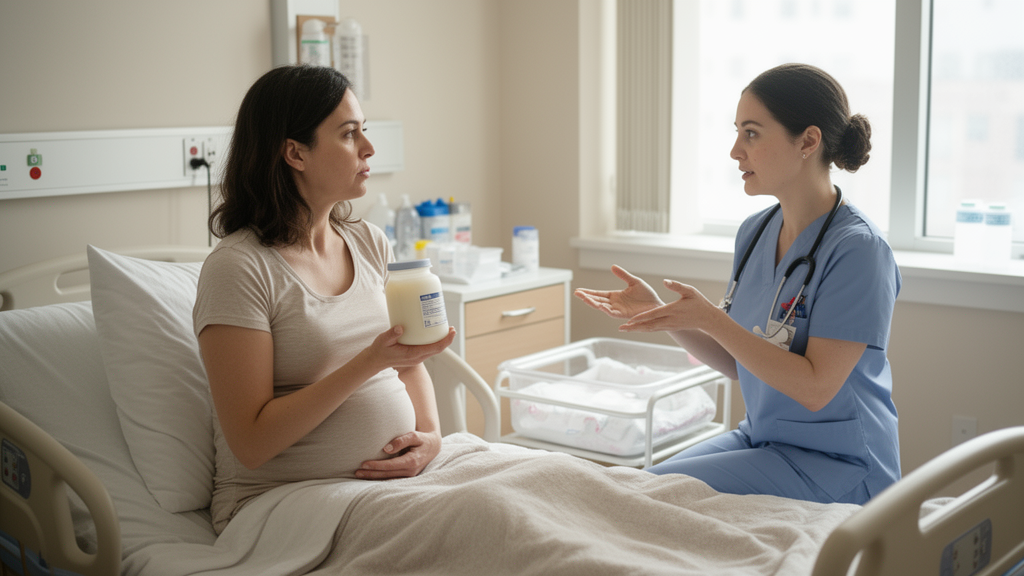
A qualitative study of 22 postnatal mothers attending a private hospital in Richards Bay, South Africa, found that donor human milk was largely unfamiliar to participants, while several expressed conditional willingness to receive it or donate their own milk after receiving a standardized explanation. Willingness to accept donor milk for a mother’s infant depended on assurances about donor screening, pasteurisation, storage and clinical need, as well as a recommendation from a trusted healthcare professional. Willingness to donate was expressed more readily and was often linked to altruism and reciprocity. The study examined anticipated decisions, not actual uptake, and cannot predict future behaviour or neonatal outcomes.
Researchers used an interpretive phenomenological design and reflexive thematic analysis to understand how mothers made sense of donor human milk during the early postnatal period, when infant-feeding decisions were being considered. Participants were purposively recruited from postnatal care at the Richards Bay hospital. They ranged from 19 to 42 years old; 12 were primiparous, 10 were multiparous, and 14 were employed. Twelve participants, or 54.55%, held a university degree. The relatively educated sample and single private-hospital setting limit statistical generalisation to public-sector services, other regions or mothers with different socioeconomic circumstances.
Each mother took part in a face-to-face, audio-recorded semi-structured interview lasting 45 to 60 minutes. Twenty interviews were conducted in English and two in isiZulu. The interviewer first asked open questions about prior knowledge and where mothers had encountered information about donor milk. Only afterward did she provide a standard explanation covering what donor milk is, who donates, how donors are screened, including for HIV, how milk is pasteurised and stored, and which infants usually receive it. Responses after this explanation therefore represent responses to new information rather than spontaneous prior knowledge.
Interviews were transcribed verbatim and checked against the recordings. The two isiZulu interviews were transcribed in isiZulu and translated into English; a second bilingual speaker independently compared the translated transcripts with the originals, and discrepancies were resolved through discussion. Culturally embedded expressions were translated for meaning rather than word for word, with isiZulu terms retained where no direct English equivalent existed. These procedures supported the interpretive analysis, although the researchers noted that subtle differences in meaning could still have been lost during translation.
Most participants said they had never heard that human milk could be formally donated, processed and provided to another infant. Those with some awareness generally described fragmented information encountered through social media, including Facebook, Instagram and TikTok, rather than through routine maternal or neonatal healthcare. None reported receiving substantive education about donor milk from a nurse, midwife or doctor during pregnancy, delivery or postnatal care. One participant said clinicians talked about breastfeeding and its benefits but “not ever about donating or taking from someone.” Several mothers suggested that donor milk should be introduced during pregnancy, before infant-feeding decisions arise in the emotionally and clinically demanding setting of neonatal care.
Safety was the most consistent concern. Participants raised infection, HIV, tuberculosis, donor health, storage, expiry dates, milk quality and the possibility that screening could fail. Few could describe donor-screening or milk-processing procedures. One participant offered a tentative account: “I assume that they check for infection and HIV. The milk is pumped out. Maybe heated.” Another worried that an infant receiving milk from an unscreened donor might be exposed to infection. The findings suggest that safeguards such as screening and pasteurisation may offer limited reassurance if their purpose and operation remain invisible to families, but the study did not test which communication methods would be most effective.
Institutional trust could function partly as a substitute for technical knowledge. Some mothers assumed that public or private hospitals would screen donated milk, while others said they would follow a healthcare provider’s recommendation. These responses did not necessarily indicate that safety was unimportant; they reflected confidence in institutions whose procedures the mothers could not independently describe. The study identifies a “trust-knowledge gap” in which hospital credibility may facilitate conditional acceptance even when procedural details are absent, whereas uncertainty about screening can encourage caution when institutional confidence is weaker. Because no intervention was evaluated, the findings do not establish that provider reassurance alone would produce sustained acceptance or safe use.
Donor milk also carried cultural and emotional meanings that biomedical safety information alone could not capture. Some mothers described breastfeeding as an expression of maternal identity, a biological bond and a responsibility that could not be transferred to another woman. One participant said she would give her baby only her own milk because “It’s my baby.” Others valued their own milk while supporting donor milk for mothers unable to breastfeed. Spiritual interpretations shaped some responses as well: one mother said each person carries a different spirit and wondered whether something intrinsic to a donor could pass through breast milk. Such views represented a distinct basis for hesitation from infection-related concerns, showing that milk sharing involved questions of identity, purity and transmission as well as biomedical risk.
Family, friends and community representation could amplify either hesitation or acceptance. Participants said strongly negative opinions from close contacts could make them doubt a feeding choice, while examples of relatives supporting one another through milk sharing could make donation seem familiar. Some perceived donor milk as associated with groups outside their own community, reinforcing its social distance. Against this backdrop, several mothers expressed willingness to donate if they had surplus milk, with donation framed as helping the community and offering reciprocal support in case they later needed milk. This distinction matters because donating did not require a mother to accept perceived safety risks on behalf of her own infant, whereas receiving it required her to negotiate trust, risk and cultural meaning together.
The research used member checking, peer debriefing, reflexive journaling, an audit trail and discussion of coded extracts and candidate themes from about 30% of transcripts with a second researcher to strengthen the interpretation. Limitations remain substantial: ward nurses may have referred mothers viewed as more articulate or interested in breastfeeding; a healthcare professional interviewing mothers inside a hospital may have prompted socially desirable responses; and the explanation of donor milk may itself have encouraged more positive statements. Most participants had also never received or donated donor milk, and the study did not interview providers, donors, recipients or family members directly. The findings therefore indicate possible programme approaches—routine antenatal and postnatal education, provider support, transparent safety communication and culturally responsive family and community engagement—rather than demonstrating that these measures increase uptake or improve neonatal outcomes.
Subject of Research: How knowledge, safety concerns, cultural meanings and social influence shape postnatal mothers’ consideration of donor human milk in Richards Bay.
Article Title: Postnatal mothers’ knowledge, perceptions and sociocultural influences on donor human milk acceptance in Richards Bay, KwaZulu-Natal, South Africa
Article References: Mhlauli, L. L., Gonah, L., Nanjoh, M. K.-K., Nomatshila, S. C., & Peter, Z. (2026). Postnatal mothers’ knowledge, perceptions and sociocultural influences on donor human milk acceptance in Richards Bay, KwaZulu-Natal, South Africa. Frontiers in Public Health, 14, Article 1984123. https://doi.org/10.3389/fpubh.2026.1984123
Image Credits: AI Generated
DOI: 10.3389/fpubh.2026.1984123
Keywords: donor human milk, human milk banking, postnatal mothers, breastfeeding, qualitative research, maternal health, milk donation, South Africa, public health, trust, Postnatal, mothers
News Source: Harold Sullivan. (October 20, 2026). Qualitative study finds conditional openness to donor milk among postnatal mothers. Scienmag.