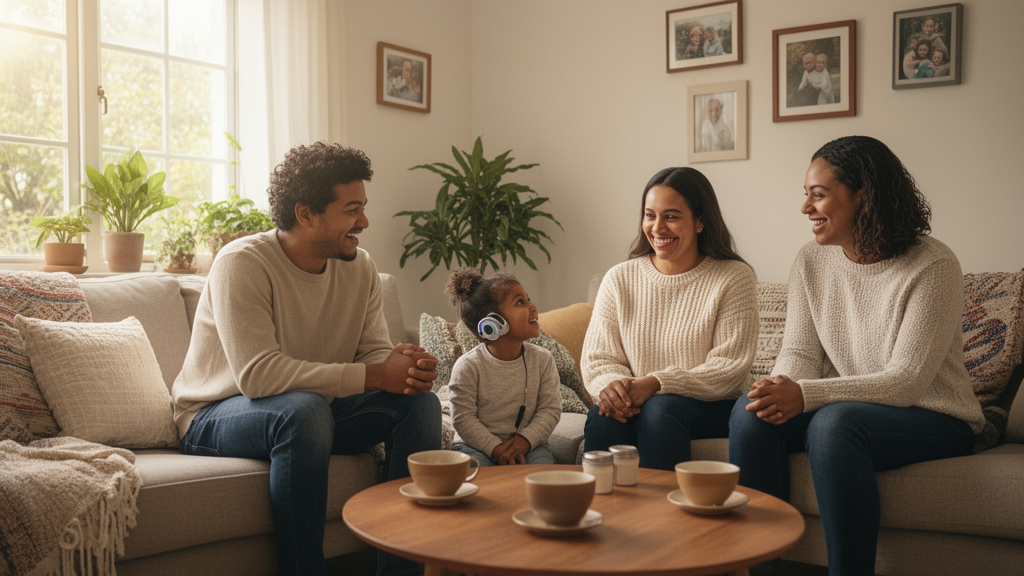
A qualitative study involving 14 immigrant families caring for deaf or hard of hearing children found that participants associated social connections with better wellbeing for their children and improved wellbeing and self-efficacy for themselves. Families also described cultural and linguistic barriers that made it difficult to find support for their child and connect with other families raising deaf or hard of hearing children. The available abstract indicates that the research was published in BMC Health Services Research, but this report is based on the abstract rather than a full assessment of the article.
Researchers conducted semi-structured interviews with parents whose primary language was not English. The families were recruited by audiologists at tertiary children’s hospitals, and immigrant identity was confirmed during interviews. Each interview was conducted in the language the parent felt comfortable using. Two researchers independently inductively coded four representative interviews to create an initial codebook, iteratively refined it, and then applied the final codebook to the remaining interviews. The analysis focused on the reported influence of social connections, barriers to those connections, their relationship to family wellbeing and self-efficacy, and recommendations for peer mentorship between families with deaf or hard of hearing children.
Thematic analysis identified three main themes: challenges faced by immigrant families, benefits of social connections, and recommendations and considerations for a peer-mentorship program. Participants said that cultural and linguistic barriers made resources supporting their child difficult to find. They also described cultural and linguistic differences and assimilation as complicating connections with other families of deaf or hard of hearing children. By contrast, families reported that social connections supported their children’s wellbeing and their own wellbeing and sense of self-efficacy. These are participants’ reported experiences and associations; the interview design did not establish that social connections caused improvements in measured wellbeing or self-efficacy.
All 14 families viewed the proposed peer-mentorship program positively and provided recommendations for its implementation, according to the abstract. The authors concluded that the reported successes, barriers and opportunities associated with social connections could guide future interventions intended to improve outcomes for immigrant families and their deaf or hard of hearing children. However, the study was a small qualitative exploration rather than a test of program efficacy. The abstract does not provide detailed demographic characteristics, quantitative effect estimates or a full account of recruitment criteria, and it does not report whether the proposed program was implemented or evaluated.
Subject of Research: Qualitative study of social connections, wellbeing and self-efficacy among immigrant parents of deaf or hard of hearing children
Article Title: Understanding the role of social connections in the wellbeing and self-efficacy of immigrant families with deaf or hard of hearing children
Article References: Chau, D., Tummala, T., Rashidi, N., Ho, S., Villegas, E., Fernald, L., & Chan, D. K. (2026). Understanding the role of social connections in the wellbeing and self-efficacy of immigrant families with deaf or hard of hearing children. BMC Health Services Research. https://doi.org/10.1186/s12913-026-15557-0
Image Credits: AI Generated
DOI: 10.1186/s12913-026-15557-0
Keywords: immigrant families, deaf children, hard of hearing children, social connections, wellbeing, self-efficacy, cultural barriers, linguistic barriers, peer mentorship, qualitative interviews, Understanding, role
News Source: Ophelia Keating. (October 20, 2026). Qualitative interviews link social connections to wellbeing in immigrant families with deaf children. Scienmag.