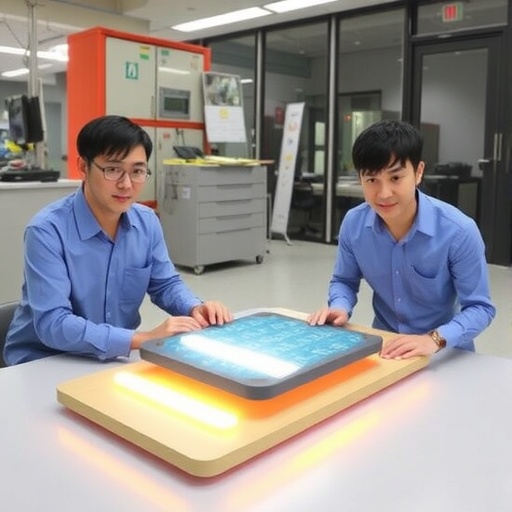
A new kind of vibration “cushion” could soon make precision machinery far more tolerant to real-world changes in load. In manufacturing lines, aerospace systems, automotive platforms, and laboratory instruments, unwanted motion can erode performance and shorten equipment life. Traditional isolators use springs and dampers to suppress vibration, but they rely on a structural compromise: strong low-frequency isolation typically demands very low static stiffness, which weakens the system’s ability to carry steady loads.
To overcome that trade-off, engineers have pursued quasi-zero stiffness (QZS) isolators. QZS designs effectively separate static and dynamic behavior by combining a positive stiffness element that supports the payload with a negative stiffness component that enables near-zero dynamic stiffness. The result is a targeted form of low-frequency isolation. Yet two major problems limit practical adoption: performance depends on careful parameter tuning for a specific payload, and many QZS systems still exhibit a residual resonant peak that can drive large oscillations and, in extreme cases, chaotic motion.
Researchers led by Professor Seunghun Baek at Pusan National University addressed both weaknesses with a hybrid control strategy for a rhombus-shaped QZS isolator. Their controllable setup uses motor actuation at joints where a horizontal spring is connected, allowing the system to actively modify the spring’s pretension. By effectively changing the horizontal spring’s initial length, the device tunes its internal stiffness landscape to maintain the QZS condition even as the payload varies.
The control concept uses two coordinated laws. The first law continuously retunes the equilibrium by adjusting the effective spring length, compensating for payload changes so low-frequency isolation remains intact. The second law regulates the same actuators in real time using the system’s measured state, generating counteracting forces that suppress the residual ultra-low-frequency resonance.
Experiments with a prototype validated the approach. In payload tests from 1.01 kg to 1.21 kg, the first control law preserved isolation performance where passive designs would fail. Under a 1.11 kg payload, the second control law achieved complete elimination of the residual resonance, preventing the large-amplitude oscillations that can threaten stability.
The work frames the challenge as a coupled problem: static payload matching and dynamic resonance elimination. By tackling them with a single hybrid actuation-and-control framework, the researchers move QZS isolation toward “smart cushion” behavior—systems that sense load changes and retune themselves quickly and reliably.
For precision applications such as chip manufacturing, where even small disturbances matter, adaptive QZS isolators could become a practical route to quieter, safer, and more stable machines.
Keywords
Quasi-zero stiffness; vibration isolation; hybrid control; payload compensation; motor actuation; residual resonance; smart actuators; experimental study; dynamic stability; control theory
Subject of Research: Not applicable
Article Title: Active equilibrium control of a rhombus QZS isolator: A hybrid strategy for payload compensation and resonance elimination
News Publication Date: 10-Jun-2026
Web References: https://doi.org/10.1016/j.ymssp.2026.114561
References: Title of original paper: Active equilibrium control of a rhombus QZS isolator: A hybrid strategy for payload compensation and resonance elimination; Journal: Mechanical Systems and Signal Processing; DOI: 10.1016/j.ymssp.2026.114561
Image Credits: Credit: Professor Seunghun Baek from Pusan National University
Tags: active vibration suppressionadaptive vibration controlaerospace vibration managementautomotive vibration mitigationdynamic stiffness controlhybrid control in vibration systemsload tolerance in vibration isolatorsprecision machinery vibration isolationPusan National University engineering researchquasi-zero stiffness isolatorssmart vibration damping systemsvibration isolation