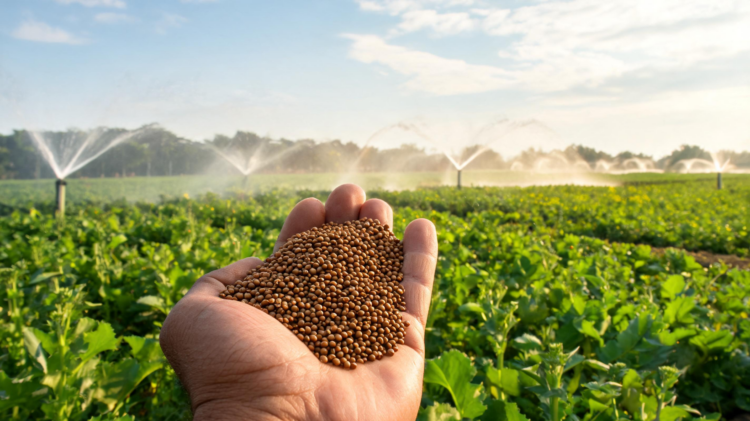
A newly reported Indian mustard variety is being positioned for a very specific but important agricultural window: timely sowing under irrigated conditions in north-western and central India. Named Pusa Mustard 37, the line is described as an “extra-bold seeded” variety in a research article published in the Indian Journal of Genetics and Plant Breeding. The report concerns varietal notification and germplasm registration, placing the release within the formal system used to identify and document improved crop material. Its significance lies less in a single headline-grabbing trait than in the attempt to match seed characteristics and crop adaptation with the practical conditions under which farmers grow mustard. The article’s title identifies the intended production environment, while the publicly available source page does not provide a full set of performance tables, yield comparisons or trait measurements. That limitation matters: Pusa Mustard 37 can be described accurately as a newly reported, targeted variety, but its advantages should not be expanded into claims that are not documented in the available material.
Mustard is a major oilseed crop, and plant breeders often design varieties around the interaction between genetics and management. A genotype that performs well in one sowing window, soil type or water regime may not produce the same result elsewhere. “Timely-sown” generally refers to establishment within the recommended seasonal window, allowing the crop to pass through vegetative growth, flowering and seed filling under conditions suited to the breeding target. “Irrigated” indicates that water is available through planned applications rather than relying entirely on rainfall. These descriptors are not incidental: they define the environmental setting in which a variety is expected to be evaluated and used. North-western and central India encompass broad agricultural zones with differing soils, temperatures and farm practices, so regional adaptation remains a central breeding challenge. Pusa Mustard 37 is therefore presented not as a universal mustard solution, but as plant material intended for a defined combination of season, geography and water availability.
The phrase “extra-bold seeded” points to a visible feature of the harvested seed: comparatively large seed size. Seed boldness can be measured through traits such as thousand-seed weight or related seed-size indices, although the supplied article page does not report a numerical value for Pusa Mustard 37. Seed size is biologically connected to development, resource allocation and the conditions experienced during seed filling. It can also influence how seed lots are graded, handled and marketed. Yet boldness alone does not establish superior oil yield, total seed yield, disease resistance or profitability. Those outcomes depend on multiple traits and on the environment in which the crop is grown. A careful account of the new variety must therefore separate its defining description from broader assumptions. The available evidence identifies Pusa Mustard 37 as an extra-bold seeded Indian mustard variety and specifies its intended cultivation conditions; it does not, in the accessible record, quantify how much larger its seeds are or demonstrate that boldness translates into a particular economic benefit.
For breeders, the development of a named variety is the endpoint of a longer process of selecting plants that combine desirable characteristics with stable adaptation. Selection may involve repeated generation advancement, observation of plant architecture and maturity, assessment of seed traits, and comparison with established material. The source identifies Naveen Singh, Rajendra Singh, Nanjundan Joghee, Mukesh Kumar Dhillon and Prashant Vasisth among the contributors, with the developer group listed as Singh, Singh, Joghee and Dhillon and Vasisth credited with writing the manuscript. Their affiliations include the Division of Genetics at ICAR–Indian Agricultural Research Institute in New Delhi, the Indian Agricultural Research Institute in Wellington, The Nilgiris, and the institute’s Division of Entomology. This combination of genetics and entomology expertise reflects the breadth of modern crop improvement, although the available article record does not detail the breeding pedigree, selection generations or specific insect-response results. The variety was developed through an ICAR-IARI in-house project, and the authors acknowledge research funding from the Indian Council of Agricultural Research.
Varietal notification and germplasm registration give a crop line an official identity within agricultural research and seed systems. Notification generally records that a variety has been recognized for a specified crop and area of adaptation, while registration preserves information about the germplasm and its distinguishing features. These processes help breeders, public agencies and seed producers refer to the same genetic material and can support later multiplication and distribution. They do not, by themselves, guarantee that every farm will obtain the same result. Seed quality, sowing date, plant population, soil fertility, irrigation scheduling, pest pressure and harvesting practices can all modify field performance. For Pusa Mustard 37, the intended fit with timely-sown irrigated production provides a practical framework for deployment, but farmers and extension services would still need locally relevant guidance before recommending it broadly. The source page supplies the identity and intended conditions of the variety, while detailed agronomic recommendations are not visible in the supplied full-text record.
The regional focus is also scientifically meaningful because mustard development takes place against changing temperature and water conditions. Crop timing determines which phases of development coincide with cooler or warmer periods, and irrigation can influence canopy growth, flowering and the filling of developing seeds. A breeding line selected for a timely-sown irrigated system may be designed to exploit a relatively predictable establishment environment, but its response can still vary when planting is delayed or water becomes limited. The title of the article does not claim that Pusa Mustard 37 is drought tolerant, heat tolerant or suitable for rain-fed cultivation, and none of those traits should be inferred from its description. Instead, the variety’s stated niche is narrower and more precise. Its reported value is the alignment of an extra-bold seed phenotype with a defined production context in parts of India where mustard is cultivated as an important seasonal oilseed.
That precision may be particularly relevant to seed-sector decision-making. Farmers do not choose varieties solely by reading a trait list; they weigh maturity, local adaptation, market preferences, input requirements and the reliability of available seed. Large seed may be attractive for reasons connected to grading or end use, but the practical importance depends on how the trait behaves across environments and whether it is accompanied by competitive yield and oil characteristics. The supplied source does not provide those comparative data, nor does it report a dataset generated or analyzed for the article. As a result, the most defensible news interpretation is that Pusa Mustard 37 represents a formally documented breeding product with a targeted agronomic brief, rather than a fully quantified breakthrough whose benefits can already be ranked against all existing varieties. Further field evidence, multilocation testing and independent agronomic assessment would be needed to establish its performance under the diverse conditions found across north-western and central India.
The report nevertheless illustrates how crop innovation often advances through incremental specialization rather than dramatic technological change. A variety can be important because it fits a particular sowing schedule, irrigation regime or regional production system, even when its distinguishing feature is a conventional breeding trait such as seed size. Pusa Mustard 37 is presented in that way: an Indian mustard line with extra-bold seeds, intended for timely-sown irrigated cultivation and documented through varietal notification and germplasm registration. The article was listed as published on 26 August 2026, with the version of record carrying the same date. Its authors declare no competing interests. What happens next will depend on seed multiplication, access to trustworthy performance information and testing beyond the initial breeding context. For now, the variety’s clearest message is methodological as much as agricultural: effective plant breeding matches a genetic package to a real production environment, while responsible reporting keeps the documented trait, the target region and the remaining evidence gaps clearly in view.
The available record also clarifies the evidentiary status of the announcement. This is a varietal-notification and germplasm-registration report, rather than a study accompanied by a publicly described experimental dataset. The source explicitly states that no datasets were generated or analysed during the study. That distinction affects how the information should be interpreted: the publication documents the identity and intended positioning of the breeding material, but it does not provide the quantitative evidence normally needed to estimate response across locations, seasons or management treatments. In particular, the accessible record cannot establish the magnitude of any advantage over existing mustard varieties.
The development setting is institutionally significant. The variety arose from an in-house project at the ICAR–Indian Agricultural Research Institute, and the work involved researchers associated with genetics, crop improvement and entomology. Such collaboration can bring different evaluation priorities into a breeding programme, including inherited plant characteristics, adaptation to a target production system and potential interactions with biological stresses. However, the source does not identify the parental lines, breeding method, selection criteria or testing protocol. Those omissions prevent a reconstruction of how the reported line was derived or which characteristics were decisive during selection.
Publication timing provides another useful boundary for interpretation. The manuscript was received on 7 August 2026, revised on 13 August, accepted on 14 August and published as a version of record on 26 August. The rapid sequence records the editorial history of this particular report, but it is not evidence of agronomic performance or of adoption by growers. The source also indicates that the article is previewed within subscription content, so conclusions drawn from the publicly visible material should remain limited to the information actually disclosed there. More complete evaluation would require access to the formal characterization and testing details, followed by independent assessment in the environments for which the variety is intended.
Subject of Research: Development and regional adaptation of the Pusa Mustard 37 Indian mustard variety
Article Title: Pusa Mustard 37: An Extra-Bold Seeded Indian Mustard Variety for Timely-Sown Irrigated Conditions in North-Western and Central India
Article References: Singh, N., Singh, R., Joghee, N., Dhillon, M. K., & Vasisth, P. (2026). Pusa Mustard 37: An Extra-Bold Seeded Indian Mustard Variety for Timely-Sown Irrigated Conditions in North-Western and Central India. Indian Journal of Genetics and Plant Breeding. https://doi.org/10.1007/s44489-026-00044-x
Image Credits: AI Generated
DOI: 10.1007/s44489-026-00044-x
Keywords: Indian mustard, Pusa Mustard 37, plant breeding, crop genetics, oilseed crops, seed traits, irrigated agriculture, regional adaptation, Pusa, Mustard, Extra-Bold, Seeded
Cite Scienmag News
APA MLA Chicago
Scienmag. (August 29, 2026). Pusa Mustard 37 Targets Bold Seeds and Timely Irrigated Sowing. https://scienmag.com/pusa-mustard-37-targets-bold-seeds-and-timely-irrigated-sowing/
Scienmag. “Pusa Mustard 37 Targets Bold Seeds and Timely Irrigated Sowing.” Scienmag, 29 August 2026, https://scienmag.com/pusa-mustard-37-targets-bold-seeds-and-timely-irrigated-sowing/. Accessed 29 August 2026.
Scienmag. “Pusa Mustard 37 Targets Bold Seeds and Timely Irrigated Sowing.” Scienmag. August 29, 2026. https://scienmag.com/pusa-mustard-37-targets-bold-seeds-and-timely-irrigated-sowing/
Copy citation Download RIS
Tags: agricultural window for mustard plantingcrop geneticsExtra-Boldextra-bold seed traitsgenetic and management interaction in mustard breedingimportance of performance data in crop varietiesIndian mustardIndian mustard variety Pusa Mustard 37irrigated agriculturemustardmustard crop adaptationnorth-western and central India mustard cultivationoilseed crop breeding strategiesoilseed cropsplant breedingPusaPusa Mustard 37regional adaptationseed characteristic matching with farming conditionsseed traitsSeededtargeted crop production environmenttimely irrigated sowingvarietal registration and germplasm documentation